The farmland gave way to rougher terrain as the afternoon wore on. Low hills rolled beneath them like the spine of something sleeping. The road narrowed. Trees began to appear—first in scattered clusters, then thickening into a proper forest that pressed close on both sides. Oak and ash, their branches meeting overhead to form a canopy that turned the light green and dim. The air cooled. Sounds changed—birdsong faded, replaced by the creak of old wood, the rustle of unseen things in the undergrowth, and the steady drip of moisture from leaves that never fully dried.
The horse slowed without being told. Its ears rotated like small dishes catching signals humans couldn't hear.
For a while the only proof they were still moving had been the road's crunch and the wagon's groan—small sounds that made the forest feel larger, not smaller. Madison rolled her shoulders under the plate; sweat had dried to salt at her collar, and every strap seemed to know her shape by now.
"How much further?" Vask asked. His voice was lower than it had been on the open road.
Mantis checked the sky through a gap in the canopy. The sun was a diffuse glow behind the leaves, more a direction than a source. "Two hours. Maybe less. The trade center sits at the forest's north edge." He pointed ahead, where the road curved into deeper shadow. "Through here."
Madison could feel the change in the party. It happened without words, without orders—a collective tightening, the way a muscle contracts before a blow. Conversations died. Hands drifted to weapons. Merita's nervous energy sharpened into something useful—her eyes swept the treeline in steady arcs, her bow already half-raised. Rovan's jaw tightened. His hand found his quiver and stayed there.
Even Puli stopped talking.
Only Mantis and Juvar seemed unchanged. The veteran walked with the same measured pace. The druid's staff clicked the same rhythm.
Madison watched the forest and thought about what Mantis had said. Trust takes time. We'll earn it. She wondered how many parties he had led. How many he had lost. The thought sat in her chest like something cold and hard.
The first sign was the horse.
It stopped. Not gradually—it planted its hooves and refused to move. Its ears flattened. Its nostrils flared wide. A tremor ran through its flanks.
"Easy," Mantis said, reaching for the bridle. "Easy."
The horse snorted and jerked its head, eyes rolling to show the whites. Foam flecked its lips.
Then Madison heard it. A low sound, barely there—not a growl, not a bark. More like breathing that belonged to something too large and too close. It came from everywhere and nowhere, muffled by the canopy, distorted by the trees.
"Eyes up," Mantis said quietly. His voice didn't change. It stayed exactly where it had been all day—calm, measured, carrying authority without volume. "Formation around the wagon. Archers, you have treeline. Knights, take the road."
They moved without argument. Three weeks of training and one morning of marching together wasn't much, but it was enough. Bodies slotted into positions they had drilled—shields coming up, bows drawn half-taut, everyone finding their angle. It wasn't smooth. It wasn't perfect. But it was fast.
Yellow eyes blinked in the undergrowth.
One pair. Low to the ground, the color of old amber.
Then four.
Then seven.
The wolves came out of the forest like grey water pouring between rocks.
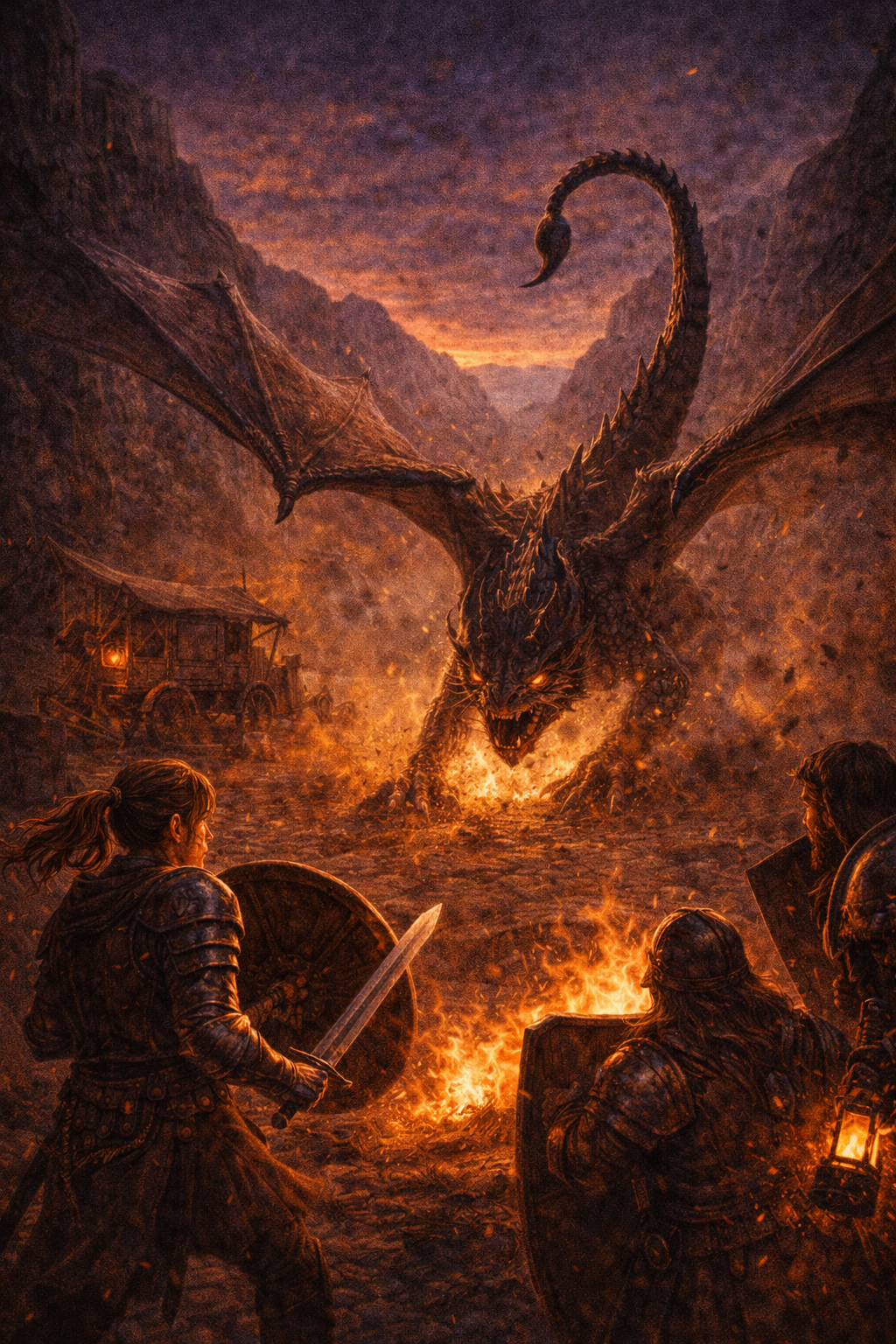
They were not the rangy, starving things Madison had imagined from stories—gaunt creatures with visible ribs, desperate and weak. These were forest wolves—heavy in the shoulder, thick-furred, coordinated. They fanned out across the road in a rough crescent, blocking the path ahead and flanking the wagon's left side. The pack leader stood at the center, head low, ears flat, teeth bared in a silent grimace that was worse than any snarl because it was patient.
No howl. No warning charge. Just steady, predatory pressure. The kind that said: We've done this before.
"Nobody panic," Mantis said. "They're testing us. Probing for weakness—whether we break formation, whether we run, whether we leave something unguarded. We give them nothing."
"Testing what exactly?" Merita whispered. Her bow was up, arrow nocked, but her fingers were trembling.
"Whether we're prey," Rovan said. He didn't whisper. He said it the way he said everything—flat, practical, without decoration. His own bow was drawn steady. "We show them we're not."
The pack leader took a step forward. Its claws clicked on the packed dirt of the road.
Mantis drew his sword. The sound of steel on leather was clean and sharp, and it seemed to cut the air in half. The wolves shifted—not retreating, but recalculating. Several of the younger ones exchanged glances, the way dogs do when the situation changes.
"Juvar," Mantis said. "Low fire. Between us and them. Don't burn the forest down."
Juvar planted his staff and murmured a word. His hand traced a quick sigil in the air—three lines, a circle, a word Madison didn't recognize—and a line of flame erupted across the road, knee-high, crackling and spitting sparks. The heat washed over them. The wolves on the right recoiled, ears flat, lips peeling back. Two younger ones broke and vanished into the brush with panicked yelps, crashing through undergrowth.
The horse screamed and lurched forward; Boro grabbed the bridle and held, his boots sliding on dirt.
The pack leader did not retreat.
It circled left, away from the fire, and two flankers came with it—older wolves, heavier, with the scars and missing patches of fur that marked survivors. They were driving for the wagon's unguarded side.
"Left! Left!" Puli shouted, and loosed an arrow.
It struck the lead flanker in the haunch. The wolf yelped—a sharp, high sound that cut through everything—and stumbled. The second wolf surged past it, eyes locked on Vask, jaws already opening.
Vask caught it on his shield with a grunt that shook his whole frame. The wolf's jaws snapped shut on the shield rim, teeth scraping metal with a sound like a knife on glass. He drove his blade downward and the wolf went limp with a wet, final sound.
The pack leader leapt.
It came over the fire line in a single bound, clearing the flame by a hand's breadth. The jump was savage and beautiful in the way that all predatory things are beautiful—pure function, no waste, every muscle doing exactly one thing.
It hit Keto in the chest.
Keto went down. His shield took the first bite—leather tearing, metal buckling under jaw pressure that was designed to crack bone. He shoved upward with his arm and punched the wolf in the jaw with his gauntleted fist. Bone cracked. The wolf snarled and bit again, this time catching the edge of his gorget.
Madison was there in two steps. The Sword of Fury came up in a tight arc—her father's blade, cutting through forest air the way it had cut through dragon fire two years ago—and caught the wolf across the ribs. The impact jarred through her arms. The wolf twisted away, bleeding, snarling—and Nocta's throwing star buried itself in its shoulder from ten meters out, the steel sinking between muscle and bone with a sound like a hammer hitting wet clay.
The wolf staggered.
Rovan put an arrow through its throat.
It dropped. The great body hit the road with a heavy thud, legs twitching, eyes glazing. Blood pooled dark on the packed earth.
The rest of the pack scattered. One heartbeat they were there—grey shapes, yellow eyes, teeth—and the next they were shadows melting into the undergrowth, carrying their wounded, their retreat as coordinated as their attack.
Juvar let the fire die. The road smoked. The air smelled of burned grass and iron and something animal.
Madison realized she had been holding her breath. When she let it go, her ribs ached—as if the fight had squeezed something tight behind her sternum and only now released it. She wiped the Sword of Fury clean on a handful of moss, slowly, because her hands were still shaking and she did not want anyone to see.
Keto got to his feet slowly, one hand braced on his knee. Blood on his gauntlet—not his own. His shield had two deep gouges in the leather facing. He stared at them for a moment, then looked up at Madison.
"Thanks," he said.
"Don't mention it."
"I won't," he said. "Easier to pretend it didn't happen."
Mantis checked the party. "Everyone good?"
Nods. Heavy breathing. Merita was pale but steady, her bow still half-drawn, her trembling gone—burned away by the fight the way morning fog burns away in sun. Puli retrieved his arrow from the brush, wiping it on his trousers. Boro patted the horse's neck, murmuring something soft and steady.
Mantis looked at the dead wolves—two on the road, one in the ditch—and then at his party.
"First blood together," he said. "Not bad. We held formation, we covered each other, and nobody panicked." He paused. "That matters more than the kill count."
They moved on. The forest thinned gradually around them, and the light returned in stages—first the green dimness brightening, then actual shafts of sun cutting through gaps in the canopy, then the trees pulling apart like curtains opening.
The trade center emerged from the tree line like a small town that had been built in a single season and never quite decided whether to stay.
Canvas pavilions and wooden stalls spread across a wide clearing at the forest's northern edge. Torches burned in iron brackets along the main paths, their flames unnecessary in the remaining daylight but already lit in anticipation of dusk. Wagons clustered in groups—some loaded, some empty, some being repaired by lamplight while their owners argued prices under awnings. Merchants hawked wares in competing voices. Guards in mixed livery patrolled the perimeter in lazy, practiced loops. Cook fires sent thin columns of smoke into the darkening sky, carrying the smell of roasted meat and bread and something spiced that made Madison's stomach clench with sudden, fierce hunger.
"Trade center," Mantis said. "We deliver, we report, we rest."
They rolled the wagon through the entrance where a bored official checked Mantis's guild insignia and waved them through without looking up from his ledger. The delivery point was a large canvas warehouse near the center, staffed by a heavyset woman with a ledger of her own and a complete lack of patience.
"Alderan's?" she said, glancing at the manifest. "You're late."
"We're on time," Mantis said.
"My clock says late." She stamped the manifest, tore off a receipt, and thrust it at him. "Unload at bay three. Don't touch anything in bays one or two. Those belong to the crown."
They unloaded. It took the better part of an hour—crates heavy with rune stones, sealed boxes that hummed faintly, containers of fluid packed in straw. Madison's arms burned by the end of it. When the last crate hit the warehouse floor and the receiving clerk signed off, she felt the tension in her shoulders release for the first time since dawn.
She stood still while the others moved around her, letting sweat cool on her skin, listening to the warehouse's distant echo—voices, a cart, someone cursing a splinter. Ordinary sounds. They felt precious.
They made camp at the trade center's eastern edge, where guild parties were allowed to pitch tents. The ground was packed dirt, level enough, and other groups were already settled nearby—tents in tidy rows, gear hung on stakes, the low hum of conversation and the scrape of whetstones on steel.
Boro got a fire going with practiced ease—kindling first, then small branches, then a steady flame that threw warm light across the camp circle. Merita and Vask set up the tents—four shelters in a tight arrangement with the wagon at center. Keto collected water from the communal well, filling skins with the methodical patience of a man who understood that water was more valuable than gold on a march. Rovan found food—a stall near the main pavilion selling bowls of stew thick with root vegetables and shredded pork, its broth dark and rich with pepper and rosemary. Fresh bread with a crust so dark it was nearly black, still warm from the oven. Dried fruit wrapped in cloth—figs and apricots, their sweetness concentrated by the sun.
They ate together for the first time without urgency.
The stew was hot and good and the kind of food that filled you from the inside out. The bread was better—dense, chewy, tasting of hearth and grain. Madison sat on a crate with her bowl in her hands, the warmth seeping through her fingers, and watched the fire throw shadows across the faces around her.
Puli sat cross-legged in the dirt, eating with the single-minded focus of someone who hadn't realized how hungry he was until the first bite told him. Keto ate slowly, methodically, as if the meal were another task to complete correctly. Merita had her quiver beside her, one hand on the bread and the other resting on the leather as if it might wander off. Boro ate in large, deliberate spoonfuls, his face blank with concentration. Vask held his bowl in both hands and drank the broth straight, then went back for seconds without asking.
Rovan finished first and leaned back against his pack. "First mission. Complete. Nobody dead. That's better than my last company."
"Your last company must have been terrible," Puli said through a mouthful of bread.
"They were." Rovan's voice held no humor this time. The firelight caught the scar on his jaw and deepened it. "Two of them are buried outside Varlin. Another one drinks himself to sleep in a room above a tavern in Haze. He sees the arrow that killed Coll every time he closes his eyes." He looked at the fire. "We were four men responsible for a wine merchant's profit. When the bandits came, nobody in the empire cared enough to send help."
The fire crackled. Night pressed in around the camp like something waiting to be acknowledged. Nobody filled the silence for a while.
Nocta spoke from the edge of the firelight, where he sat with his back against the wagon wheel, idly cleaning a throwing star with a rag. "Wolves are one thing," he said. "The missions won't stay this simple."
Mantis, who had been writing something on the mission receipt—his handwriting small and precise, tilted left—looked up. "No. They won't. Enjoy simple while it lasts." He set down his pen and regarded his party in the firelight. "Today worked because the threat was manageable and nobody froze. Remember that feeling—the way you moved without thinking, the way you covered each other. Build on it. Because the next threat won't be wolves, and it won't give you time to remember what you're supposed to do."
He rolled a small scroll, sealed it with wax from the fire, and pressed his guild ring into the stamp. Then he whistled—a short, sharp note that cut through the camp noise—and held out his arm.
A messenger bird dropped from somewhere overhead and landed on his forearm. Small, dark-feathered, eyes bright. It cocked its head and watched Mantis with the focused intelligence of a creature bred for a single purpose.
Mantis tied the scroll to its leg with a strip of leather. "Hegal's Guild, Haze operations post," he told it. "Completion report and request for next assignment."
He lifted his arm. The bird launched itself into the dark, wings beating hard, and vanished above the torchlight like a thrown stone.
"Now we wait," Mantis said.
Madison finished her stew and set the bowl aside. The camp had grown quieter around them. Other parties were settling in—lanterns dimmed, voices dropping to murmurs. Somewhere a minstrel played a reed pipe, the melody thin and sweet and lonely in the cooling air, carried on wind that smelled of pine and distance and the faint, electric residue of the runes they'd delivered.
Puli appeared beside her with two cups—water, not ale.
"You all right?" he asked.
"Yeah." She took the cup. The water was cold from the well, sharp on her teeth. "You?"
"Honest answer? I'm terrified." He grinned—the same grin he'd had since they were children on Jul, the one that said he knew the situation was bad and had decided to find it funny anyway. "But in a good way. If there's a good way."
"There isn't."
"Then I'm terrified in the normal way." He sat down beside her, their shoulders touching. "Tyba would have liked this. The camp. The fire. The part where nobody tried to kill us. Well—the wolves tried, but that almost doesn't count."
Madison looked at the stars. They were thick and bright here, away from the city lights—a field of cold silver pinned to a sky so dark it looked like velvet.
Somewhere beyond the treeline an animal screamed once and stopped mid-note, as if the night had snatched the sound out of its throat. The camp dogs didn't answer. Madison told herself it was wolves still hunting—and felt the lie settle, comfortable and wrong.
"He's out there somewhere," she said. "Different party. Different road."
"Yeah." Puli was quiet for a moment. "We'll see him at Solundria. That's where everyone reports."
"If."
Puli looked at her. "When," he said firmly. "When we see him at Solundria."
Mantis's voice drifted from the fire. "Get some sleep. When the bird comes back, we move."
Madison lay down on her bedroll, the Sword of Fury within arm's reach, and watched the fire shrink as the embers glowed orange and deep. She could hear the camp settling around her—Boro's slow, steady breathing; Merita turning restlessly on her mat; the distant sound of the horse cropping grass. Somewhere an owl called, the sound round and hollow, and was answered by silence.
She thought about Mantis's words. Trust takes time. She thought about Keto's hand reaching up from the ground, and the wolf's weight, and the sound the Sword of Fury made when it hit bone. She thought about Nocta's easy smile and the tightness in her gut that accompanied it.
She thought about her father's statue standing in Jul's square, watching over cobblestones that were probably wet with morning dew right now. She wondered if Elane was awake. If Xot was sleeping. If the fishing boats were already heading out, their lanterns cutting lines of gold across the dark water.
The team was starting to feel like something.
Not a unit. Not yet.
But the beginning of one.
She closed her eyes and slept better than she had since leaving Jul.
ZELO
Rain in Solundria turned the alleys into long ribbons of mud and lamp-smear.
Zelo sat under a broken awning behind a shuttered dye shop with a clay bottle in his hand and no memory of when he had stolen it. His jaw was unshaven, his knuckles split, his coat stiff with old blood and newer wine. He had been a druid once—properly trained, the deep kind his family's coin had paid for, good with growth and ley-work and bad with grief—and when the orcs took his mother and father in the last of the Race Wars he set about drinking the fortune they left him, coin by coin, staff and circle and name all going the same way down. After the money ran out he fought in paid circles in Varlin's south district until even that went to the bottle. Now he traded old medals for drink and slept where the city forgot to look.
A pair of druid apprentices in green wraps passed the alley mouth and did what respectable people did when they recognized decline: they looked away politely and faster.
He laughed once, without humor, and drank.
From the main road came wagon noise—iron-bound wheels, disciplined pace, escort whistles spaced with military precision. Zelo leaned forward just enough to see three black-lacquered crates marked for eastern transfer. Each crate had a lead seal stamped with a skull so faint it vanished unless the lamplight hit it sideways.
"Same mark again," muttered a porter in guild livery as he hurried past. "Third run this month. Same buyer out of Dron."
Zelo lowered his eyes before anyone noticed he had listened. He did not care who bought what. He did not care where the road led.
He told himself that and drank until night took the rest.