MADISON
Juvar's blood did not wash off.
Madison had scrubbed her hands three times before dawn—once with water from the barrel, once with sand from the road's edge, once with the lye soap Boro kept wrapped in oilskin at the bottom of his pack. She scrubbed until the skin over her knuckles cracked and stung, until the water in the basin turned from pink to clear, until there was nothing left to wash and her hands were raw and clean and trembling.
The smell still clung to her throat. Iron and something else—something organic, something warm, like the inside of a living thing exposed to air that was never meant to touch it.
She told herself it was memory.
It might have been.
The Sword of Fury hung at her hip, cleaned and oiled, its edge catching the last stars before the sky paled. She had wiped the blade with grass and then with cloth and then with oil, the way Captain Thorne had taught her, and the steel shone the same way it always had. That sameness was the worst part. The sword did not know what it had done. It did not care. It was metal and leather and balance, and it would cut tomorrow the same way it had cut today, and the day after that, and the day after that, until someone broke it or buried it or lost it in a river. The sword carried no guilt. Only she did.
Be present, Thorne's voice said in her head. Whatever comes, be present for it.
She was present. That was the problem.
They left Juvar in the plains where the wind could take what it wanted, and they moved before dawn.
Mantis gave orders from the wagon through clenched teeth. His poisoned leg lay wrapped in linen and pulsing with antidote and support healing runes—Tibia magic, low-grade, the kind any field druid could sustain—that bought him pain management, not peace. The venom from the wyvern's barbed tail had settled deep into the muscle tissue, and every time the wagon hit a rut his face went gray and his hands gripped the sideboards hard enough to whiten the wood.
He did not complain. Mantis never complained. He issued commands with the same flat precision he always used, as if pain were a subordinate he had ordered to wait outside.
"Archers placed high," he said. "Shields on the flanks. Rotating watch. No single file on open ground."
Party Five's formation tightened around what remained of the caravan: shields outside, archers with clear sightlines, wounded in the center, everyone too tired to speak more than was needed. Boro walked point with his jaw set and his shield arm loose. Vask held the left flank, head turning every few seconds to scan the grass. Rovan kept pace on the right, bow strung, three arrows held between the fingers of his draw hand the way Puli had taught him months ago in Jul—ready nocked, no fumbling.
Puli walked beside Madison near the rear. He hadn't spoken since they left Juvar's body. His silence was not anger. It was the quiet of a man counting ammunition and not liking the number.
Merita lay in the wagon beside Mantis, still unconscious from the wyvern's blow, her breathing shallow and irregular, her face the color of old candle wax. No one said what everyone was thinking: that she might not wake up, and that carrying her was slowing them down, and that slowing down on this road might kill them all.
They marched toward Solundria with half a mission, a broken caravan, a dying leader, and no certainty they would live long enough to report any of it.
The morning dragged. The sun climbed into a sky the color of hammered tin and stayed there, pressing heat into armor and sweat into cloth. Dust rose from the road and coated everything—lips, eyelids, the inside of Madison's throat. She drank from her waterskin in small sips, rationing without being told, because Thorne had beaten that habit into her before she ever left Jul.
By midday the plains began to change. The grass shortened. The soil darkened, turning from red-brown to black. Water gathered in low places—standing pools that reflected nothing and smelled of rot and sulfur. Trees appeared in clusters at first, then thickets, then walls of dark wood that closed around the road like a fist.
By late day, the north approach to Solundria swallowed them whole.
Swamp roads. Drowned roots breaking through mud like bones through skin. Trees so dark their bark looked burned, crowding so close to the path that their branches interlocked overhead and turned the road into a tunnel of wet shadow. The light that filtered through was green and sickly, the color of pond water in a jar.
The air changed too. Thick. Warm. Wet enough to taste. The smell of standing water and decaying leaves mixed with something sharper underneath—mineral, metallic, like blood diluted in rain.
Madison's hand found the Sword of Fury's hilt and stayed there.
Puli moved up beside her. His eyes tracked the canopy, the root clusters, the dark spaces between trunks where the undergrowth was too thick to see through and too thin to stop a man.
"Bad ground," he said quietly.
"I know."
"If they hit us here, we can't form up. No room for shield line. No room for flanking. Just meat in a tube."
Madison didn't answer because he was right and answering wouldn't change it.
Mantis must have been thinking the same thing. From the wagon, his voice came strained but steady: "Close formation. Shields tight. Archers watch the flanks—not ahead, the flanks. If it comes, it comes from the sides."
Boro tightened. Vask tightened. Rovan shifted his grip on his bow and scanned the treeline with the focused intensity of a man who expected to die and wanted to see it coming.
It came.
A sound first—not a shout, not a horn, but the wet snap of branches being pushed aside by something fast. Then shapes in the undergrowth. Dark figures rising from behind root clusters and fallen logs where they had been lying in the mud, covered in leaves and bark dust, invisible until they moved.
Bozton's party hit like a butcher's blade: one clean opening strike, then speed, then no air left for argument.
The first arrow took Boro in the shoulder, spinning him half around. He caught his balance, raised his shield, and roared—a sound of fury, not pain—but the second arrow came before the roar finished, punching through the gap between his shield and his chest plate. He staggered.
Rovan loosed three arrows in four heartbeats. The first buried itself in a tree trunk. The second found flesh—a shout of pain from the undergrowth, male, sharp. The third never arrived. A throwing star sang out of the darkness and caught Rovan in the throat.
Madison saw it happen. She saw the metal enter and the blood leave and Rovan's hands go to his neck as if trying to hold something in that had already decided to come out. He made a sound—not a word, not a cry, something between a cough and a whisper—and his knees buckled. His bow fell from his fingers and landed in the mud. His body followed a heartbeat later, folding sideways against a root cluster, his eyes wide and startled, as if dying were an insult he had not expected from the world.
Nocta. The throwing star was Nocta's. She knew it by the spin, by the angle, by the way it had arrived without warning from a direction no one was watching.
"Contact left! Contact right!" Keto bellowed, and the formation shattered.
It did not break from cowardice. It broke because the road was too narrow for a shield line and the enemy was on both sides and above and possibly behind, and there was nowhere to form up and nowhere to fall back to and the trees pressed in like walls of a room getting smaller.
Vask met the first Brotherhood knight to come through the undergrowth—a stocky man with a shortsword and no helmet—and their blades met with a crack that echoed off the canopy. Vask drove him back a step, then two, then a third figure came from behind a tree and took Vask's flank and he had to spin to meet it, leaving the road open.
Keto locked shields with another—a heavy, grinding contest of weight and will, boots churning mud, breath coming in grunts. He pushed. The Brotherhood fighter pushed back. Neither moved more than a foot.
Madison drew the Sword of Fury and felt its weight settle into her grip like a handshake from something old and familiar. A Brotherhood archer rose from behind a fallen log fifteen paces away and drew on her. She threw herself sideways, felt the arrow clip her pauldron and skip off the steel, and came up running. The archer fumbled for a second shaft. She closed the distance before he found it. The Sword of Fury opened his arm from wrist to elbow and he screamed and dropped the bow and staggered backward into the undergrowth.
Puli put an arrow into the treeline. Then another. He was shooting by sound—tracking movement through brush, aiming at noise, firing into dark spaces where shapes might be men or might be shadows. One of his arrows drew a scream. The others drew silence.
And then Mantis was in the fight.
He came off the wagon badly—dropping rather than climbing, his poisoned leg buckling the moment it took weight, his face going white with a pain that would have floored a lesser man. But Mantis was not a lesser man. Mantis was a knight who had held shield lines against charging cavalry and organized retreats under arrow storms and broken three ambushes before his thirtieth year. He caught himself on his sword, straightened, and limped into the center of the road with his blade raised and his teeth bared and something in his eyes that was not courage but something older and less kind.
Fury.
He met the first Brotherhood fighter with a strike that split the man's shield in half. The man behind the shield stumbled, and Mantis drove his pommel into the man's jaw and sent him spinning into the mud. A second fighter closed from the left. Mantis pivoted on his good leg, took the blow on his vambrace, and replied with a cut that opened the man's cheek to the bone.
For a moment—one impossible, golden moment—it looked like he might turn the center. The Brotherhood fighters recoiled. The pressure eased. Madison felt the line reform around Mantis like water flowing back into a shape it had forgotten.
Then the darkness came.
Not shadow. Not dimming light. Something else entirely—a pressure that arrived without source or direction, as if the air itself had thickened and turned hostile. Madison felt it in her chest first, then her limbs, then behind her eyes. A weight. A lock. The sensation of drowning in something that was not water.

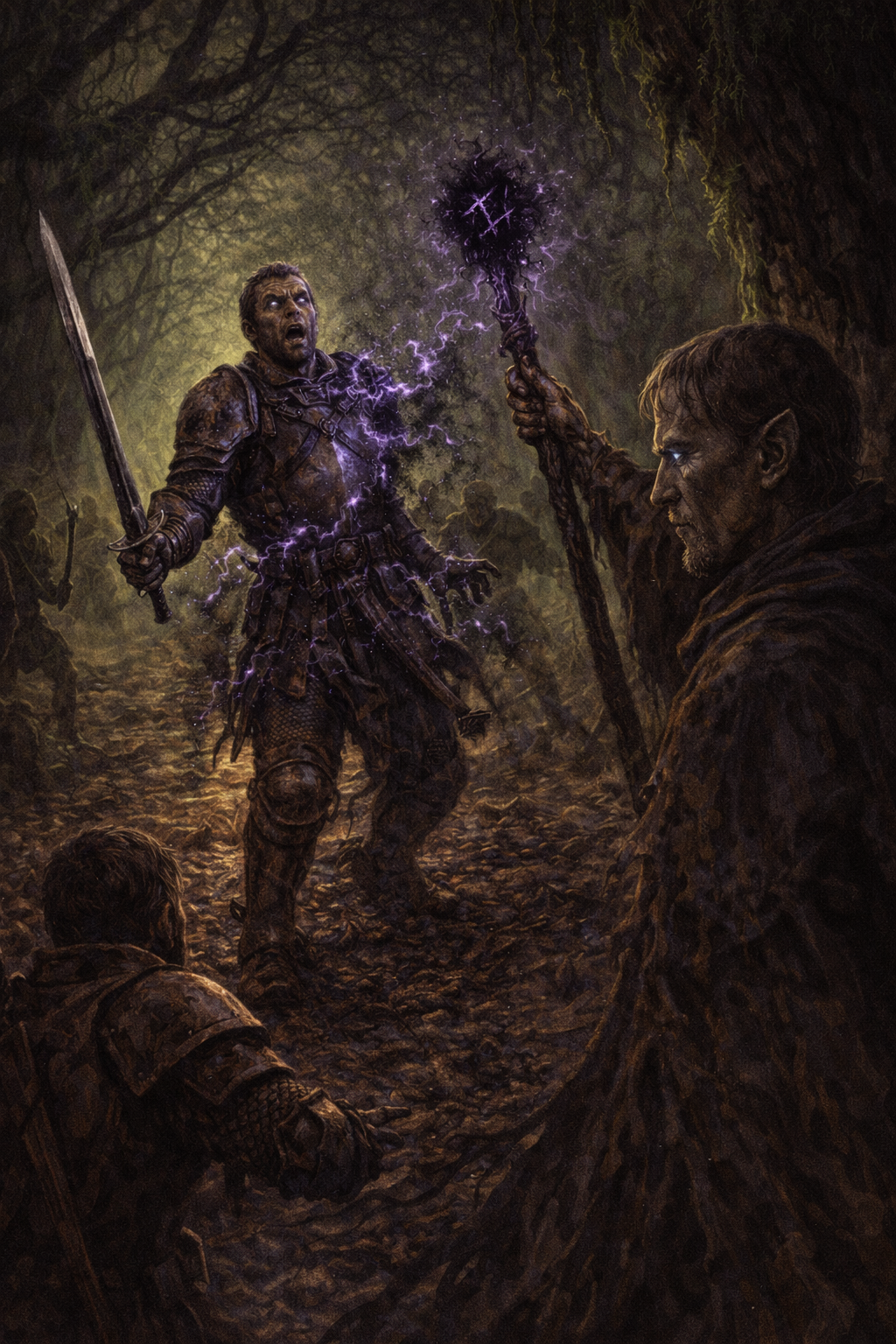
Dragon Eye stepped out from behind a moss-covered oak.
He was taller than she expected. Thin. His staff carved with deep, deliberate marks that looked like old scars. His eyes were pale—the color of river ice—and absolutely calm. He moved with the unhurried certainty of a man who had already decided how this would end.
He raised his staff and spoke a word.
Madison did not hear it clearly. It was not a word meant for human ears—it slid past comprehension the way a knife slides past a rib, and the sound of it left a residue in the air that tasted like iron filings and burnt hair.
The rune that formed at the tip of his staff was unlike anything she had ever seen. Not light. Not fire. Not the clean geometric patterns of guild-sanctioned magic. This was dark. Pressurized. It pulsed with a color that was not a color—an absence, a hole in the visible spectrum that the eye refused to accept and the mind refused to name.
Dark magic. Forbidden. The kind of casting that got druids executed in Haze and exiled in Solundria and whispered about in guild halls as if speaking the words too loudly might summon the practice.
The rune struck Mantis in the chest.
He froze.
Not the way a man freezes when he is surprised. Not the way a man freezes when he is afraid. He froze the way stone freezes—completely, utterly, every muscle locked in the exact position it occupied at the moment of contact. His sword arm stayed raised. His knee stayed bent. His lips stayed parted around the word he had been about to shout. His eyes stayed open.
His eyes stayed aware.
Madison saw it. She saw the consciousness behind the paralysis—the fury and the terror and the helpless, screaming comprehension of a man who was still alive inside a body that had become his coffin. Mantis could not blink. Could not breathe. Could not twitch a finger or turn his head or close his eyes against what was coming.
He could only watch.
Bozton stepped through the line.
He was everything the stories said—broad, heavy, dark-armored, moving with the deliberate weight of a man who did not hurry because hurrying implied doubt. His sword was drawn. It was not ornamental. It was a working blade, notched and scarred and sharp enough to catch the green light and hold it along the edge like a thread of malice.
He stopped in front of Mantis.
For a moment they were face to face—the paralyzed man and the man who had come to kill him. Bozton's eyes were flat. Not angry. Not triumphant. Empty in the way a verdict is empty after the arguments are over and the sentence has already been decided.
"For Juvar," Bozton said.
He drove the blade into Mantis's chest.
The sound was wrong. Everything about it was wrong—the resistance, the give, the way Mantis's body rocked backward from the impact but did not fall because the paralysis held him upright even as the steel went through him. Blood appeared around the blade's entry point, spreading across the front of his armor in a dark stain that grew faster than Madison's mind could process.
Bozton pulled the blade free.
Mantis's eyes did not close. The paralysis held them open, and in the last seconds before the light left them Madison saw everything—the rage, the grief, the unbearable indignity of dying without the ability to fight back or fall down or scream.
Then the light went out, and what remained was a statue of meat and metal that had been a man named Mantis, and the paralysis held him standing in the road like a monument to its own cruelty.
Madison screamed.
She did not know she was going to scream until she heard it—raw, shapeless, torn from somewhere beneath her ribs. She surged forward with the Sword of Fury raised, and the world narrowed to Bozton's face and the blood on his blade and the sound of her own voice breaking against the trees.
A hand closed on the back of her armor and hauled her sideways with force enough to wrench her shoulder.
"No!" Puli shouted in her ear. "No—we're done! Madison, we're done!"
She fought him. She twisted and pulled and tried to break free, and Puli's grip held because Puli was stronger than he looked and because he had grabbed her with both hands and planted his feet and was not letting go even if she broke his fingers.
"Listen to me," he said, voice cracked and desperate. "We are three. They are ten. If you charge him, you die, and then I die, and Keto dies, and no one goes back to tell them what happened. No one. Is that what Mantis would want?"
She stopped fighting. Not because the anger left—it didn't leave, it settled into her bones like heat into iron—but because Puli was right, and being right was the cruelest thing he could have been.
Keto broke from the collapsing line. He came through the undergrowth at a dead sprint, shield abandoned, blood on his face from a cut above his eye, and he did not look back.
"Move!" Keto shouted. "They're reforming!"
They ran.
They abandoned the caravan, the cargo, Merita in the wagon, the dead, and the dying because there was no world where they carried all of it and survived. The road broke open behind them as the trees thinned and the swamp gave way to firmer ground, and they ran without formation, without discipline, without anything except torn breath and the animal knowledge that stopping meant joining Mantis on the road.
By the time the trees were behind them and the marsh mist rose around their ankles and the sky opened above them like a wound, they were three survivors running on exhaustion and panic and nothing else.
Madison's lungs burned. Her legs were lead. She could feel every bruise, every cut, every place where armor had bitten into flesh during the fight. The Sword of Fury dragged at her hip. Puli's breath came in ragged gasps beside her. Keto ran with the uneven gait of a man whose body had decided it was finished and whose mind had overruled the decision.
They did not speak.
There was nothing to say.
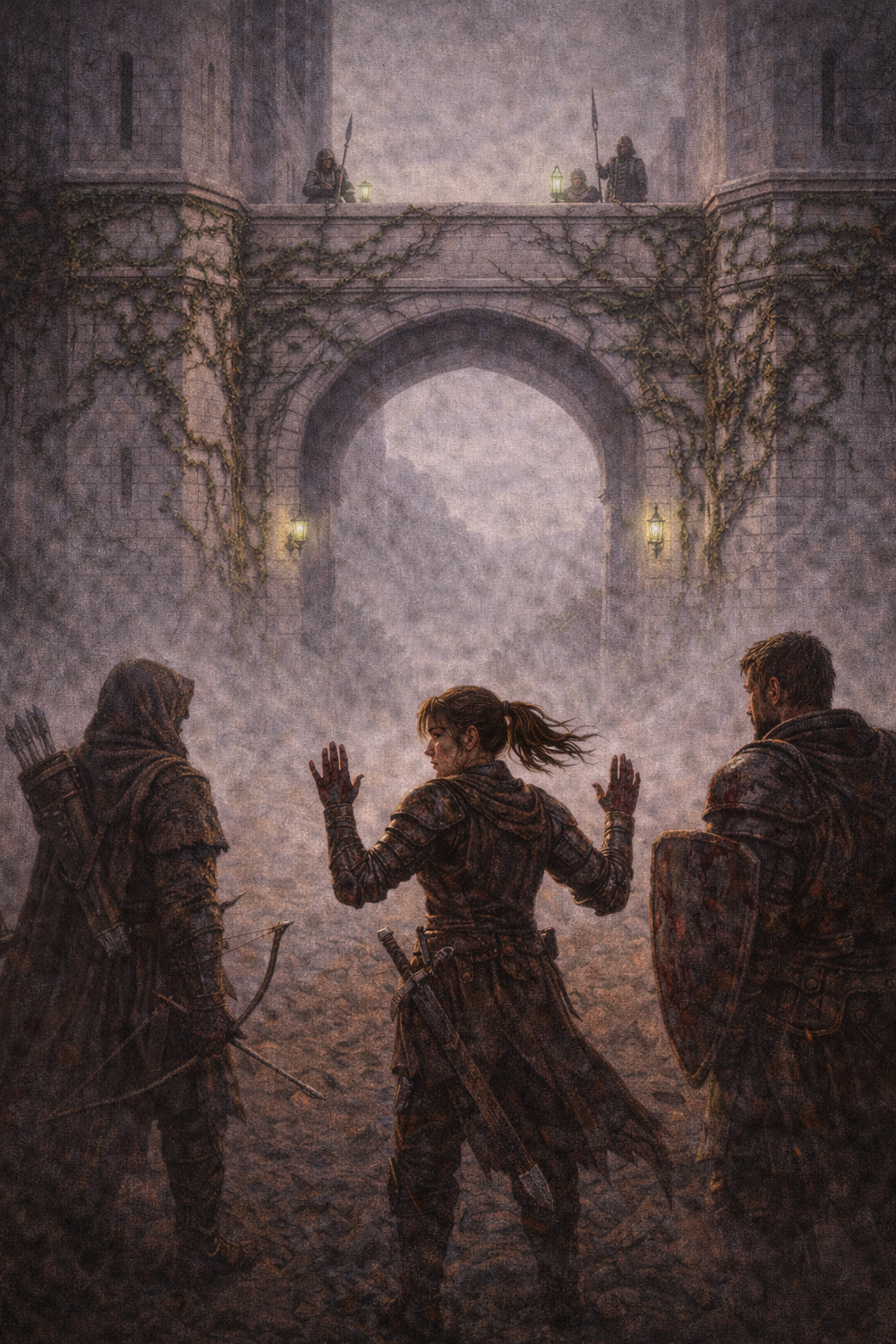
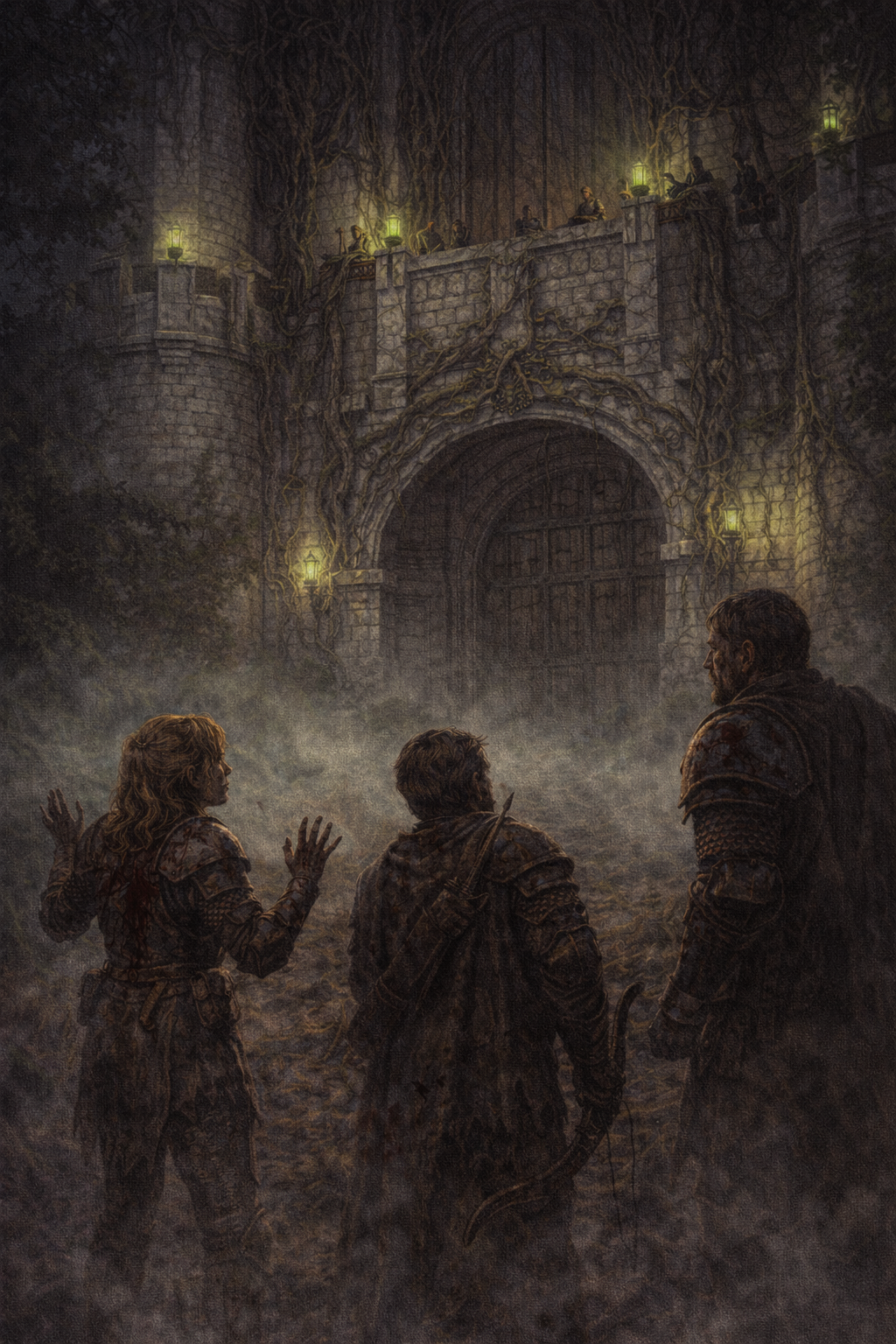
Solundria's northern gate rose out of the marsh mist like a wall carved from moonstone and moss.
It was massive—three stories of white stone threaded with living vine, the kind of architecture that only existed where dwarven geomancers and human druids had built together and built to last. Reed-water sloshed under the causeway. Lanterns burned green along the parapet, their light catching the mist and turning it into something that looked almost peaceful. Spearpoints flashed above the wall where sentries paced.
"Halt!" one of the gate guards shouted from the walkway. His voice was sharp and practiced, the voice of a man who had shouted the same word a thousand times and meant it every time. "Weapons low! Hands where I can see them!"
They stopped because they had no strength left to do anything else.
Keto turned at once, shield arm raised out of instinct even though his shield was somewhere in the mud behind them, his back to the gate, scanning the road for pursuit. Blood from the cut above his eye had dried in a dark line down the left side of his face, giving him the look of a man who had been crying tears of something worse than water.
Madison and Puli raised empty hands. Madison's arms shook. She locked her elbows to hide it.
"We're Hegal's Guild," she said. Her voice was raw—scraped out, hollow, the voice of someone who had screamed on a swamp road an hour ago and hadn't recovered. "Party Five. Ambushed on the north road. We need entry now."
"Everyone says that," the guard replied. He descended the stair with two others, lantern in one hand, spear in the other. His face was weathered, middle-aged, skeptical in the particular way of men who guarded gates for a living and had learned that desperation and deception wore the same face. "Who's your leader?"
Madison swallowed. The word came up like a stone from deep water.
"Dead."
The word sat in the mist between them. The guard's eyes moved from Madison to Puli to Keto's blood-streaked face and back to Madison. Something shifted in his expression—not sympathy, not yet, but the beginning of belief.
Puli stepped forward and held out his guild insignia with shaking fingers. Madison did the same. The small bronze discs were smeared with dried blood and mud and the general filth of a day spent fighting and running and not dying. The guard took both, wiped the blood off one with his thumb, and held them up to the lantern glow. He turned them. Checked the guild stamp. Checked the serial marks on the back.
"These are current," he said to the guard beside him.
Another guard peered past them down the dark road. The mist had thickened behind them, turning the causeway into a corridor that ended in nothing. "You followed?"
Keto didn't look away from the treeline. "If they were, they're smart enough not to show at your gate."
"How many in your party originally?" the first guard asked.
Madison had to think. The number felt wrong in her mouth. "Nine. With the druid who betrayed us, ten."
The guard's eyebrows rose. "And now three."
"Now three."
He handed back the insignias.
"Open," he barked to the wall.
Chains groaned somewhere inside the stone. The gate gave a hand's breadth, then enough for three bodies to slide through single file. The guards stepped aside to let them pass, and Madison felt the stone close behind her with a sound that was supposed to mean safety and instead meant nothing at all.
The guards sealed the gate immediately. The chains groaned again. The mist stayed outside.
"You report to the guild district," the first guard said. "Straight down the Silver Way, left at the third canal bridge. No stopping. No wandering. If you need a healer, there's a station at the second bridge—"
"We don't need a healer," Madison said. What she needed was not something a healer could provide.
The guard looked at her for a long moment, then nodded once. "Move along, then. And get that blood off your faces before you scare the market folk."
Madison almost laughed at the idea of scaring anyone. She felt about as frightening as a wet dog.
They walked.
Solundria at night should have felt peaceful.
Green lantern-glow hung in gardens that grew from the walls themselves—flowering vines and trailing ferns cascading from stone balconies, their leaves catching the light and turning it into something soft and living. Water channels cut through the streets in clean geometric patterns, reflecting the silver towers that rose above the rooftops in spirals of stone and living wood. The air smelled of wet stone, night-blooming flowers, and cooking fires drifting from market lanes where late vendors sold roasted nuts and spiced tea and flatbread slathered with herb butter.
Madison felt none of it.
Her body was one long shiver that had nothing to do with cold. Her armor pulled at bruises she hadn't counted—her ribs, her shoulder where Puli had grabbed her, the inside of her left arm where something sharp had grazed the skin during the fight and she hadn't noticed until now. Her boots were heavy with swamp mud. Her hair hung in damp ropes against her neck.
She walked through the most beautiful city she had ever seen, and all she could see was Mantis.
Standing frozen in the road. Eyes open. Sword raised in a hand that would never swing it again. The blood spreading across his chest like a flower blooming in a place where flowers did not grow.
He was still conscious. The thought circled like a vulture, slow and patient and impossible to chase away. When the blade went in, he was still conscious. He felt it. He knew.
Puli walked slightly ahead, scanning every alley mouth and doorway and shadow with the mechanical alertness of a man running on training because everything else had been used up. His quiver was empty. His bow was unstrung. He carried them anyway, because putting them down would mean admitting they were done, and admitting they were done was something none of them were ready to do.
Keto still kept turning to check behind them every dozen steps. Each time his head snapped around, his hand went to the place where his shield should have been and found nothing. Each time he found nothing, his jaw clenched tighter. He moved like a man expecting a blow from behind—because he had received one, and the lesson had been permanent.
They crossed a canal bridge. Then another. The water below was clear and still, reflecting lantern light and the shapes of towers and the three figures moving above it—bloodied, broken, walking through beauty like ghosts through a feast.
At a market crossing they heard a familiar voice arguing over map routes.
"—no, the southern cut adds two days minimum, and that's assuming the ford at Tellwen hasn't flooded again—"
Tyba.
Puli's head snapped toward the voice like a compass finding north.
"Tyba!"
Tyba turned from the map stall where he stood with a rolled chart in one hand and a look of mild frustration on his face. He saw them, and the frustration vanished. His skin went white—not pale, white, the color of paper, the color of bone—and the map slipped from his fingers and unrolled across the cobblestones.
He broke into a run. "By the gods." He reached them and stopped short, his eyes moving from Madison's mud-caked armor to Puli's empty quiver to Keto's blood-streaked face. "What happened to you?"
Madison opened her mouth and failed to find a beginning. There were too many beginnings. The wyvern. The betrayal. The execution. The dawn and the road and the smell of swamp water and the sound of a blade entering a man who could not move. She closed her mouth again.
Puli answered for all three. His voice was flat and efficient, the way a man talks when emotion would break the sentence in half. "Stoneheart mission broke. Betrayal. Juvar dead. Bozton attacked us on the north road. Mantis is gone."
Tyba stared. "Gone?"
Keto said it the way you say a fact that doesn't care about your feelings. "Killed."
Tyba's jaw tightened. His hands curled into fists at his sides, then uncurled, then curled again. He looked like a man trying to find something to hit and settling for his own palms. He glanced over his shoulder at the men who had been with him—five from his party, armed and armored, led by a broad-shouldered veteran knight with iron-grey hair and a narrow scar through one eyebrow that pulled the skin into a permanent expression of skeptical assessment.
"This is Raida," Tyba said quickly. "Party leader. Raida—these are my people. Party Five."
Raida stepped forward and took in the three of them with a single sweep of eyes that had seen worse and expected to see worse again. His gaze paused on the blood. On the empty quiver. On the way Madison's right hand would not leave the hilt of her sword.
"You can brief while we move," he said. His voice was calm and commanding in the way of men who did not waste authority on volume. "Not here. Too open."
"Guildhouse," Tyba said. "Now."
The Solundria guildhouse was no tent camp.
It was a fortified townhouse of red timber and white stone, built in the Solundrian style—dwarven stonework at the foundation, druidic living wood woven through the upper stories, the whole structure simultaneously wealthy enough to offend poor men and practical enough to survive a riot. Ironbound doors reinforced with rune-etched crossbars. Guarded windows with arrow slits cut beneath the sills. Interior courtyards lit with rune-lamps that cast a steady, sourceless glow. Weapon racks in the foyer. Message boards covered in mission briefs and casualty lists and supply requests written in three different hands.
A place for staging operations, storing mission loot, swapping equipment, and pretending guild wars were only business.
Hegal was already inside.
He sat at the head of a long oak table in the main hall, a map of the northern approaches spread before him, weighted at the corners with a cup, a dagger, a coin purse, and a chunk of raw geomancer crystal. His hands were folded. His face was still. He looked like a man who had been waiting for bad news and had spent the waiting time deciding how to receive it.

Todd stood to his right like a drawn blade. Tall. Lean. His spear leaned against the wall within arm's reach, and his massive shield—big enough to shelter two men—stood propped beside it. His eyes tracked the door the way a predator tracks movement.
When Madison, Puli, and Keto entered with Tyba and Raida's group, conversation in the main hall fell by half. Heads turned. Eyes measured. The guild members at the other tables saw three people covered in blood and swamp mud walking with the rigid, hollow gait of survivors, and they knew what that meant before anyone spoke.
Hegal took one look at them and said, "Food. Water. Seats."
A steward brought bread, dried meat, and three cups of water. Madison took the water and drank it in one long swallow. The bread sat untouched. Her stomach was a clenched fist.
They did not sit.
Raida reported first—clean and structured, like a commander giving casualties to a superior who required precision, not sympathy:
"Recovered survivors of Party Five at the north gate. Three of original nine. Confirmed dead in the field: Mantis, party leader. Rovan, archer. Caravan abandoned under enemy pressure. Merita unaccounted for—unconscious in the wagon when they broke contact. Enemy force identified as Bozton's party, including Nocta, Athena, and a druid designated Dragon Eye."
Todd slammed a fist onto the table hard enough to rattle the cups and bounce the dagger off the map's edge. "Again. Them again."
The room went quiet. Todd's anger was not a performance. It was the real thing—the kind that comes from recognizing a pattern and hating yourself for not breaking it sooner.
Hegal did not raise his voice.
"Details," he said.
Madison spoke then, because if she did not, someone else would do it wrong. Someone would smooth the edges or skip the parts that mattered or tell it the way reports are told—clean, clinical, a list of events stripped of everything that made them real.
She would not allow that. Mantis deserved better than a clean report.
She told it plainly. Her voice was steady because she forced it to be steady, the way you force a cracked wall to stand by leaning something heavy against it.
"The wyvern attack on the Stoneheart approach. Mantis was poisoned—barbed tail, deep muscle. The druid Juvar applied antidote runes and support healing. Same druid who betrayed us." She paused. Let the irony sit. "Nocta and Juvar were Brotherhood. They stole six crates from the caravan during the night. We caught Juvar. Nocta escaped with the cargo and a woman named Athena."
"What happened to Juvar?" Hegal asked. He already knew. His tone said he already knew.
"Guild law," Madison said. "Mantis ordered execution. I carried it out."
No one moved. No one looked away.
"We moved for Solundria at dawn," she continued. "Forced march. Mantis in the wagon. The north approach—swamp road, bad ground, no room for formation. Bozton's party ambushed us." She took a breath. "Rovan died first. Throwing star to the throat. Nocta's work. The Brotherhood hit both flanks simultaneously. We couldn't form a line. Mantis came off the wagon and fought wounded. He nearly turned the center."
She stopped. The next part sat in her throat like a bone.
"Then their druid—Dragon Eye—cast a rune I've never seen before."
Todd's head came up.
"It wasn't light," Madison said. "It wasn't fire. It wasn't any kind of guild-sanctioned casting. It was dark. Pressurized. A paralysis rune. It hit Mantis and he—"
Her voice cracked. She closed her eyes for one heartbeat. Opened them.
"He froze. Standing. Conscious. He could see. He couldn't move. And Bozton walked up and killed him while he stood there."
Silence filled the room the way water fills a hole—completely, without resistance.
No one interrupted until the word paralysis had settled. Then Todd and Hegal looked at each other.
Not surprise.
Recognition.
Madison saw it. She saw the shared knowledge pass between them like a coin exchanged under a table—quick, practiced, secret. They had heard this before. They knew what it meant. And the fact that they knew changed the shape of everything.
"You're sure?" Todd asked. His voice was careful. Too careful for a man who had just slammed a table. "Paralysis. Dark-rune channeling. Not a binding rune, not a hold spell—paralysis."
Madison held his eyes. "I watched him lock in place while he was still conscious. I watched him die without the ability to close his own eyes."
Todd's jaw worked. He looked at Hegal.
Hegal exhaled through his nose—a long, controlled breath that carried the weight of decisions being made in real time.
"The caravan is lost," he said. "That mission is ash." He glanced toward Todd. "This isn't about merchant compensation anymore."
Todd bared his teeth. The expression was not a smile. "Then say it."
Hegal looked around the table. His gaze touched each person—Madison, Puli, Keto, Tyba, Raida, the five others—and settled on nothing.
"Bozton's party has been hunting ours in intervals," he said. "Targeted strikes. Specific intelligence. They knew where Party Five would be and when. That is not raiding. That is warfare. No more pretending this is isolated."
"And dark-rune channeling," Todd added. "That changes what we're facing. Dragon Eye isn't some hedge druid with ambitions. Someone supplied him. Someone taught him. The Pure Light order has been collecting practitioners for years—Remirik's doctrine, Ultra's followers. If the Brotherhood has access to that kind of magic—"
He didn't finish the sentence. He didn't need to.
Keto spoke up for the first time since entering. "What do we do?"
"We move the center," Hegal said. His voice had shifted into command register—flat, certain, allowing no argument. "Our strongest fighters and best stores are in Barlin. Not here. Solundria is a waystation, not a fortress. If the Brotherhood has dark-rune capability, we need walls and numbers and every advantage we can stack."
Tyba frowned. "Barlin is too far overland. Ten days if the roads are kind. Fifteen if they're not."
"So we don't go overland," Todd said.
He looked at Hegal.
Hegal looked back once, then nodded.
"Get your outer cloaks," he told them. "No banners. No noise. We travel below the city."
They left through a side court and cut through night markets where the late vendors were packing their stalls and the cobblestones shone with oil and spilled broth. Hegal walked at the front, Todd at the rear, the rest in a loose column that attracted no more attention than any other armed group moving through a city where armed groups were common.
Hegal led them into a narrow service alley between dye-houses. The walls were stained with indigo and saffron and madder root—streaks of color that ran down the stone like the walls were bleeding in shades no body would produce. The air smelled of chemical mordant and old cloth.
He put his palm on a blank section of wall and murmured three clipped words.
The mortar shimmered. Light moved through the stone in a pattern that looked like veins, briefly luminous, then gone.
A door appeared where there had been none. Wooden. Iron-banded. Old in the way that functional things are old—worn smooth by use, not decay.
Hegal pushed it open, and the smell of underground rose to meet them.
The group descended stone steps into Solundria's underworks—sewer channels, smugglers' passages, and hidden bazaars stitched together into a second city that existed beneath the first like a shadow with its own economy. The ceiling was low—arched stone, sweating with moisture, lit by lamps that hung from iron hooks driven into the mortar at irregular intervals. The floor was worn flagstone, slick in places, dry in others, marked by the passage of thousands of feet that had walked here without the city above ever knowing.
It smelled of wet limestone, lamp oil, spice smoke, and old coin. Underneath that, the faint mineral edge of running water—not sewage, but the natural channels that fed Solundria's famous canals, diverted here into secondary paths that no city planner had ever approved.
Stalls lined the tunnels. Rune-sellers with their wares laid out on black velvet—binding runes, ward runes, enhancement runes, each one glowing faintly with stored potential, their prices written in chalk on slate boards that could be erased the moment a patrol appeared. Charm-cutters who worked at small benches with magnifying lenses strapped to their heads, carving sigils into bone and horn and compressed crystal with tools so small they looked like surgical instruments. Illicit map brokers whose charts showed routes that did not exist on any official survey—smuggler paths, hidden passes, tunnels between cities that predated the cities themselves. Armor patchers who could reinforce a breastplate in twenty minutes and ask no questions about the dent. Fluid dealers with too many locks on their trunks, selling bottled substances in colors that nature did not authorize.
Not pure black market—more like the empire's taxes had been politely ignored underground for decades, and everyone involved had agreed to keep the arrangement quiet.
Madison saw Tyba staring at a cage full of pale cave-lizards, their translucent skin revealing the faint blue tracery of veins beneath, their eyes reflecting the lamplight in flat discs of gold.
"You wanted adventure," she muttered.
He answered without humor. "I wanted sleep."
The words landed wrong. Sleep was what Mantis would never have again. Madison looked away.
Hegal stopped near a forge-lit corner where the tunnel widened into a small workshop. Bellows huffed. An anvil sat on a stump of petrified wood. Behind a cluttered counter stacked with crystal samples, geomancer tools, and jars of reagents arranged in an order that made sense only to their owner, a dwarf in layered geomancer robes was arguing with a young human merchant over crystal quality.
"—I don't care what your supplier told you, boy, this is fracture-grade at best. You try to channel through this, it'll split before the third syllable and take your fingers with it. I've seen it happen. I've cleaned up after it. Get out."
The merchant retreated with the offending crystal held at arm's length, as if it might explode on principle.
"Goshnak," Hegal called.
The dwarf turned. He was old by dwarven standards—old enough that his beard had gone from iron-grey to silver and his eyebrows had achieved the bushy independence of small animals living above his eyes. But his hands were steady and his gaze was sharp and the geomancer robes he wore were covered in the stains and burns of active practice, not ceremony.
He blinked at Hegal, then broke into a grin that showed two gold teeth and a gap where a third had been.
"Hegal. Back this soon? Lose a bet?"
"Worse," Hegal said. "I need a portal brew."
Goshnak's grin flattened. The gold teeth disappeared behind pressed lips. His eyes moved past Hegal to the group behind him—ten people, armed, bloody, wearing the expression of people who had recently been somewhere they never wanted to go again.
"At this hour? For that many bodies?"
"Ten."
"Expensive ten." Goshnak's fingers drummed on the counter. "Portal brew for ten is not a casual ask, Hegal. The beholder eyes alone cost more than this stall. The mana syrup has to be fresh. The binding—"
"We know what it costs," Todd said. He folded his arms, and the motion pulled his cloak back to reveal the guild insignia on his chest—the mark that meant debts would be honored. "We pay what we can now. The rest clears on guild bond."
Goshnak scratched his beard and eyed the blood on Madison's vambrace—dried now, cracking at the edges, dark as old rust. Then Keto's torn shield straps, dangling from an arm that had nothing left to hold. Then Puli's empty quiver loops, the leather still shaped around arrows that weren't there.
"Hard night," he muttered. His tone changed. The merchant sharpness softened into something else—not sympathy, not quite, but the practical compassion of a man who had seen hard nights himself and knew what they cost. "Fine. You owe me enough to make me hate you, and I will collect, Hegal. I will collect."
He moved fast after that. His hands found drawers and horn cases and locked compartments with the practiced speed of a craftsman who could do this blindfolded. Powdered geomancer salts—fine as dust, shimmering faintly, smelling of deep earth and crushed mineral. Distilled mana syrup in a glass vial, viscous and blue-white, catching the forge light and refracting it into tiny rainbows. Ground shell from something large and old, the fragments still carrying the iridescent sheen of the ocean. Two beholder eyes in a sealed glass jar—round, amber, unsettling in the way they seemed to track movement when no one touched them, as if something behind the preserved tissue still retained the habit of watching. A strip of preserved ape sinew for binding, dried to the consistency of old leather, tough enough to hold the components in suspension while the brew catalyzed.
He mixed them in a stone mortar with a pestle that had been worn to a smooth nub by years of use. His movements were precise and unhurried—grinding, folding, tilting, adding liquids in measured drops that hissed when they hit the powder.
Tyba leaned toward Puli and whispered, "If I drink that, I die."
Puli whispered back, "If Hegal drinks it, we probably only vomit."
"Encouraging."
The brew turned from swamp-green to deep violet—a color that looked wrong in lamplight, too saturated, too alive, as if the liquid itself were aware of what it was about to be used for.
Goshnak corked it in a thick glass bottle and shoved it into Hegal's hand.
"One cast," he said. "One. No hesitation once you start the gate. The brew burns fast—you've got maybe forty seconds between first invocation and frame collapse. If you stall, the destination locks wrong and you come out inside a wall. If the frame destabilizes entirely, I am not cleaning pieces of you off my ceiling."
Hegal passed him a heavy coin pouch. Goshnak caught it one-handed, bounced it once, and frowned.
"Not enough," he said automatically.
"I know."
Goshnak snorted. "Then don't die before paying the rest. I know where your guildhouse is."
Behind the underground market quarter lay a service alley no wider than a wagon axle.
The walls were bare stone, slick with condensation, close enough that Madison could touch both sides if she extended her arms. The ceiling was low. The air was still. The only light came from a single rune-lamp at the far end, casting a weak amber glow that turned their faces into masks of shadow and bone.
Hegal stood in the center of the alley. He uncorked the violet brew, lifted it to his lips, and drank.
The smell hit first—metal, ozone, bitter herbs, and something underneath that was not a smell but a sensation: the feeling of pressure changing, of air being displaced by something that occupied space without being visible.
Then he cast.
His hands traced a tight geometric pattern in the air—precise, controlled, each gesture flowing into the next with the fluidity of long practice. Runes flashed in sequence: white, blue, gold, then a color Madison had no name for. The alley darkened at the center point as if depth itself had been peeled back—not shadow, but the absence of dimension, a place where forward and backward and up and down had been temporarily removed from the laws of the world.
A portal opened.
It looked like a black well hung upright, its edge ringed in brilliant, stable blue that pulsed with the steady rhythm of a heartbeat. The center was dark—not the darkness of an unlit room but the darkness of distance compressed into a point, the kind of dark that existed between places rather than inside them.
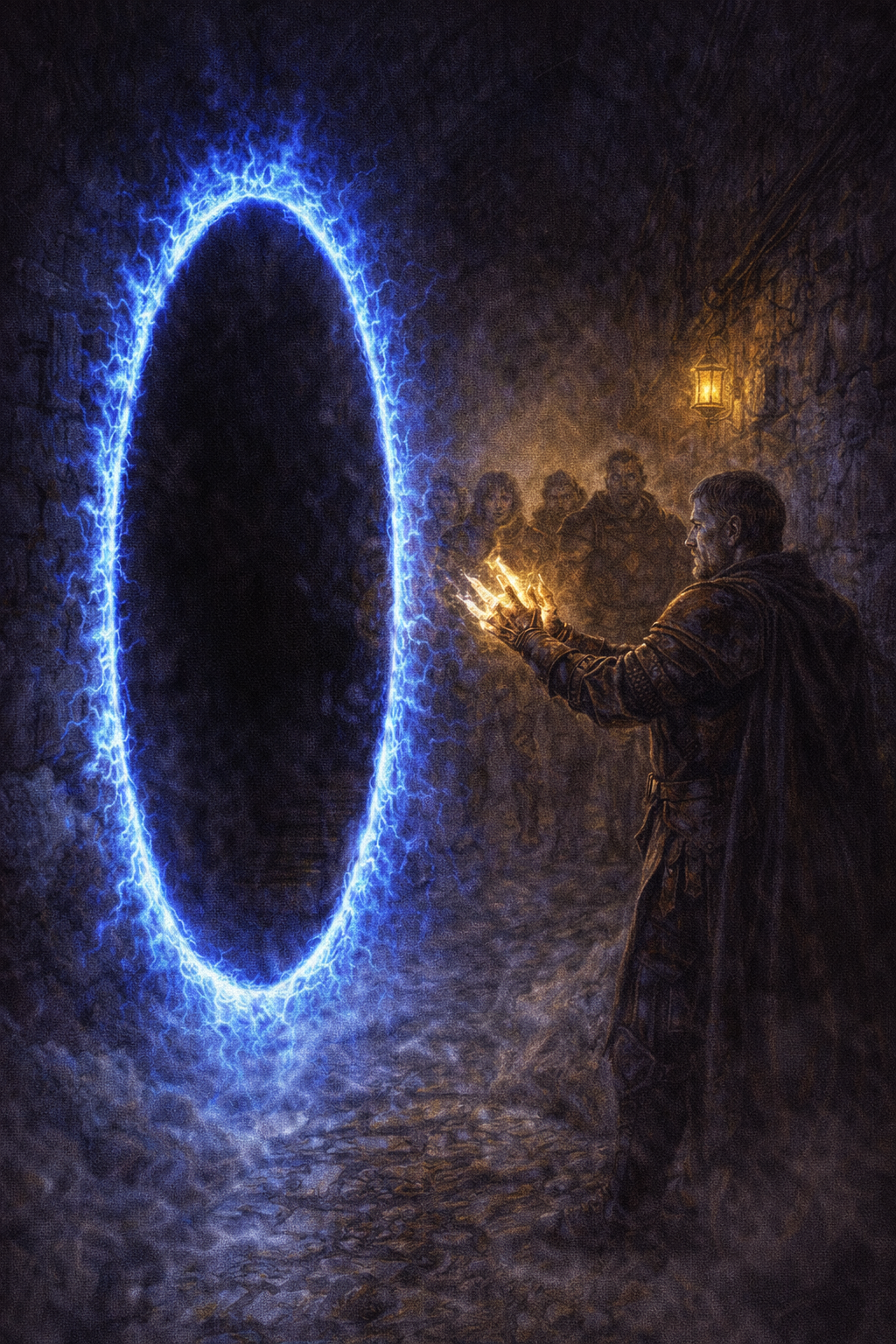
When Madison stared too long she thought she saw floorboards on the other side. Then shelves. Then a ceiling and a wall and the suggestion of a room that existed somewhere impossibly far from this tunnel. Then nothing. The image flickered as if the destination could not decide how much it wanted to be seen.
The air around the portal's edge hummed. Not a sound—a vibration she felt in her teeth and the bones of her wrists.
Todd turned to the group.
"First portal for most of you?" he asked.
A few weak nods. Tyba's face had gone the color of the brew before mixing—swamp-green.
"Good," Todd said. He was not smiling, but his voice had the steady, practiced calm of a man who had done this before and survived it. "Close your eyes, breathe once, jump clean. Don't grab the frame. Don't think about where you are between here and there. Don't hold your breath—it makes the pressure worse. Jump, land, move."
Hegal stepped through first. One moment he was standing in the alley, the next he was inside the dark and gone—not walking, not falling, simply elsewhere.
Todd pointed. "Go."
One by one, they jumped.
Keto went first among them—because Keto always went first, because Keto had decided long ago that the front of the line was where fear could be converted into momentum. He closed his eyes, took one breath, and stepped through. The portal swallowed him without sound.
Puli followed. His face was set, jaw tight, eyes open at the last instant as if he couldn't stop himself from watching.
Tyba went third. He hesitated at the edge, swallowed hard, whispered something that might have been a prayer or a curse, and jumped.
Raida and his people went in quick succession—professionals, calm, efficient, treating the portal like a door rather than a miracle.
Madison last before Todd.
She stood at the edge and looked into the dark. It looked back. The blue ring pulsed.
Somewhere on the other side, Mantis was not waiting. Mantis would never be waiting anywhere again. He was standing on a swamp road in the north approach, held upright by a rune that should never have existed, eyes open, seeing nothing.
She closed her eyes.
She stepped into cold.
For one impossible instant she had no weight, no direction, no body. She was between—between places, between breaths, between the person she had been before the north road and the person she would be after it. The cold was not temperature. It was absence. The absence of everything except motion and the dim, distant certainty that somewhere ahead there was a floor and she was going to hit it.
Then her boots struck wood, hard, and her knees buckled and she went down on one knee with a crack that sent pain shooting up her thigh.
A hand gripped her forearm. Steady. Strong.
Hegal.
"Up," he said. "Make room."
She stood and pulled to the side, and a moment later Todd came through behind her. The portal collapsed with a low sucking pop—a sound like the world closing a mouth it should never have opened—and then there was only candlelight and breath and the echo of ten people standing in a space that smelled of old wood and stored grain.
They were in a vast basement. Barrels lined the walls in ordered rows. Casks and crate towers rose to the ceiling. Preserved rations in sealed containers bore dates and inventory marks. Mission chests branded with guild marks sat locked and chained along the far wall. The air was cool and dry and tasted of dust and wax.
Hegal flicked his fingers and cast a spark-runner spell. Threads of pale light shot outward from his hand like luminous insects, climbing sconces and lantern racks and wall-mounted fixtures, waking the room in stages until the basement was fully lit and the shadows had been pushed back into the corners where they belonged.
"Welcome," he said. "Barlin guildhouse."
They climbed from the storage level into the main hall.
It was huge.
The ceiling was high—vaulted timber, dark with age and smoke, hung with guild banners in Hegal's colors. The hall was wide enough to hold a hundred people and currently held close to that number. Parties filled long tables, their armor and weapons piled around them like the shed skins of animals that had grown too large for their coverings. Some argued over maps pinned flat with daggers, tracing routes with charcoal-stained fingers and debating distances and terrain with the intensity of men whose lives depended on getting the numbers right. Others polished blades, brewed field mixtures over small portable burners, sorted runes into categorized pouches, re-strung bows, patched armor with needle and wire, or slept upright in their chairs with helmets in their laps and hands resting on hilts.
Conversations folded around Hegal as he passed: respect given in short nods, quick salutes offered without ceremony, brief reports delivered in low voices. A quartermaster pressed a supply manifest into Todd's hand. A knight with a bandaged arm asked about deployment. A druid reported ward integrity on the eastern perimeter.
Madison had never seen a guild operation this large.
It looked less like a house and more like a war engine disguised as one—a machine built from people and steel and purpose, ticking over in the quiet hours, waiting for someone to point it at a target and say go.
She thought of the small camps she had known. The open-field bivouacs with two lanterns and a watch rotation of four. The broken caravan on the plains. This was something else entirely. This was what happened when a guild stopped being a business and started being an army.
Hegal stopped on the stair landing and addressed only his immediate ten.
"Not tonight," he said. His voice was quieter now—not commanding, not strategic, but human. The voice of a man who could see exhaustion in the faces before him and had the decency to acknowledge it. "You're dead on your feet. Every one of you. Sleep. Eat if you can. We assemble at first light."
No one argued.
Madison found a narrow cot in a second-floor side room that held six other cots and smelled of old linen and lamp oil. She sat on the edge with half her armor still buckled, too tired to remove it, too wired to sleep. The room was dim. A single rune-lamp cast low amber light across the floor. She could hear the muffled sound of the main hall below—voices, footsteps, the clink of metal on metal—and the silence between.
She unbuckled her vambraces and set them on the floor beside the cot. Her hands were raw from scrubbing. The skin over her knuckles was cracked and tender. Juvar's blood was gone—had been gone since morning—but she could still feel it. A phantom weight. A stain that existed beneath the skin where soap could not reach.
She lay down.
The cot was hard. The pillow was thin. The blanket smelled of someone else's sleep.
When she closed her eyes, she saw Mantis.
Not the way he had lived—steady, commanding, the kind of man who made you believe a bad situation was survivable simply by standing in the middle of it and refusing to leave. Not the way he had fought—wounded and furious, splitting shields and driving men back with nothing but will and a sword arm that pain could not slow.
She saw him the way he had died.
Frozen. Upright. Eyes open and furious and aware. The blade entering his chest while he watched. The blood spreading. The light going out in stages, like a candle drowning in its own wax.
She saw Bozton's mouth forming the words. For Juvar.
She saw Dragon Eye's pale eyes. Calm. Indifferent. The eyes of a man who had cast a forbidden rune and felt nothing about it.
She saw her own hands, scrubbed raw, and Juvar's blood that would not wash off no matter how many times she tried.
Madison lay on the narrow cot in the Barlin guildhouse and stared at the dark ceiling and felt the weight of every death she had witnessed and every death she had caused settle onto her chest like armor she could not unbuckle.
She did not sleep much.