Haze rose from the coast in layers of white. At first it was a blur—then the details sharpened. Tall buildings, towers, apartments, walls of pale stone that caught the sun and gleamed. The port was the largest in the empire: the capital of the humans, the heart of trade and power. As the cutter approached, the scale of it opened before them. Dozens of ships at anchor or tied to the docks, masts like a forest. Merchants unloading cargo—barrels of beer and wine, crates that might hold jewels or armory, weapons in oiled wraps, bales of cloth, fish in baskets, food in sacks. The air smelled of salt, tar, and a hundred different goods. Rich men and women stepped from polished vessels onto the quay; laborers heaved and shouted. And everywhere, the Royal Army: warriors in the emperor's colors, patrols along the waterfront, guards at the main landings. The empire's strength, on display. Madison had never seen anything like it.
Captain Thorne brought them in. The cutter slid alongside a pier; ropes were thrown, made fast. The gangplank went down. Madison, Puli, and Tyba shouldered their packs and made for the dock. The wood was solid under her boots—strange, after hours of the deck shifting. Thorne followed them to the rail. He caught Madison's eye and leaned in—closer than he had with the others. His coat smelled of salt and wind. His voice dropped. "Take care. Remember everything I taught you. Don't trust easy. In battle, always watch your flanks." He held her gaze. "You're his daughter. That makes you a target for some and a hope for others. Neither is safe. Go well."
"Thank you," she said. "For the passage. For the stories."
He nodded. She stepped onto the gangplank with Puli and Tyba. When they reached the quay and looked back, the cutter was already casting off. Thorne raised a hand. They raised theirs. Then the ship turned and began to shrink toward the horizon. The noise of the port closed around them—voices, creaking wood, the cry of gulls. Madison felt the weight of the Sword of Fury at her side. Okay, she thought. This is it.
She let herself stand still for three breaths—only three—while the quay jostled around her. Puli bumped her elbow; Tyba shifted his pack higher. The solid wood under her boots still seemed to sway slightly, a ghost of the deck. She rolled her shoulders once, feeling the straps bite, and tasted salt on her lip. One step, she told herself. Then the next.
They had hours before the trials. "What do we do?" Tyba asked. Around them the quay seethed—porters, merchants, guards. The white buildings loomed.
"Get some food," Puli said. "We might as well eat. No point standing around."
They walked. The streets of Haze were cobblestone, wide and crowded. The press of bodies was constant; they had to step aside for caravans, for men carrying crates, for a woman in a sedan chair. Street performers did magic tricks at the corners—small flames in the palm of a hand, coins that vanished and reappeared—and children darted between the stalls. They passed a massive trade station, stalls and awnings and the smell of spices and leather and something sweet, honey or dried fruit. Near the bank steps, a clerk in imperial grey read a tithe notice aloud while merchants grumbled about a new imperial levy they would never see itemized—only felt, like weather that arrived before clouds. None of them could have said what it paid for. That was rather the point.
A great bank rose on their left, columns and guarded doors, the emperor's eagle carved above the lintel. Beyond it, big houses, white-walled, with tiled roofs that caught the sun. The noise was constant—voices, footsteps, the clop of hooves. Madison had never seen so many people in one place. She kept her hand near her pack, where her coin purse lay.
They found a tavern in a side lane—a low building with a sign that creaked in the wind, a tankard painted on the wood. "Let's sit here," Puli said.
Inside it was dim and loud. The air was thick with the smell of ale and smoke and something roasting. They took a table near the back, ordered food and something to drink. When the cups came, Puli raised his, then set it down. "Actually—we're going to trials. Might as well not drink any alcohol. Stay sharp."
Tyba and Madison agreed. They ate—bread, stew, a wedge of cheese—and watched the room. Low beams crossed the ceiling; the fire in the hearth threw shadows on the walls. The wall beside the hearth was shingled with bills—bounties, lost cargo, a reward for a runaway apprentice—and one had been pinned over so many times the corners had furred to felt. Tyba leaned to read it and huffed a laugh. It was not a bounty at all but a kind of handbill: Crescendo. Contracts considered. No banners. No questions. Someone had inked a crude crown onto the painted helm—a joke, or a tribute. "That's the one from the road stories," Tyba said. "Walked a drake's hoard out of the high passes alone, they say. Half of these are forged—men sign his name to sell their own work." Puli grunted around a mouthful of bread. "Famous enough to be counterfeited." The name meant nothing to Madison yet. She filed it the way you file weather in a country you do not live in. At a nearby table a hooded figure sat alone, hunched over his cup. The hood hid most of his face—only a sharp chin and a thin mouth visible when he spoke. He was lean, narrow-shouldered, and his hands were never still: they flicked and twisted in the air as if he were already throwing something. "I'll use my throwing stars. Impress Hegal. They'll see." His voice was a mutter, for himself or for no one.
At the next table over sat two others. Both had the look of archers—the way they carried their shoulders, the calluses on their draw hands. Bows were propped against their chairs, quivers at their feet. The first was a man in his thirties, broad in the chest, with short dark hair going grey at the temples and a scar that ran along his jaw and down his neck. His arms were thick; he had the build of someone who had drawn a heavy bow for years. The second was younger, maybe Madison's age, lanky and restless—long limbs, dark skin, hair tied back in a short tail. His fingers tapped the table. He kept glancing at the door. Puli had been listening. He leaned over. "You're also going to the Hegal's trials? For recruitment?"
The older archer nodded. "Yeah. You too?"
"We are. This is Madison, this is Tyba. My peers. We're from Jul."
"Jul. Long way." The older one extended a hand. "Nocta. This is Acav. We're here for the same thing. Think it'll be easy to get into the guild?"
"Hope so," Puli said. They traded a few more words—where they'd come from, what they'd heard about the trials. Then the food came and the conversation drifted. When they were done eating, Madison, Puli, and Tyba left the tavern. Nocta and Acav stayed behind. The sun was still high; the street was warm.
Outside, the lane felt narrower than it had on the way in—the buildings leaning a fraction closer, or perhaps her attention had sharpened. A cart rattled past; a child darted after a hoop. For a heartbeat Madison imagined telling her mother about the hooded man muttering in the tavern, then decided some details would only add worry without adding truth.
Puli glanced at the sky. "We should move. Registration won't wait."
They tightened their packs and walked.
Haze pressed around them in white stone and noise. Market cries. Horses. Wheels on cobblestone. They cut through side streets and crowded lanes, heading for the north gate where everyone said the guild recruiters were gathering candidates. Madison walked in armor that was still stiff in places from being cleaned the night before. The Sword of Fury rode heavy against her hip, each step a reminder of her father's hand once wrapped around that same grip.
At the north gate, imperial guards checked no names, asked no questions. They only pointed people through. Beyond the arch, the city sound dropped away in layers, replaced by wind and road and the clatter of gear from those marching ahead.
The road rose gradually over dry ground flecked with yellow grass. Candidates stretched in a loose stream before and behind them: robed mages murmuring to each other, broad-shouldered warriors with shields strapped to their backs, archers with feathered shafts rising from quivers like painted reeds. Everyone walked faster than they wanted to admit.
"How far?" Tyba asked.
"Not far," Puli said. "They said a few kilometers."
They crested a low rise.
The camp opened below.
Not a military camp built for war and mud and siege. This was an organized storm. Red-and-gold pennants snapped from high poles. Practice rings had been marked in chalk and stakes. Archers shot in long lanes where moving targets jerked across ropes and pulleys. Mages worked in circles burned dark into the ground, flaring runes and small controlled blasts. Warriors drilled in rotating lines while instructors barked cadence.
The place sounded like iron rain: bowstrings thrumming, steel clashing, shouted counts, hooves stamping, the occasional crack of spellfire. It smelled of sweat, leather oil, dust, and sharp arcane ozone. Madison had seen training yards before. She had never seen one like this.
"Gods," Tyba breathed.
Puli's eyes were wide in spite of himself. "If this is just the gate..."
"Then let's see the inside," Madison said, though her stomach had tightened.
They entered with the rest of the candidates. Guild personnel moved constantly through the crowd, easy to spot in red-and-gold shoulder wraps and metal insignias pinned at the collar. They directed people, settled disputes, shouted lane assignments, hauled targets back into place. The entire camp moved with practiced efficiency, like a body that had done this a hundred times.
Then the first horn sounded.
Low, long, and deep enough to vibrate in Madison's chest.
A second horn answered from the far side of camp.
"Make way!" someone shouted. "Open the road!"
The crowd split down the center, forming a corridor. Two red horses trotted through, coats dark as spilled wine, tack polished, nostrils flaring. On the first sat a man with a stern, carved face and broad shoulders under red-gold armor. His black hair was streaked with grey at the temples. He rode as if the ground itself made room for him.
Hegal.
Even those who had never seen him recognized him at once.
Behind him rode Todd, second in command, younger and leaner, with a massive shield strapped over his back and a spear lashed to his saddle. The shield was absurdly large for one man, rimmed in steel, scarred by old impacts. People whispered as they passed: Todd carried Hegal's shield by oath, by rank, by trust.
Both men dismounted near the central platform. The camp quieted in waves.
Hegal stepped up.
He did not raise his voice much; he did not need to.
"Welcome," he said. "Some of you will leave this camp as members of Hegal's Guild. Most of you will not."
No one shifted. No one coughed.
"You will be tested to your limits," he went on. "Not to impress me. To reveal yourselves. Archers, mages, druids, warriors: each discipline is tested differently. Follow my officers. Pass your trials, and you earn our colors. Fail, and you leave today." He turned slightly, glancing across the camp. "Begin."
No one cheered. Relief would have been disrespect; fear would have been admission. The camp held its breath for the space of a horn note—then movement returned all at once.
"Archers! This side!" "Warriors to the north lane!" "Mages, hold your line!"
Madison looked at Puli and Tyba. They stood close for one more moment, three friends from Jul in the center of too much noise and too many strangers.
"Good luck," Puli said.
"Don't get yourself killed," Tyba added.
Madison almost smiled. "Same to you."
Then they were gone, swallowed by different streams of people.
Madison stood alone for a moment in the current, watching Puli's red hair vanish between two tents, Tyba's shoulders turn toward the archery pennants. Her throat tightened—not with loneliness exactly, but with the sudden nakedness of being only herself in a place built to measure strangers. She pressed her palm to the Sword of Fury's pommel until the chill of the metal steadied her, then followed the warrior stream.
The warrior line moved out of camp toward rougher ground where scrub grass gave way to scattered stone. They walked uphill under a hard afternoon sun. No one talked much.
At the top of a broad shelf of land, they found him.
Lanz.
Druid robes in layered greens and brown. Weathered face. Long hair tied back with leather cord. Staff tipped with carved stone and threaded with old roots that still looked alive. He regarded the line as if he had seen every variation of fear and pride already.
"I am Lanz," he said. "I test the warriors."
His tone carried no drama. No ceremony. Just fact.
"One by one," he continued. "You enter the arena. You face what I call. You pass, or you do not."
He struck his staff once.
The ground shuddered.
Stone surged upward in a ring, blocks lifting and locking together until a circular wall stood taller than two men. Another gesture raised internal partitions and entry channels. In less than a minute, a bare arena existed where empty ground had been.
"First," Lanz said.
A broad-armed man stepped forward, jaw set. He entered. The opening sealed behind him with a grinding crash.
Outside, the waiting warriors heard only confusion.
A roar. Then heavy impacts. Then a scream that cut off abruptly.
The entry opened. The man stumbled out white-faced, his left arm hanging useless. "I surrender," he gasped. "I surrender." He did not wait for instruction. He left at a run.
Next.
One after another they entered. Some emerged shaking from the surrender gate. Some did not emerge there at all. A few appeared through a far opening and were led away by guild staff with the clipped efficiency of people used to this work.
Madison waited.
Her mouth was dry. She watched the sun slide, inch by inch, along the arena's stone lip—time made visible—and listened to the camp's distant noise: a rhythm of shouts and impacts that did not care whether she was ready. A girl near her vomited quietly into the grass and was led away without comment. Madison understood. Fear had a stomach.
When Lanz called her, her legs moved before she registered it.
She unhooked her shield. Drew the Sword of Fury.
The steel came free with a sound that seemed too loud against the stone walls.
She stepped inside.
The entry sealed behind her.
Inside, the arena was smaller than it had looked from outside. Bare earth floor. High walls. No audience. No distraction. Just her and Lanz.
Lanz's mouth twitched at one corner.
"A woman warrior," he said. "Good. Are you ready?"
Madison swallowed once and nodded.
Lanz spread his fingers.
The air warped.
What appeared was shaped like a bear, but it was wrong in scale and proportion, as if someone had taken the idea of a bear and exaggerated every violent part. Massive shoulders. Claws too long. Jaw too wide.
It charged immediately.
Madison set her stance and caught the first impact on her shield. The force drove her back hard enough to carve furrows in the dirt. Her shoulder screamed. She pivoted before the second swipe, felt claws scrape steel inches from her face, and slashed across its flank. Dark blood sprayed hot against her forearm.
The beast wheeled faster than she expected, reared, and came down.
She stepped inside its arc and drove the Sword of Fury up beneath the jaw and into the throat. The creature convulsed, slammed against her shield, then crashed sideways in a mass of fur and blood and dust.
Silence returned in a ragged rush.
Her ears rang. Blood hammered in her wrists; her mouth tasted of copper and dust. She stayed behind the shield another heartbeat, waiting for something else to move, because her body refused to believe the first thing had stayed dead.
Lanz inclined his head.
"Good," he said.
He lifted his staff again.
An orc warrior formed out of stone dust and shadow: heavy armor, scarred shield, brutal axe. It did not roar. It simply attacked.
The first blow landed like a hammer on an anvil. Second blow: higher, faster. Third: low feint into a shield bash that nearly took Madison off her feet.
She could not match that strength head-on. Every block numbed her arm farther up the shoulder.
Captain Thorne's voice surfaced through the panic:
If he's bigger, don't beat his strength. Break his pattern.
She gave ground deliberately, inviting overcommitment. The orc pressed, aggressive, hammering the same side. When its front foot planted too far forward, she chopped at the knee seam. Metal buckled. It stumbled. She struck the shield arm where plate overlapped leather. Once. Twice. The orc lost the shield. She stepped inside its recovery and drove her blade through the opening under the collar.
It dissolved before it hit the dirt.
Lanz watched her with a new expression, harder to read.
"Very few defeat that one," he said.
He planted the staff.
The temperature in the arena seemed to drop, then spike.
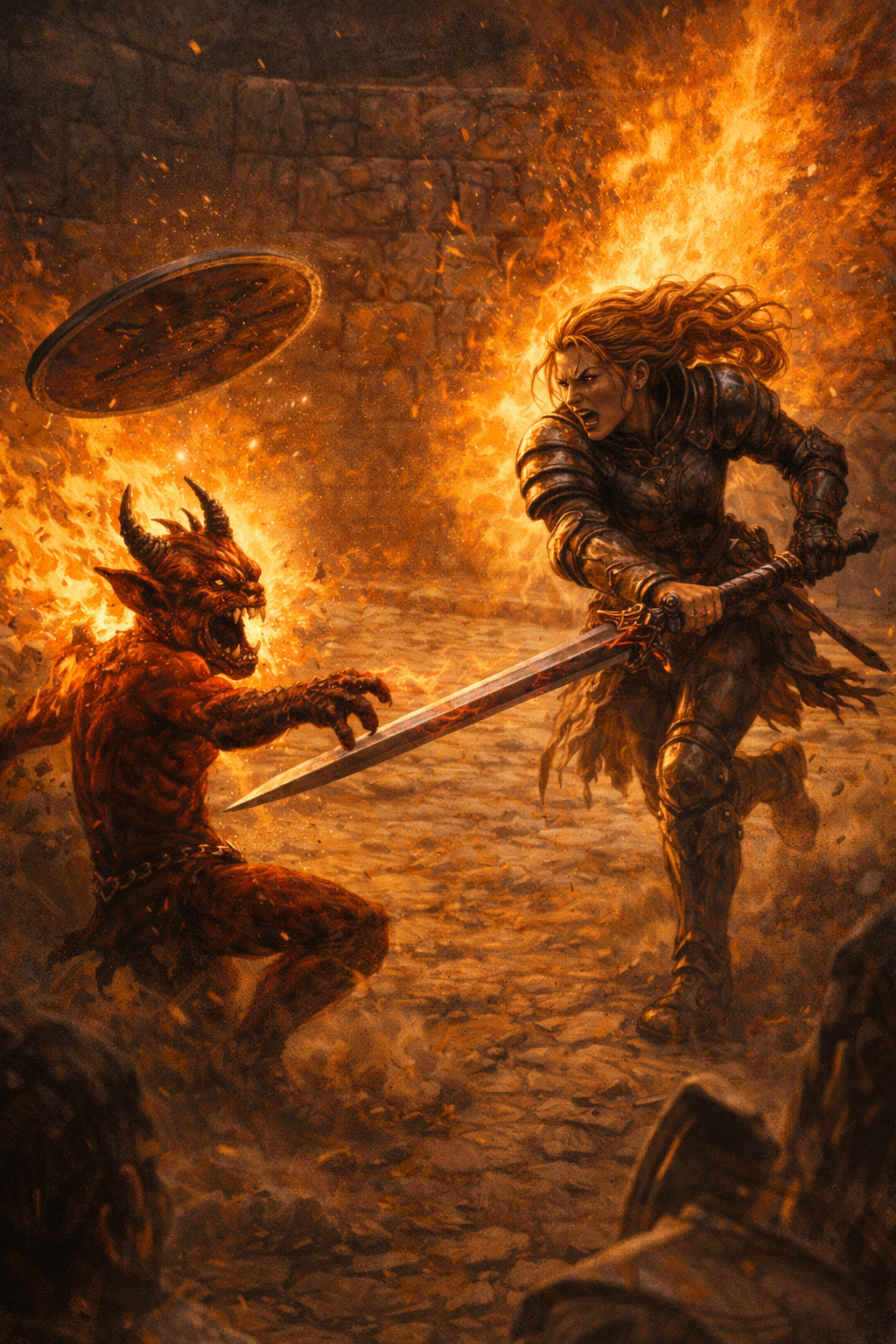
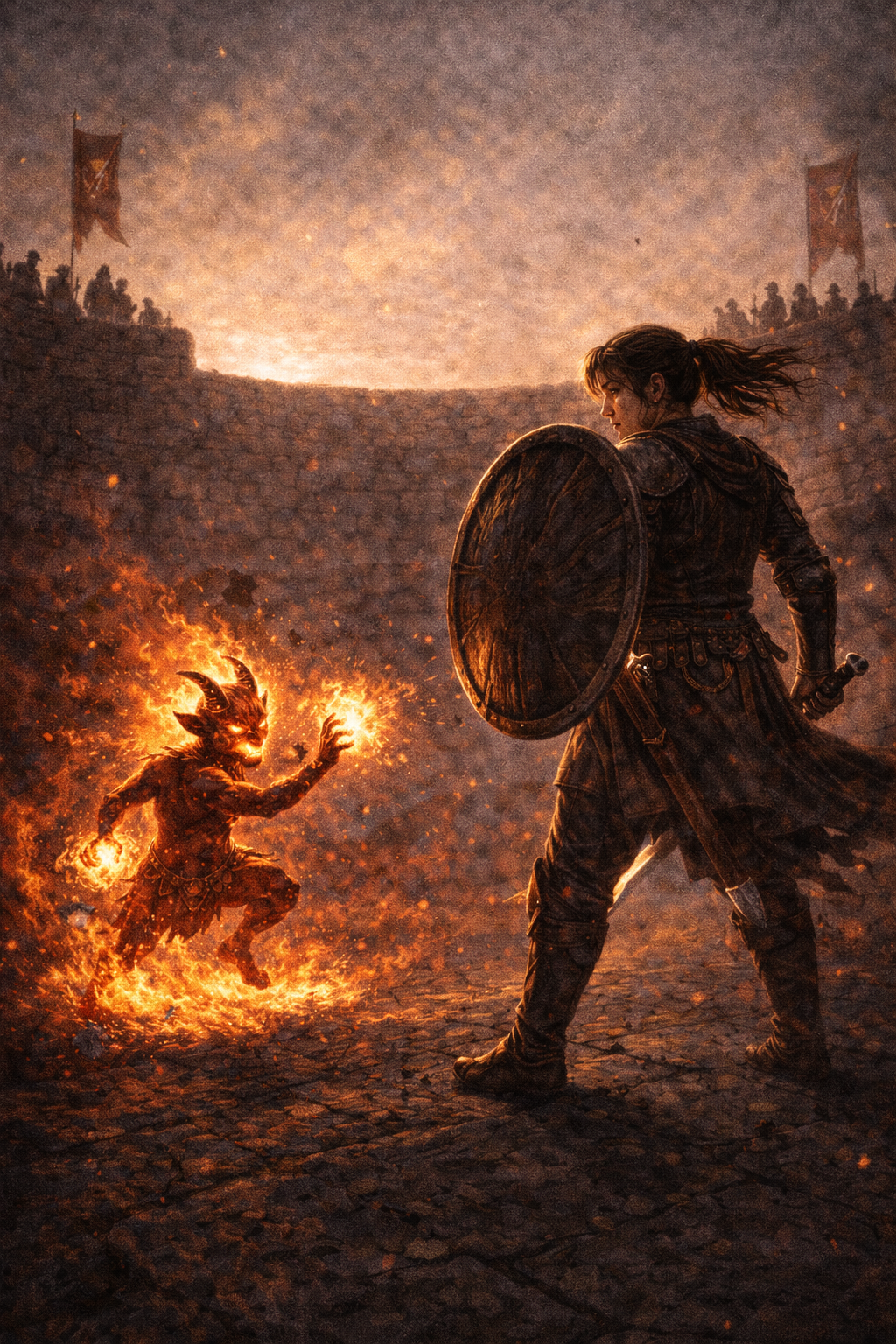
The demon appeared in a blur of red skin, horns, and heat shimmer.
It moved impossibly fast.
Firebombs erupted from its hands, not thrown in arcs but snapped into place where she was about to be. Dirt exploded at her heels. Stone fragments hit her cheek. Smoke thickened. She could barely track it; every time she turned, it was already somewhere else, another burst flaring.
She tried to close distance and nearly died for it.
The demon feinted left, reappeared right, and dropped a fire charge at her feet. She threw herself into a roll and came up coughing, hair singed at the ends, left gauntlet blackened.
This was not a strength fight.
This was timing.
She forced herself to stop chasing.
She watched.
The demon had a tell: each time it gathered a larger flame, its right shoulder dipped half a heartbeat before release.
She waited for it.
Shoulder dip.
She ripped her shield off and hurled it like a spinning disc. It slammed into the demon's forearm. The fire charge detonated wide against the wall, showering sparks.
Madison ran through the gap.
One stride. Two. Three.
The Sword of Fury drove through the demon's chest and out its back. The creature shrieked in a sound like tearing metal, then collapsed into ash and black cinders that blew apart in the heat.
Madison stayed crouched, blade down, gasping for air that tasted of sulfur.
Heat still licked along her hairline. She could feel where the fire had kissed—small, petty burns, nothing that would stop her, everything that would remind her tonight in the dark. She counted four breaths before she trusted her knees to straighten.
Lanz did not speak for a long moment.
Then he gave one short laugh, sharp with disbelief.
"Nobody beats the demon on first pass," he said. "Nobody." He pointed to the far opening. "Go. You've passed."
Her legs felt unsteady, but they carried her.
She walked through the pass gate into sunlight.
The main camp took time to find again. By the time she returned, her armor was scorched in two places, dust-caked at the knees, and streaked with blood that was not hers.
She found a quiet patch of ground by a supply crate and dropped to a knee. Her shoulder still throbbed from the bear's first impact; her left arm felt like it had been struck with a hammer a dozen times. She dug into her pack with clumsy fingers and pulled out a support healing rune. The stone was warm against her palm, the etched symbol faintly alive. She pressed it to the sore spot beneath her collar and whispered the activation word she had been taught.
Heat spread through her like a held breath finally released—slow at first, then deeper, loosening the worst of the pain. She drank a mouthful of life fluid after, the red liquid tasting metallic and sharp, and felt steadier when she stood.
Puli and Tyba sat near a supply crate eating stale bread.
Tyba looked up and nearly choked. "By the gods. You look like you fought a whole war."
"Did you pass?" Puli asked, already grinning like he knew the answer.
Madison let herself sink down beside them. "Yeah. I passed."
"We passed too," Tyba said. "Archery trials weren't easy, but..." He shrugged. "Nothing like whatever happened to you."
"Range drills," Puli said. "Moving targets. Fast draws. Precision under pressure. A timed volley. No demons." He leaned closer. "Please tell me there was a demon."
Madison looked at him flatly. "There was a demon."
Tyba slapped his knee and laughed. "Of course there was."
They sat there while the last candidates were filtered through the different trial lanes, each group carrying its own bruises and pride.
The afternoon stretched until it became a texture: dust in the teeth, sweat gone cold under armor, the sound of someone retching two lanes over and the flat voice of a healer telling them to breathe. Madison let herself lean against the crate until the wood dug into her spine—proof she was still in a body, not only in adrenaline.
Near sunset, horns sounded again.
Those who passed were gathered in a broad semicircle before Hegal and Todd. The light had gone copper; long shadows stretched between tents. Dust hung in the air like a veil.
Hegal stepped forward.
"Those who stand here passed," he said. "You wear our colors now. You carry our name. Do not cheapen either."
One by one, recruits came forward.
Each received a folded set of guild issue: red-and-gold surcoat, field wraps, insignia badge stamped with Hegal's mark. Madison took hers with dirty hands and stared at the insignia a beat too long. It was heavier than it looked.
Todd moved down the line after Hegal, correcting straps, checking fits, issuing clipped instructions to quartermasters. Efficient. Unsmiling.
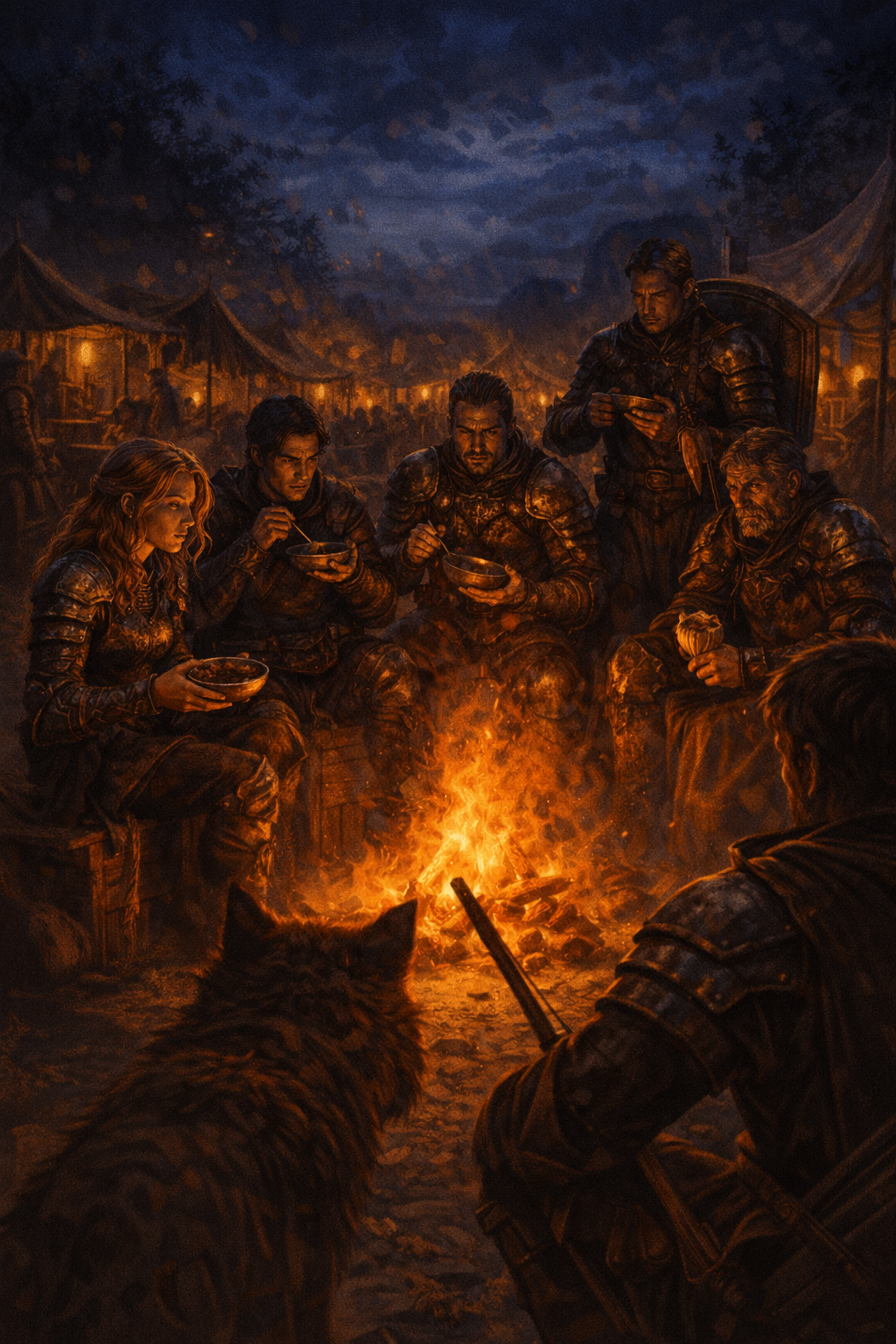
That night the camp shifted from testing ground to celebration. Fires burned in circles. Meat roasted. Bread passed hand to hand. People who had been strangers at noon were trading stories by moonrise. Not everyone drank; many did. Madison ate until her body stopped shaking and then lay on her cloak under open sky, Sword of Fury within arm's reach.
Laughter rose and fell like surf. She listened without joining, too tired to perform joy, too grateful to resent it. When her eyelids finally dragged shut, the last thing she heard was a distant forge-hammer—someone still working, even now—and she let the rhythm lull her down.
She slept hard.
ZELO
Solundria at midnight wore its beauty like armor—silver spires, water channels cut in perfect lines, gardens drinking light from rune-lamps. Zelo stood in the guild annex map room with a wax stylus and a headache that had nothing to do with ink.
He had been sober for four months, two weeks, and—he glanced at the narrow window above the map table—approximately six hours. He still counted. The druid who had once memorized root systems and ley convergence with a discipline his teachers had called rare now used the same exactness to count the hours between himself and the last cup of anything that blurred the edges. Four months and two weeks. It was not a long time. But it was longer than nothing.
The headache came from attention. He had nothing but attention, these days.
It had not always been so. He had been born to a house with coin enough to buy a calling—his parents had wanted a druid in the family the way other houses wanted a soldier or a magistrate, and they had paid for true instruction, the deep kind: circles, ley-work, the long patient grammar of growing things. He had been good. Better than good. Then the orcs came down through the border valleys in the last years of the Race Wars, and the country his mother and father rode out to hold did not give them back. The fortune they left him turned out to be exactly the right size to drown in. It had taken him the better part of three years to reach the bottom of it.
A rider had come in from the eastern trade knot at dusk—young courier, muddy from the Varlin pass, with gossip dressed as facts tucked inside official route reports. Hegal's recruitment had stripped three escort teams from the eastern contracts. Rotations wobbled. Two private freight agreements had lapsed because the guild preferred recruits over coin this month. And a sealed crate bound for Dron had been refused at a dwarf checkpoint outside Stoneheart for "irregular seals."
The rider had said it like it was a bureaucratic complaint.
Zelo had written it down like it was something else.
He traced the route with his stylus: Pyrathis — coastal shipping knot — Dron approach — Stoneheart checkpoint. The line bent and trembled under his hand. He thought of what he had seen six hours ago, before dinner — before the meal he had eaten and kept down and been unremarkably grateful for — and he set the stylus flat against the table.
The Solundria underworks ran four levels below the canal streets: old infrastructure from before the rune-lamp era, drainage channels and access corridors and vaulted transfer rooms where freight moved without street traffic. Guild annexes used them for discretion. Everyone who worked logistics used them for discretion. Some organizations used them for something less clean than discretion.
Zelo had been cutting through the third-level corridor at midday when he saw the courier. Ordinary satchel, ordinary pace — except for the patch stitched to the satchel's exterior flap. Small. The color of old bone. A skull pressed into the fabric with the kind of care that was not ornament.
He knew that seal.
Five years ago, before the drinking had swallowed his last organized thought, he had spent a season in the workshop of a hedge druid named Hosta who kept a library of prohibited rune-marks — the kind that moved through markets where nobody checked licenses. Hosta's library contained eleven seal families. The skull seal was the only one Hosta refused to discuss beyond a single fact: it was not banned by the empire because the empire had not yet decided to acknowledge it existed.
They traffic in death-runes, Hosta had said once, and then changed the subject permanently.
Zelo had followed the courier at enough distance to see which transfer room he entered, waited, noted the two men who left the same room twelve minutes later by a different route, and then walked back up to the street and eaten a bowl of salted lentils and thought about whether to say anything to anyone.
He was not a guild member. He was a street-contract scout under Raida's company — Party Nine — which meant he was a name on a shortlist and not much else. The kind of information that moved through Solundria's underworks was not his problem to solve.
He had gone to dinner. He had come to the map room. He had spent four hours watching route lines before he admitted that the headache was not from the maps.
The lamp guttered.
Zelo tucked the route notes under his arm and went to find Raida.
She was where she always was after midnight: the small room off the annex kitchen, two chairs and a low table, the remains of a meal she had not finished, a reading lamp burning too bright. She was not reading. She was sitting with her arms crossed, staring at the wall with the expression of someone doing arithmetic that did not come out clean.
She did not turn her head when he sat down across from her.
"You look like a man carrying information he doesn't know what to do with," she said.
"Yes."
"Does it cost me anything?"
"I want food."
Raida looked at him then. Not surprised — she had never, in the three months he had been under her company, looked surprised by anything — but present. Weighing. She was a compact woman with close-cropped hair going silver at one temple and a scar across the back of her right hand she never explained. She had recruited him off a canal-side wall in Varlin's south district, where he had been sitting in the damp with two copper coins—all that was left of a dead family's fortune—and the whole ruined year behind him, and she had not asked about the drinking. She had said: you have a druid's eye for pattern and you're sober today. Come do something with that.
He had not gone back for the coins.
He laid out what he had seen in the underworks: the courier, the satchel, the skull-seal patch. The room number. The two men, their build and direction. Then he put the route notes flat on the table and told her about the Dron-bound crate refused at Stoneheart for irregular seals.
Raida listened. She did not write anything down. She did not ask him to repeat himself.
When he finished, she stood, went to the kitchen, and came back with half a flat loaf and a bowl of cold roast meat and the heel of a hard cheese.
"Eat," she said, sitting back down. "I'll send the route note east in the morning. Don't mention the underworks courier to anyone in the annex."
"Because?"
"Because I don't know yet what I'm looking at and I don't want it muddied." She watched him eat for a moment. "You have the druid's pattern sense. You know what it means when something moves along the same lines in two different cities without anyone coordinating it out loud?"
"It means someone coordinated it quietly."
"Right." She picked up the route note and read it again. "Hegal's going to need people who can read that kind of pressure. Not just sword arms." She set the note back down. "If you get through the season without falling off, I'm going to give your name to someone."
Zelo tore off a piece of bread. "Give it to who?"
She only shook her head once — the motion that meant filed, not discussed.
He ate. The bread was yesterday's but it was real and he tasted it and it stayed down. Above them, Solundria turned in its silver-and-water beauty, beautiful the way armor is beautiful — surfaces bright, joints hidden, weight designed for someone else's war.
He thought of Tyba in Haze, probably passed out in a recruit camp. Of the Jul girl — loud, stubborn, sword too heavy for her center of gravity — stepping into the same machine that ate schedules and spat casualties.
He thought of skull seals moving through dwarf checkpoints and transfer rooms.
He went back to the map room. He made a note in the margin: Pressure rising — not bandits. Politics.
Then he blew out the lamp and went to wake his party. If the roads were lying, maps had to move before blood did.
ELOISE — PYRATHIS SANDS
The desert did not care about oaths.
Wind came first—dry and sharp, tasting of stone ground to powder—and then the sand followed, a living wall that swallowed sound and color until the world became a single furious thing. Five camels moved through it with their heads low and eyes filmed, ropes creaking as they dragged sleds behind them. The sled runners hissed over dunes. Men in wrapped cloth and leather leaned into the pull with shoulders bowed, hands numb on the lines.
They were not merchants. Their posture was too disciplined, their weapons too maintained. Soldiers tasked with a job no one wanted spoken aloud.
On each sled sat a crate bound in iron hoops. The wood looked wrong—as if it had been left in seawater for months. Hairline cracks spidered across the boards, and in those cracks something dark had seeped. Not tar. Not pitch. A stain that seemed to drink the lamplight and leave the grain brittle and grey. The closer you stood, the more your teeth wanted to grit.
One man glanced back at the nearest crate, then quickly away, as if the act of looking counted as a sin.
The sandstorm thinned for a heartbeat.
Three figures stood where nothing should have stood at all.
They were hooded, their cloaks deep red edged in dull gold that caught what little light survived the storm. The air around them shimmered—not from heat, but from a pressure that made the skin prickle. The soldiers saw them at the same time the camels did.
One camel screamed.
The middle figure lifted a hand.
A wave of fire rolled out, low and wide, a flat sheet that did not flicker like a torch but flowed like a tide. It hit the first line of soldiers and turned cloth to ash before the scream finished leaving their throats. It hit the camels and dropped them mid-step, the animals collapsing in smoking heaps that dragged the sleds sideways. Sand hissed into the sudden heat and became glassy clumps underfoot.
The storm tried to swallow the scene again.
The middle mage spoke a single syllable and the sand peeled away from them, forced outward as if pushed by an invisible dome. A pocket of stillness formed—quiet air, clear sight—while beyond it the desert raged on, blind and roaring.
In the calm, faces became possible.
The older woman’s hair was a red that had begun to lose its war to time, strands of grey woven through it like frost in dried grass. Her eyes were hard, the color of old amber. Queen Eloise of Varlin wore no crown in the storm; she did not need one. Beside her stood a younger redhead, leaner, with a sharper jaw and impatience in her posture, as if every second spent here was a risk she could taste. Lyrra, court mage and keeper of the queen’s private records, kept one hand near the rune satchel at her hip.
The third figure remained half in the storm, a shadow at the edge of the bubble, watching the emptiness for threats that might move inside the sand.
The older woman stepped to the nearest crate and placed her palm against the rotting wood.
The wood sagged as if relieved to be touched.
“Open it,” she said.
The younger woman drew a knife and cut the straps. The lid came free with a sound like bone snapping.
Inside, runes lay stacked in felt-lined trays.
They were not the warm reds of flame or the clean blues of utility. These were darker than the night the storm had eaten. Each rune had a skull shape worked into the stone, not carved like an artist’s flourish but impressed like a seal—simple, brutal, undeniable. The air above them felt colder. Wronger. As if the world itself was trying not to acknowledge their existence.
The younger woman exhaled and her breath fogged in the desert heat.
The older woman did not touch them. She only looked, and her expression tightened with something that might have been satisfaction—or fear.
“So the tales are true,” Eloise murmured.
She was not looking at Lyrra when she said it. She was looking at the skull pressed into the stone like a signature — simple, undeniable, patient. The expression on her face was not the shock of discovery. It was the expression of a woman watching an old wound finally show its shape.
“Who is moving them?” Lyrra asked. “Who has the reach for this?”
“Someone who has been willing to wait,” Eloise said. “Someone who expects a kingdom to hollow from the inside before they need to touch the walls.”
Lyrra kept her voice low. “Maximo warned you before Southport. He said the supply ledgers were lying.”
“He did.”
Eloise straightened, but she did not move away from the crate. The desert pressed at the edge of their stillness — sand and wind and two years of unanswered questions — and she stood with her back to all of it.
“He found the discrepancies four months before the battle,” she said. “Military-grade components logged through civilian freight accounts. Quantities with no corresponding contract on any record he could access above or below the official chain. He brought me the ledger pages in person. He would not trust them to a courier.” A breath. “Two weeks after he showed me those pages, he received orders assigning him to Southport. Personally. Signed by a general senior enough that refusal would have been read as insubordination.”
The storm outside the bubble roared on, indifferent. Lyrra did not speak.
“He came to me before he sailed,” Eloise said. Her voice did not waver. She had carried this for two years and she had learned the shape of it. “He said: if anything happens to me there, don’t look at who killed me. Look at who moves the logistics afterward. Look at what disappears from the chain.” She looked down at the skull seal. “Then a red drake appeared at the only port in a generation where a man like Maximo would be required to spend himself.”
Silence held inside the stillness. The bubble of calm air was the only quiet thing in the desert.
“He didn’t die because he was a hero in the wrong place,” Lyrra said. Not a question. She had helped Eloise carry this. But saying it aloud above physical proof was different from knowing it in a private room.
“He died because he read a ledger page that someone needed unread.”
Lyrra looked down at the crates. When she raised her eyes, something in them had shifted — from aide calculating risk to something older and quieter.
“These are the same supply chain,” she said.
“Same seal family. Same freight architecture: Pyrathis origin, coastal redistribution, Dron-adjacent handoff, then dispersal to whoever is paying for outcomes.” Eloise laid her palm flat against the rotting wood — not quite a gesture of grief, not quite of purpose, something between the two that she allowed herself because no one else was watching. “Two years later. Larger volume, more buyers, deeper reach. But the same mark. Because the mark is the contract. And the contract has not changed.”
She lifted her hand.
“We carry this ourselves,” she said. “No dispatch riders. No imperial courier chains. Nothing set down in a room I cannot seal from both ends.” She turned to face Lyrra directly. “If someone inside the imperial structure is protecting this network, they have been doing it for at least two years. I will not trust a channel I cannot see end to end.”
Lyrra’s jaw set. “Who else knows you’re here?”
“Everyone who is standing in this storm.” Eloise turned toward the wall of churning sand. “Maximo trusted a chain that had already been compromised. I will not repeat his mistake and call it grief.”
Lyrra’s gaze moved across the dead soldiers, the camels dark and still against the sand, the empty desert that would leave no record of any of this.
“And we leave no trail,” she said.
A nod. Final as a dropped blade.
They spoke words that were swallowed by the storm, and the air shivered. Their bodies blurred, then thinned, then were simply… not. Even the pocket of stillness seemed to forget the shape of them.
The bubble collapsed.
Sand rushed back in. Heat and grit and noise returned as if nothing had happened, as if the desert had dreamed the fire and the skull-marked stones.
Only the crates remained, half-buried, rotting in silence—waiting for the next hands bold enough to claim them.
The wind kept tearing at the dunes, indifferent. Somewhere to the north, a bird called once and thought better of it.