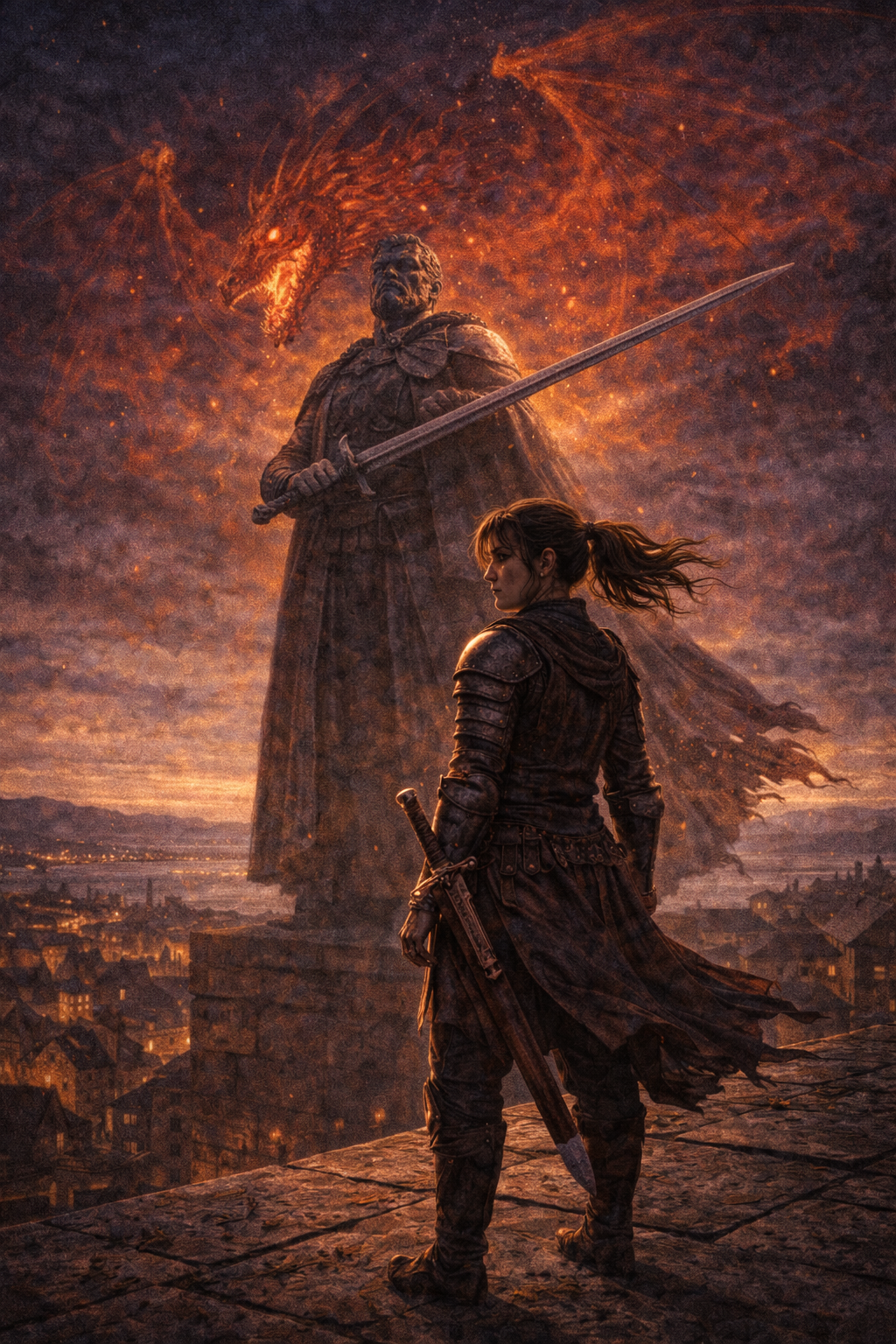
HARLAN
Harlan wiped the sweat from his brow. The heat pressed down on Southport like a blacksmith's forge—unnatural for this time of year, when the sea breeze should have carried the chill of the gulf. He stood in his fields, the earth soft under his boots, the scent of turned soil and salt in the air. His cattle grazed lazily, tails flicking at flies. In the distance, the town drowsed in the afternoon: fishermen mending nets on the quay, merchants calling prices from shaded stalls, children chasing gulls across the cobblestones. The empire's banner hung limp over the gate. A good day. An ordinary day. The Race Wars had ended barely a year ago; peace still felt new, fragile, like a scab over a wound.
"Probably just a strange season," Harlan said to Old Man Corwin as the blacksmith's cart passed, wheels creaking. "The weather's been odd since the wars ended."
Corwin grunted something back. The cart rolled on. Harlan leaned on his pitchfork and squinted at the sky. Something was wrong. The air shimmered. The cattle stirred—heads lifted, ears twitching, a low unease running through them. Harlan followed their gaze.
His blood ran cold.
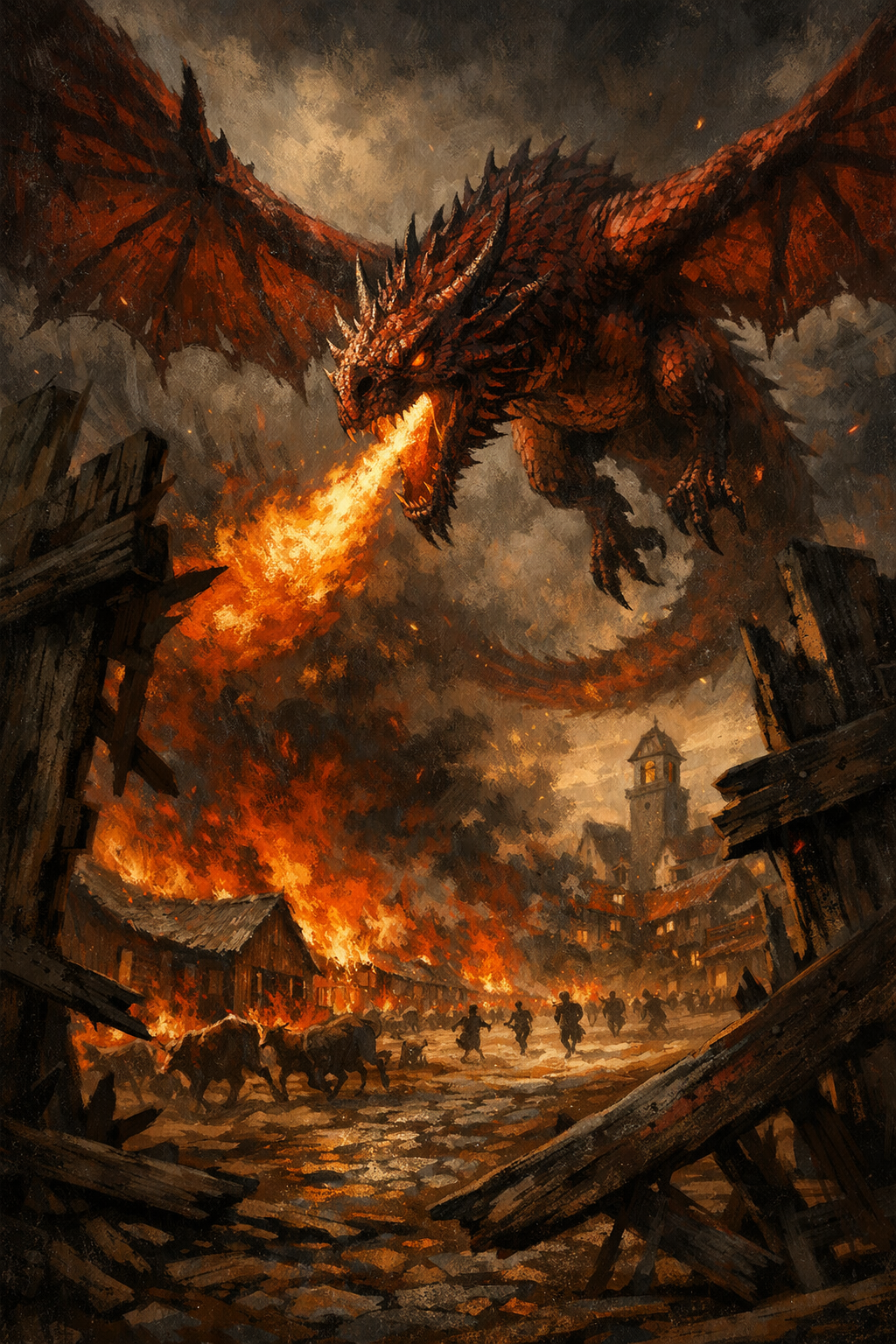
A red blur streaked the horizon. It grew. Unfolded. Wings like sails of bloodied leather, scales gleaming like heated iron, eyes burning with a hunger that twisted his stomach. A dragon. The word lodged in his throat like a bone. Sailors spoke of such creatures from Draconia, that cursed isle far south, but they were myths. Stories for children. He stood there, pitchfork in his hand, for one impossible heartbeat. Then it dove. Its roar shattered the air like cracking stone.
Harlan dropped the pitchfork and ran. Behind him, flames burst from the beast's maw—a river of fire that swept the field. The cattle bellowed, hides blistering, flesh charring in an instant; the stench of burned hair and meat hit him like a fist. Barns ignited, timbers cracking. He did not look back. He ran for the town, for the gates, for Mira and the boys—where were they? From the streets, screams rose. Women, children, men shouting names. The bell tolled, deep and urgent, each peal a plea. He ran until his lungs burned, boots pounding the dirt, the dragon's shadow passing over him again and again as it circled, hunting. The ground shook. The air tasted of cinders.
At the gates, the captain of the Southport guard stood on the wall, voice raw from shouting. He was calling the militia. Men and women were already gathering—guards in worn mail, fishermen still reeking of the morning catch, a handful of merchants and smiths with whatever they had grabbed. Blades. Spears. Whatever would bite. They formed up in the shadow of the gatehouse, faces pale, hands white on their grips. Harlan pushed through the crowd, searching for his family. The captain's words carried over the din: hold the line, draw the beast's eye, buy time for the rest to run—to the cellars, to the woods, to the boats. Every heartbeat they stood was a heartbeat more for mothers and children and the old. The militia nodded. They did not break. Above them, the dragon wheeled. Tail lashing. Then it came down.
It raked the streets with fire. It crushed the gate with a sweep of its tail—timbers exploding into splinters, the front rank swallowed in flame and rubble. The militia held until they could not. Casualties mounted. The cobblestones ran with ash. The air tasted of burned meat and grief. The town was being swallowed.
Then, from the north—dust, and the glint of steel. Horns. The thunder of hooves and marching feet.
Maximo came.
His battalion had been tracking the dragon; they arrived just in time. From the north they came—warriors in formation, dwarf engineers rolling ballistas off their wagons, sorcerers with runes already blazing at their fingertips. They had hunted it for days. They knew what they faced: a red. The rarest and most dangerous of the great drakes, fire made flesh, scales harder than tempered steel, cunning enough to have razed Southport and left the empire's southern flank exposed. The ballistas loosed. Iron bolts the length of a man punched into the beast's flank—and stuck, drawing a roar that split the sky. Runes flared, searing the red hide, and the dragon turned on them.
It was not a beast to be pinned easily. It tore one harpoon free in a spray of blood and crushed a ballista with its tail; warriors who had closed in were swallowed in a wash of flame, shields melting, screams cut short. The sorcerers threw everything they had—volley after volley—and the dragon answered with fire that turned the air to an oven, that left the earth glassy and black. More men fell. The beast was bleeding, harpoons still in its side and leg, but it was not done. It lunged, wings beating, and the lines buckled. For a heartbeat it seemed it would take to the sky again and burn them all from above.
Maximo waded in.
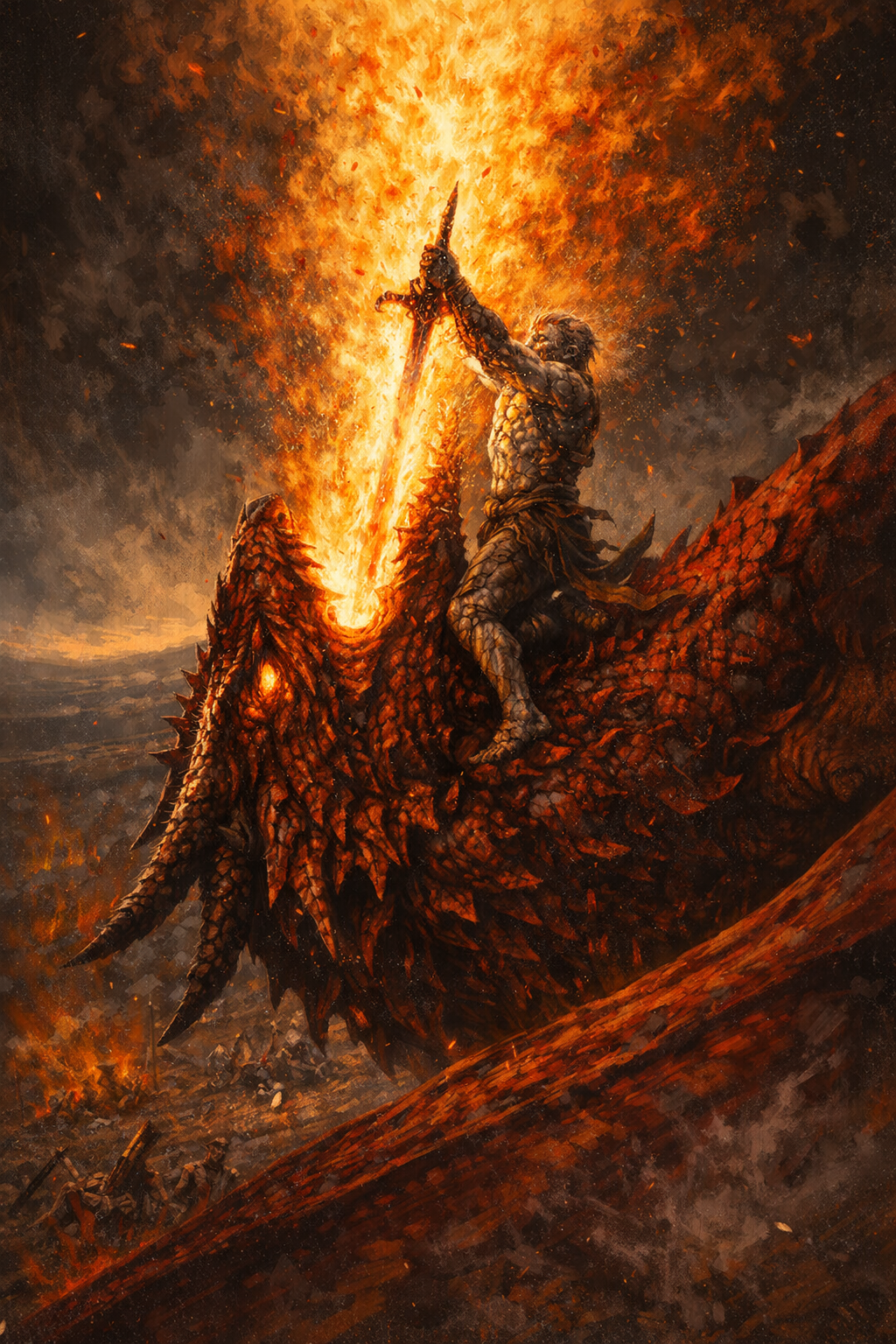
No order. No hesitation. He had the Sword of Fury in his hands, the blade singing—or screaming—as he ran. He did not wait for the dragon to tire. He did not wait for another volley. He went straight into the fire and the thrashing, past the dead and the dying. The heat was unbearable. The beast's scales threw back the light. When its head came down to bite he was already on its neck. The scales there were like plate; his first strike sparked and skidded. The dragon writhed, trying to throw him, to crush him against the ground, to roast him in a breath. He held on. He found the gap where the jaw met the throat and drove the steel in. Once. Again. The dragon's roar became a gurgle. Its flame turned inward, building—not to breathe at the army, but at him. At the man on its neck who had killed it. Maximo saw it coming. He did not let go. He drove the blade in one last time, to the hilt, and the red dragon's final breath erupted—a blast of scorching flame that enveloped him, that turned his flesh to stone in an instant. When the fire cleared he was still astride the beast, a statue of triumph and torment. The dragon lay dead beneath him. The sword, clutched in his petrified grip, fell silent at last. The field was quiet. Only the crackle of cooling embers, and the sound of men who had no words.
Fifteen years passed. The statue was brought to Jul, to the central square. Salt wind and rain weathered it; the stone face stayed fixed on the horizon, the sword still gripped in petrified hands. Fishermen passed it on their way to the docks. Children grew up in its shadow. The story was told and retold—around campfires, in taverns, by old warriors to the young—until it became legend.
MADISON
It was all in her head.
Madison blinked. The dragon's roar faded into the clang of steel. The smell of smoke and blood became salt air and the grit of the training yard. She was in Jul, behind the harbormaster's storehouse—packed dirt under her knees, the smell of tar and rope from the docks, gulls crying overhead. The light was late afternoon, long shadows across the yard. Captain Thorne had been drilling her with dull blades for an hour, maybe more. The tales had pulled her under again. She'd been swinging at him as if he were the beast itself.
And she had almost hurt him.
The exchange had started simple. Advance, parry, step back. Then the rhythm had changed. She drove him back—a flurry of blows, dull edges ringing, her wrists burning—until his shoulders hit the storehouse wall. He tried to roll clear; she came in low, her blade taking his legs. He went down hard. She went down with him, one knee in the dirt, the point of her practice sword driving for his throat. At the last instant he raised his guard. The parry was late. The impact shuddered up her arm; the dull edge stopped a hand's breadth from his neck. Only then did the vision crack. Southport and the dragon bled away. She saw his face—grey, strained, the scar on his cheek standing out white. The taste of her own breath, sharp in her mouth. The dirt under her knee. A sharp blade would have opened him.
"Madison." His voice was rough, careful. "Let go."
She dropped the sword and stumbled back. "Captain—I'm sorry. I didn't—I was somewhere else."
"I noticed." Thorne sat up slowly, rubbing his wrist. He was in his sixties, grizzled, shoulders rounded now where they had once been broad. He got to his feet with a grunt, picked up her practice blade, and handed it back. There was something like a chuckle in his throat—not quite amusement, not quite breathlessness. "Go easy on me. When I was in the Royal Army I was fast. I was strong. Age took its toll. If you put your mind to it, you'll have me on my back every time—and one of these days you might not come back to your senses before the edge goes in."
Madison sheathed the dull sword, her hand unsteady. "I didn't mean to. The story—I was seeing it. Southport. The dragon. Him."
"I know." Thorne walked to the water bucket at the edge of the yard, dipped a ladle, drank. He offered her the ladle. She took it. The water was warm from the sun but it washed the dust from her throat. "I was there with the battalion. I saw the ballistas and the runes. I saw him go in. I saw what was left when the flame went out." He set the ladle down. "So I train you. So you learn to carry that sword without losing yourself in the stories. Understood?"
"Understood."
She glanced at the sky. The light was going; the first stars would show soon. "It's so late. I need to run home—Mom'll be waiting for dinner. It's getting dark."
"Yeah, yeah. Don't worry." Thorne nodded toward the gear. "I'll clean up. See you tomorrow for training."
"Thank you."
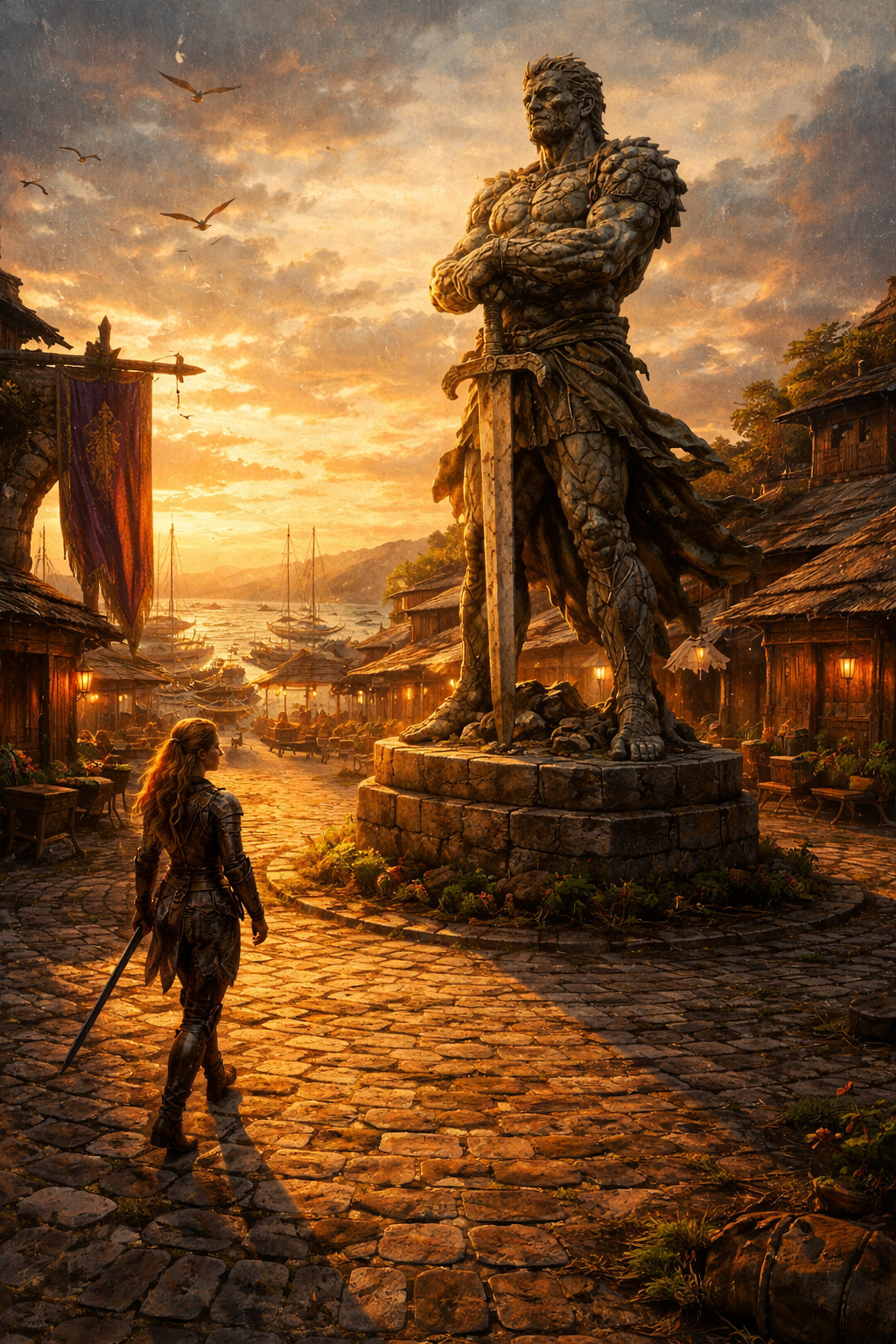
She left him in the yard and took the familiar path through the center of town. The alleys were narrow, the stones uneven under her boots. She passed a baker closing his shutters, the smell of yesterday's bread still lingering; a woman sweeping her step. The square opened ahead—cobblestones, the smell of fish and wood smoke, the statue of her father in the middle, stone eyes fixed on the horizon. She always passed this way. Always looked. The statue's shadow stretched long in the dusk. She was almost past it when a voice cut through the air.
"Madison! Madison!"
She turned. Puli was striding toward her, dark hair whipping in the wind, one hand raised. In the other he held a folded sheet—a poster, torn from one of the boards that lined the square. "Have you seen this? I took it from the board by the well."
"What are you talking about? I'm late for dinner. Mom's going to be angry."
"Wait, wait—just a minute." He thrust the poster at her. "Take it. Read it."
She took it, frowning. The paper was cheap, already soft at the folds. The light was fading; she had to tilt the sheet toward the last of the sun. Hegal's Guild. Coming to Haze. Recruitment. Her breath caught. "Hegal's Guild? They're coming to Haze?"
"Looking for recruits. That's what it says."
She skimmed the rest—dates, place, requirements—and folded the poster again, her mind already racing. "I'll take a look. Talk to you later." She didn't wait for his answer. She walked home with the poster in her hand, the words burning in her head. The streets grew quieter as she left the square. At the door of her house she paused, the paper warm in her grip, and then she went in.
The house smelled of bread and stew. Low ceiling, warm from the hearth; the table was set with three bowls, a loaf on a board, a crock of butter. Elane was at the table, setting out spoons; Xot, Madison's brother, was already in his seat, waiting. He looked up as she came in. "Where were you? We're about to eat."
Madison closed the door and held up the poster. "Mom. Hegal's Guild is coming to Haze. They're holding recruitment trials. I'm thinking of going. I want to join."
Elane's hands stilled. The spoon in her grip caught the firelight. She had lost Maximo to the empire's wars—to duty, to a dragon's breath. The idea of Madison leaving Jul, of her daughter walking the same path, had always sat like a stone in her chest. But she had also watched Madison train. Had seen the way she looked at the statue in the square. Her biggest dream was to follow her father's legacy, to earn a place in the Royal Army. Hegal's Guild was a stepping stone—a guild that took requests from across the Baltia Empire, paid handsomely for hunts and difficult tasks, and opened doors for those who proved themselves. Elane set the spoon down. "When?"
"Tomorrow afternoon." Madison's voice was bright, almost shaking with it. "The trials are tomorrow afternoon. I'm going to do this. I've got to show what I can do. This is the chance."
Elane was quiet. Tomorrow. She had thought—weeks, maybe. Time to prepare. Time to talk. "Tomorrow," she said. She tried to keep her voice even. "That's—Madison, that's so soon. Maybe you should wait. This feels rushed. You only just heard, and now you're leaving in the morning?"
"Are you crazy?" Madison's eyes flashed. "Mom, Hegal's Guild never comes to Haze. They're always in Varlin or traveling up north. How am I supposed to get there on my own? This is the best chance I'll have. The best opportunity to apply and see if I can join. I'm not waiting."
Xot watched them both, saying nothing. His plate was empty; he had not yet taken bread. Elane looked at her daughter—the set of her jaw, the gold hair tied back, the same determination she had seen in Maximo. She wanted to say more. To ask for a week, a few days. The words did not come. She drew a breath. "Then we eat. We'll talk more after."
They ate. The stew was warm, thick with vegetables and shreds of fish; the bread was fresh, the crust crackling under their fingers. Madison kept the poster beside her plate, glancing at it as if it might vanish. No one spoke for a long moment. The fire crackled. Outside, the last of the light faded. Elane felt the worry and the pride tangled together, and did not untangle them aloud.
Later, in her room, Madison lit the lamp and spread the poster on the bed. The flame threw shadows on the walls. She read it again. Tomorrow afternoon. The trials were tomorrow afternoon. Her stomach dropped. I'm not ready. I don't have supplies.
She stood and started pulling out what she had. Support healing runes from the last time she'd stocked up—she laid them in a row on the desk, the symbols catching the light. Mana fluids and life fluids, a handful of vials that gleamed when she moved them. Her sword, the one she trained with; her plate armor in the corner, dull in the shadows. She lifted the breastplate. It was heavier than she remembered. She took a rag and began to polish it—the slow, familiar motion, the smell of oil and metal. The work steadying her. Pack. Prepare. She had one night. She could make it.
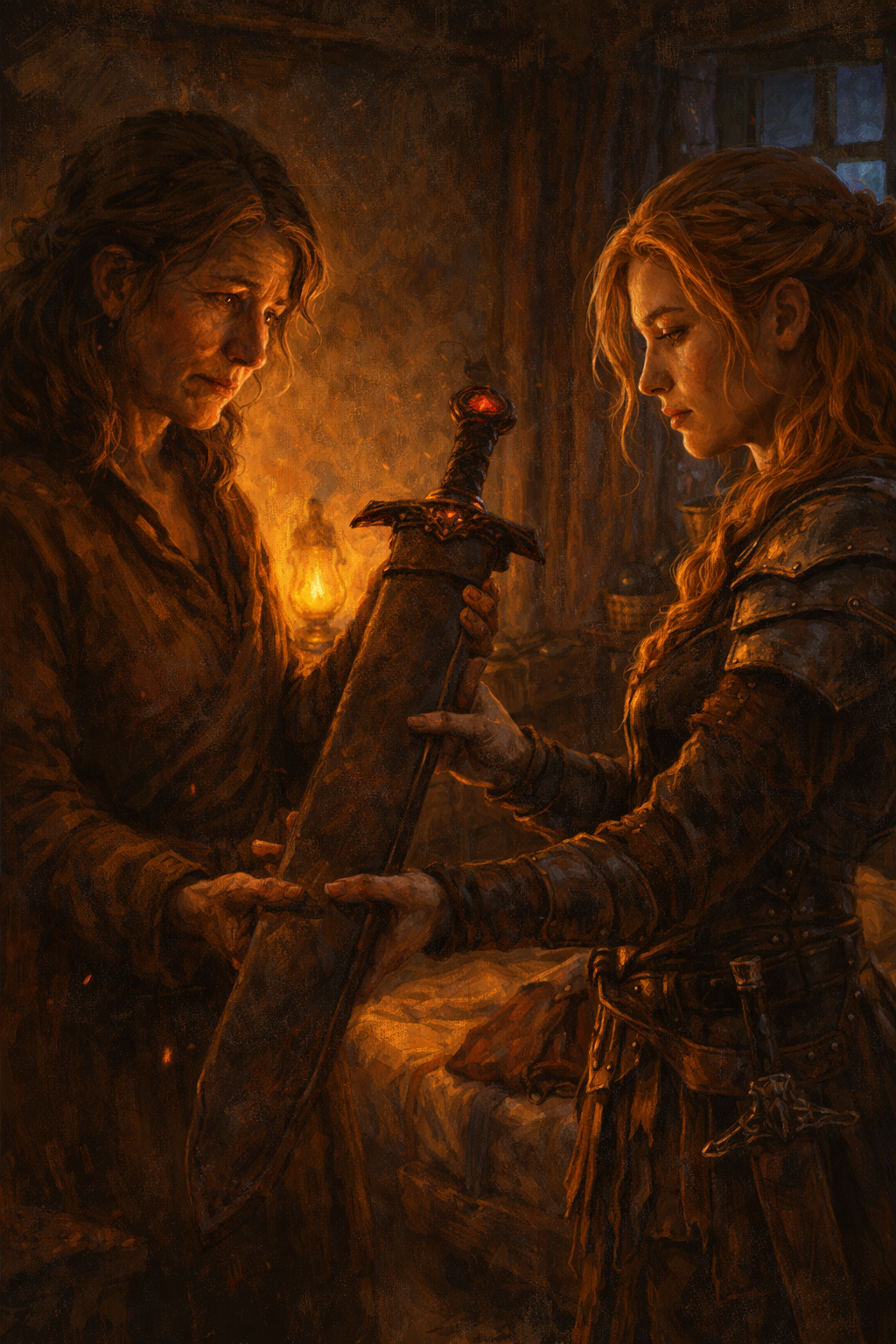
A knock at the door. Her mother stepped in, a silhouette against the corridor's dimness. In her hands she carried the Sword of Fury—Maximo's blade, the one that had hung on the wall in the main room since the statue had come to Jul. The scabbard was dark, worn at the edges. Elane took in the runes on the desk, the fluids, the armor, the half-packed bag on the bed. Her face did something complicated—pride, fear, resolve. She held out the sword. "Your father always said this sword took care of him. I would feel better if it accompanies you."
Madison set down the rag. She took the Sword of Fury. The weight was familiar from the few times she had been allowed to hold it; the leather of the grip was warm from her mother's hands. "Thank you."
"You're really going."
"Yes."
"Then go well." Elane did not say come back. She did not have to. She crossed the room and touched Madison's shoulder, once. Then she left, closing the door softly.
Xot appeared in the doorway a moment later, leaning against the frame. The lamp lit one side of his face. "So you're off to get yourself killed."
"I'm going to try out for Hegal's Guild. There's a difference."
"Same family, same risk." But his voice wasn't cruel. "Just don't end up a statue, Maddie."
She threw the rag at him. He ducked, grinning, and left her to her packing.
The next morning the air was cool, the sky pale. Madison stood in the doorway in her plate armor, pack on her back, the Sword of Fury at her side. Elane was there. She looked at her daughter and her face crumpled. She pulled Madison into a hug and held on—really held on—and Madison felt her mother's shoulders shake. Elane was crying. She had not cried at the table. She was crying now. "Come back to us," she said into Madison's hair. "You come back."
"I will. I promise."
Elane let go slowly. She wiped her eyes with the back of her hand, then cupped Madison's face. "Go well. Write if you can."
"I will."
Xot had come out behind his mother. He stood there a moment, then stepped in and hugged Madison too—quick, rough, the way brothers do. "Don't do anything stupid."
"You're one to talk." Her voice was thick. She punched his shoulder. He grinned, but his eyes were red. "Just come back, Maddie."
"Yeah." She had to clear her throat. "I will."
Then she turned and walked toward the square. She did not look back. If she looked back, she might not leave.
Tyba and Puli were already there when she arrived. The statue of her father watched over the cobblestones; the first fishermen were already heading for the docks, and the smell of smoke from morning fires hung in the air. Both of them had seen the poster. Both had the same fever in their eyes.
"I already talked with my mother," Madison said. "I'm definitely going."
"We're going too," Puli said. Tyba nodded. "We should grab some equipment today and rush for Haze at midday. Trials are in the afternoon—we've got a tight window."
"How do we get there?" Tyba asked. "Horses? Walk?"
Madison had already thought it through. "If we walk we're not making it. It's twelve hours on foot. We'd miss the trials." She paused. "Captain Thorne has ships. He can sail us. Three, four hours to Haze—we'll make it with time to spare."
Puli and Tyba exchanged a look. "You think he'll do it?"
"I'll ask. You two get supplies—runes, fluids, whatever you need. Puli, Tyba—arrows. You're archers; make sure you're set." She was already moving. "I'll find the captain. We'll meet back here once we're packed. Then we sail."
She found Captain Thorne at the docks. The cutter was small but trim, ropes coiled neat on the deck. He was checking the rigging, his hands running along a line. He looked up—and did a double take. She was in full armor. And at her side, the Sword of Fury. He had seen that blade before. He had seen it on Maximo. For a moment he said nothing. Then a slow grin spread across his face. "These are not training hours. Why are you in full armor? Perhaps you're here to kill an old man."
She almost laughed. "I'm not here for training." She told him everything Hegal's Guild, Haze, the trials in the afternoon, the need to get there in time. He listened, his weathered face giving nothing away. When she finished he was quiet a moment. The gulls cried overhead. Somewhere a crate thudded onto a pier.
"All right," he said. "I'll have to put off a few things I had today. But yeah—for sure I can take you. Gather the others. Get your gear. Come back when you're ready and we'll sail."
"Thank you. I'll gather them."
The morning went in a blur—the apothecary for a few more runes and fluids, the market for food, everything stuffed into packs. Madison, Puli, and Tyba met again at the docks, breathless and laden. Captain Thorne was already aboard, the crew making ready. "Get on," he said. "We're casting off."
They boarded. The deck shifted under their feet; the ropes creaked. The sails caught the wind. Jul shrank behind them—the harbor, the roofs, the square where the statue stood, a small shape against the sky. Madison stood at the rail, the Sword of Fury at her side, and watched the island disappear. The coast of the mainland was a pale line ahead. The trip would take three, four hours. Puli and Tyba found a spot by the mast, checking their quivers and talking in low voices. The sea was calm, a deep blue-green; the cutter cut through the water with a steady rhythm. Salt spray touched her face. The sun climbed.
After a while Captain Thorne left the helm to his mate and came to stand beside Madison. He did not speak at first. The wind pulled at his grey hair; his hands rested on the rail. Madison waited. The water slapped the hull. Then he said, "Let me tell you a story. Not the dragon—you've heard that one. This one's from the Race Wars. When your father and the army went after Sante."
Madison turned. "The dark elf."
"Sante. The Shadow Weaver. He ruled from Shadowthorne Keep—an elven stronghold, but twisted. They said he and his kind were preparing dark magic there. Rituals. Things that would have turned the war. The emperor sent Maximo and a handpicked force to take the keep and end it." Thorne's voice was rough, distant, as if he were seeing it again. "I was there. We fought through the gates, through the corridors. The place was full of that magic—you could feel it in the air, like oil on your skin. Sante had his pendant, a gem the size of a fist. Dark power in it. Your father went straight for him. Sword of Fury against whatever Sante was weaving. Maximo cut through it. Pierced his chest. Destroyed the pendant. The gem cracked—and they said the magic inside bled into the blade. I don't know if that's true. But after that day the sword was different. Your father never spoke of it much." He was quiet a moment. "So when you carry it—you're carrying that too. Not just the dragon. The dark elf. Whatever got into the steel."
Madison's hand had found the hilt at her side. She didn't remember moving it. The leather was warm from the sun. "Did he ever say what it felt like?"
"Like it was hungry," Thorne said. "That's all he said. Then he changed the subject." He nodded toward the bow. "We're close. You'll see Haze soon."
Haze rose from the coast in layers of white. At first it was a blur—then the details sharpened. Tall buildings, towers, apartments, walls of pale stone that caught the sun and gleamed. The port was the largest in the empire: the capital of the humans, the heart of trade and power. As the cutter approached, the scale of it opened before them. Dozens of ships at anchor or tied to the docks, masts like a forest. Merchants unloading cargo—barrels of beer and wine, crates that might hold jewels or armory, weapons in oiled wraps, bales of cloth, fish in baskets, food in sacks. The air smelled of salt, tar, and a hundred different goods. Rich men and women stepped from polished vessels onto the quay; laborers heaved and shouted. And everywhere, the Royal Army: warriors in the emperor's colors, patrols along the waterfront, guards at the main landings. The empire's strength, on display. Madison had never seen anything like it.
Captain Thorne brought them in. The cutter slid alongside a pier; ropes were thrown, made fast. The gangplank went down. Madison, Puli, and Tyba shouldered their packs and made for the dock. The wood was solid under her boots—strange, after hours of the deck shifting. Thorne followed them to the rail. He caught Madison's eye and leaned in—closer than he had with the others. His coat smelled of salt and wind. His voice dropped. "Take care. Remember everything I taught you. Don't trust easy. In battle, always watch your flanks." He held her gaze. "You're his daughter. That makes you a target for some and a hope for others. Neither is safe. Go well."
"Thank you," she said. "For the passage. For the stories."
He nodded. She stepped onto the gangplank with Puli and Tyba. When they reached the quay and looked back, the cutter was already casting off. Thorne raised a hand. They raised theirs. Then the ship turned and began to shrink toward the horizon. The noise of the port closed around them—voices, creaking wood, the cry of gulls. Madison felt the weight of the Sword of Fury at her side. Okay, she thought. This is it.
They had hours before the trials. "What do we do?" Tyba asked. Around them the quay seethed—porters, merchants, guards. The white buildings loomed.
"Get some food," Puli said. "We might as well eat. No point standing around."
They walked. The streets of Haze were cobblestone, wide and crowded. The press of bodies was constant; they had to step aside for caravans, for men carrying crates, for a woman in a sedan chair. Street performers did magic tricks at the corners—small flames in the palm of a hand, coins that vanished and reappeared—and children darted between the stalls. They passed a massive trade station, stalls and awnings and the smell of spices and leather and something sweet, honey or dried fruit. A great bank rose on their left, columns and guarded doors, the emperor's eagle carved above the lintel. Beyond it, big houses, white-walled, with tiled roofs that caught the sun. The noise was constant—voices, footsteps, the clop of hooves. Madison had never seen so many people in one place. She kept her hand near her pack, where her coin purse lay.
They found a tavern in a side lane—a low building with a sign that creaked in the wind, a tankard painted on the wood. "Let's sit here," Puli said.
Inside it was dim and loud. The air was thick with the smell of ale and smoke and something roasting. They took a table near the back, ordered food and something to drink. When the cups came, Puli raised his, then set it down. "Actually—we're going to trials. Might as well not drink any alcohol. Stay sharp."
Tyba and Madison agreed. They ate—bread, stew, a wedge of cheese—and watched the room. Low beams crossed the ceiling; the fire in the hearth threw shadows on the walls. At a nearby table a hooded figure sat alone, hunched over his cup. The hood hid most of his face—only a sharp chin and a thin mouth visible when he spoke. He was lean, narrow-shouldered, and his hands were never still: they flicked and twisted in the air as if he were already throwing something. "I'll use my throwing stars. Impress Hegal. They'll see." His voice was a mutter, for himself or for no one.
At the next table over sat two others. Both had the look of archers—the way they carried their shoulders, the calluses on their draw hands. Bows were propped against their chairs, quivers at their feet. The first was a man in his thirties, broad in the chest, with short dark hair going grey at the temples and a scar that ran along his jaw and down his neck. His arms were thick; he had the build of someone who had drawn a heavy bow for years. The second was younger, maybe Madison's age, lanky and restless—long limbs, dark skin, hair tied back in a short tail. His fingers tapped the table. He kept glancing at the door. Puli had been listening. He leaned over. "You're also going to the Hegal's trials? For recruitment?"
The older archer nodded. "Yeah. You too?"
"We are. This is Madison, this is Tyba. My peers. We're from Jul."
"Jul. Long way." The older one extended a hand. "Nocta. This is Acav. We're here for the same thing. Think it'll be easy to get into the guild?"
"Hope so," Puli said. They traded a few more words—where they'd come from, what they'd heard about the trials. Then the food came and the conversation drifted. When they were done eating, Madison, Puli, and Tyba left the tavern. Nocta and Acav stayed behind. The sun was still high; the street was warm.
Puli glanced at the sky. "We should move. Registration won't wait."
They tightened their packs and walked.
Haze pressed around them in white stone and noise. Market cries. Horses. Wheels on cobblestone. They cut through side streets and crowded lanes, heading for the north gate where everyone said the guild recruiters were gathering candidates. Madison walked in armor that was still stiff in places from being cleaned the night before. The Sword of Fury rode heavy against her hip, each step a reminder of her father's hand once wrapped around that same grip.
At the north gate, imperial guards checked no names, asked no questions. They only pointed people through. Beyond the arch, the city sound dropped away in layers, replaced by wind and road and the clatter of gear from those marching ahead.
The road rose gradually over dry ground flecked with yellow grass. Candidates stretched in a loose stream before and behind them: robed mages murmuring to each other, broad-shouldered warriors with shields strapped to their backs, archers with feathered shafts rising from quivers like painted reeds. Everyone walked faster than they wanted to admit.
"How far?" Tyba asked.
"Not far," Puli said. "They said a few kilometers."
They crested a low rise.
The camp opened below.
Not a military camp built for war and mud and siege. This was an organized storm. Red-and-gold pennants snapped from high poles. Practice rings had been marked in chalk and stakes. Archers shot in long lanes where moving targets jerked across ropes and pulleys. Mages worked in circles burned dark into the ground, flaring runes and small controlled blasts. Warriors drilled in rotating lines while instructors barked cadence.
The place sounded like iron rain: bowstrings thrumming, steel clashing, shouted counts, hooves stamping, the occasional crack of spellfire. It smelled of sweat, leather oil, dust, and sharp arcane ozone. Madison had seen training yards before. She had never seen one like this.
"Gods," Tyba breathed.
Puli's eyes were wide in spite of himself. "If this is just the gate..."
"Then let's see the inside," Madison said, though her stomach had tightened.
They entered with the rest of the candidates. Guild personnel moved constantly through the crowd, easy to spot in red-and-gold shoulder wraps and metal insignias pinned at the collar. They directed people, settled disputes, shouted lane assignments, hauled targets back into place. The entire camp moved with practiced efficiency, like a body that had done this a hundred times.
Then the first horn sounded.
Low, long, and deep enough to vibrate in Madison's chest.
A second horn answered from the far side of camp.
"Make way!" someone shouted. "Open the road!"
The crowd split down the center, forming a corridor. Two red horses trotted through, coats dark as spilled wine, tack polished, nostrils flaring. On the first sat a man with a stern, carved face and broad shoulders under red-gold armor. His black hair was streaked with grey at the temples. He rode as if the ground itself made room for him.
Hegal.
Even those who had never seen him recognized him at once.
Behind him rode Todd, second in command, younger and leaner, with a massive shield strapped over his back and a spear lashed to his saddle. The shield was absurdly large for one man, rimmed in steel, scarred by old impacts. People whispered as they passed: Todd carried Hegal's shield by oath, by rank, by trust.
Both men dismounted near the central platform. The camp quieted in waves.
Hegal stepped up.
He did not raise his voice much; he did not need to.
"Welcome," he said. "Some of you will leave this camp as members of Hegal's Guild. Most of you will not."
No one shifted. No one coughed.
"You will be tested to your limits," he went on. "Not to impress me. To reveal yourselves. Archers, mages, druids, warriors: each discipline is tested differently. Follow my officers. Pass your trials, and you earn our colors. Fail, and you leave today." He turned slightly, glancing across the camp. "Begin."
Movement returned all at once.
"Archers! This side!" "Warriors to the north lane!" "Mages, hold your line!"
Madison looked at Puli and Tyba. They stood close for one more moment, three friends from Jul in the center of too much noise and too many strangers.
"Good luck," Puli said.
"Don't get yourself killed," Tyba added.
Madison almost smiled. "Same to you."
Then they were gone, swallowed by different streams of people.
The warrior line moved out of camp toward rougher ground where scrub grass gave way to scattered stone. They walked uphill under a hard afternoon sun. No one talked much.
At the top of a broad shelf of land, they found him.
Lanz.
Druid robes in layered greens and brown. Weathered face. Long hair tied back with leather cord. Staff tipped with carved stone and threaded with old roots that still looked alive. He regarded the line as if he had seen every variation of fear and pride already.
"I am Lanz," he said. "I test the warriors."
His tone carried no drama. No ceremony. Just fact.
"One by one," he continued. "You enter the arena. You face what I call. You pass, or you do not."
He struck his staff once.
The ground shuddered.
Stone surged upward in a ring, blocks lifting and locking together until a circular wall stood taller than two men. Another gesture raised internal partitions and entry channels. In less than a minute, a bare arena existed where empty ground had been.
"First," Lanz said.
A broad-armed man stepped forward, jaw set. He entered. The opening sealed behind him with a grinding crash.
Outside, the waiting warriors heard only confusion.
A roar. Then heavy impacts. Then a scream that cut off abruptly.
The entry opened. The man stumbled out white-faced, his left arm hanging useless. "I surrender," he gasped. "I surrender." He did not wait for instruction. He left at a run.
Next.
One after another they entered. Some emerged shaking from the surrender gate. Some did not emerge there at all. A few appeared through a far opening and were led away by guild staff with the clipped efficiency of people used to this work.
Madison waited.
Her mouth was dry.
When Lanz called her, her legs moved before she registered it.
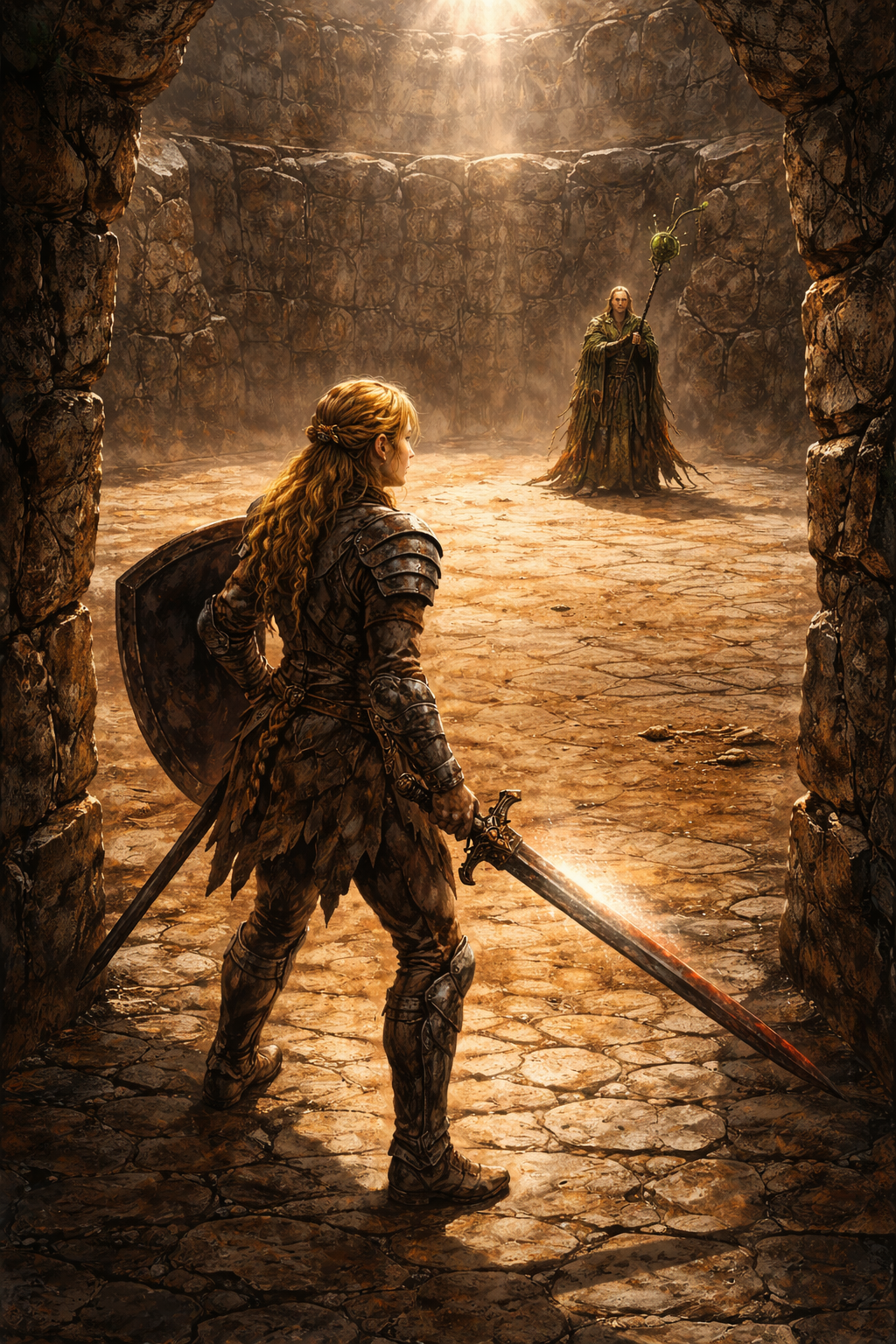
She unhooked her shield. Drew the Sword of Fury.
The steel came free with a sound that seemed too loud against the stone walls.
She stepped inside.
The entry sealed behind her.
Inside, the arena was smaller than it had looked from outside. Bare earth floor. High walls. No audience. No distraction. Just her and Lanz.
Lanz's mouth twitched at one corner.
"A woman warrior," he said. "Good. Are you ready?"
Madison swallowed once and nodded.
Lanz spread his fingers.
The air warped.
What appeared was shaped like a bear, but it was wrong in scale and proportion, as if someone had taken the idea of a bear and exaggerated every violent part. Massive shoulders. Claws too long. Jaw too wide.
It charged immediately.
Madison set her stance and caught the first impact on her shield. The force drove her back hard enough to carve furrows in the dirt. Her shoulder screamed. She pivoted before the second swipe, felt claws scrape steel inches from her face, and slashed across its flank. Dark blood sprayed hot against her forearm.
The beast wheeled faster than she expected, reared, and came down.
She stepped inside its arc and drove the Sword of Fury up beneath the jaw and into the throat. The creature convulsed, slammed against her shield, then crashed sideways in a mass of fur and blood and dust.
Silence returned in a ragged rush.
Lanz inclined his head.
"Good," he said.
He lifted his staff again.
An orc warrior formed out of stone dust and shadow: heavy armor, scarred shield, brutal axe. It did not roar. It simply attacked.
The first blow landed like a hammer on an anvil. Second blow: higher, faster. Third: low feint into a shield bash that nearly took Madison off her feet.
She could not match that strength head-on. Every block numbed her arm farther up the shoulder.
Captain Thorne's voice surfaced through the panic:
If he's bigger, don't beat his strength. Break his pattern.
She gave ground deliberately, inviting overcommitment. The orc pressed, aggressive, hammering the same side. When its front foot planted too far forward, she chopped at the knee seam. Metal buckled. It stumbled. She struck the shield arm where plate overlapped leather. Once. Twice. The orc lost the shield. She stepped inside its recovery and drove her blade through the opening under the collar.
It dissolved before it hit the dirt.
Lanz watched her with a new expression, harder to read.
"Very few defeat that one," he said.
He planted the staff.
The temperature in the arena seemed to drop, then spike.
The demon appeared in a blur of red skin, horns, and heat shimmer.
It moved impossibly fast.
Firebombs erupted from its hands, not thrown in arcs but snapped into place where she was about to be. Dirt exploded at her heels. Stone fragments hit her cheek. Smoke thickened. She could barely track it; every time she turned, it was already somewhere else, another burst flaring.
She tried to close distance and nearly died for it.
The demon feinted left, reappeared right, and dropped a fire charge at her feet. She threw herself into a roll and came up coughing, hair singed at the ends, left gauntlet blackened.
This was not a strength fight.
This was timing.
She forced herself to stop chasing.
She watched.
The demon had a tell: each time it gathered a larger flame, its right shoulder dipped half a heartbeat before release.
She waited for it.
Shoulder dip.
She ripped her shield off and hurled it like a spinning disc. It slammed into the demon's forearm. The fire charge detonated wide against the wall, showering sparks.
Madison ran through the gap.
One stride. Two. Three.
The Sword of Fury drove through the demon's chest and out its back. The creature shrieked in a sound like tearing metal, then collapsed into ash and black cinders that blew apart in the heat.
Madison stayed crouched, blade down, gasping for air that tasted of sulfur.
Lanz did not speak for a long moment.
Then he gave one short laugh, sharp with disbelief.
"Nobody beats the demon on first pass," he said. "Nobody." He pointed to the far opening. "Go. You've passed."
Her legs felt unsteady, but they carried her.
She walked through the pass gate into sunlight.
The main camp took time to find again. By the time she returned, her armor was scorched in two places, dust-caked at the knees, and streaked with blood that was not hers.
She found a quiet patch of ground by a supply crate and dropped to a knee. Her shoulder still throbbed from the bear's first impact; her left arm felt like it had been struck with a hammer a dozen times. She dug into her pack with clumsy fingers and pulled out a support healing rune. The stone was warm against her palm, the etched symbol faintly alive. She pressed it to the sore spot beneath her collar and whispered the activation word she had been taught.
Heat spread through her like a held breath finally released—slow at first, then deeper, loosening the worst of the pain. She drank a mouthful of life fluid after, the red liquid tasting metallic and sharp, and felt steadier when she stood.
Puli and Tyba sat near a supply crate eating stale bread.
Tyba looked up and nearly choked. "By the gods. You look like you fought a whole war."
"Did you pass?" Puli asked, already grinning like he knew the answer.
Madison let herself sink down beside them. "Yeah. I passed."
"We passed too," Tyba said. "Archery trials weren't easy, but..." He shrugged. "Nothing like whatever happened to you."
"Range drills," Puli said. "Moving targets. Fast draws. Precision under pressure. A timed volley. No demons." He leaned closer. "Please tell me there was a demon."
Madison looked at him flatly. "There was a demon."
Tyba slapped his knee and laughed. "Of course there was."
They sat there while the last candidates were filtered through the different trial lanes, each group carrying its own bruises and pride.
Near sunset, horns sounded again.
Those who passed were gathered in a broad semicircle before Hegal and Todd. The light had gone copper; long shadows stretched between tents. Dust hung in the air like a veil.
Hegal stepped forward.
"Those who stand here passed," he said. "You wear our colors now. You carry our name. Do not cheapen either."
One by one, recruits came forward.
Each received a folded set of guild issue: red-and-gold surcoat, field wraps, insignia badge stamped with Hegal's mark. Madison took hers with dirty hands and stared at the insignia a beat too long. It was heavier than it looked.
Todd moved down the line after Hegal, correcting straps, checking fits, issuing clipped instructions to quartermasters. Efficient. Unsmiling.
That night the camp shifted from testing ground to celebration. Fires burned in circles. Meat roasted. Bread passed hand to hand. People who had been strangers at noon were trading stories by moonrise. Not everyone drank; many did. Madison ate until her body stopped shaking and then lay on her cloak under open sky, Sword of Fury within arm's reach.
She slept hard.
PYRATHIS
The desert did not care about oaths.
Wind came first—dry and sharp, tasting of stone ground to powder—and then the sand followed, a living wall that swallowed sound and color until the world became a single furious thing. Five camels moved through it with their heads low and eyes filmed, ropes creaking as they dragged sleds behind them. The sled runners hissed over dunes. Men in wrapped cloth and leather leaned into the pull with shoulders bowed, hands numb on the lines.
They were not merchants. Their posture was too disciplined, their weapons too maintained. Soldiers tasked with a job no one wanted spoken aloud.
On each sled sat a crate bound in iron hoops. The wood looked wrong—as if it had been left in seawater for months. Hairline cracks spidered across the boards, and in those cracks something dark had seeped. Not tar. Not pitch. A stain that seemed to drink the lamplight and leave the grain brittle and grey. The closer you stood, the more your teeth wanted to grit.
One man glanced back at the nearest crate, then quickly away, as if the act of looking counted as a sin.
The sandstorm thinned for a heartbeat.
Three figures stood where nothing should have stood at all.
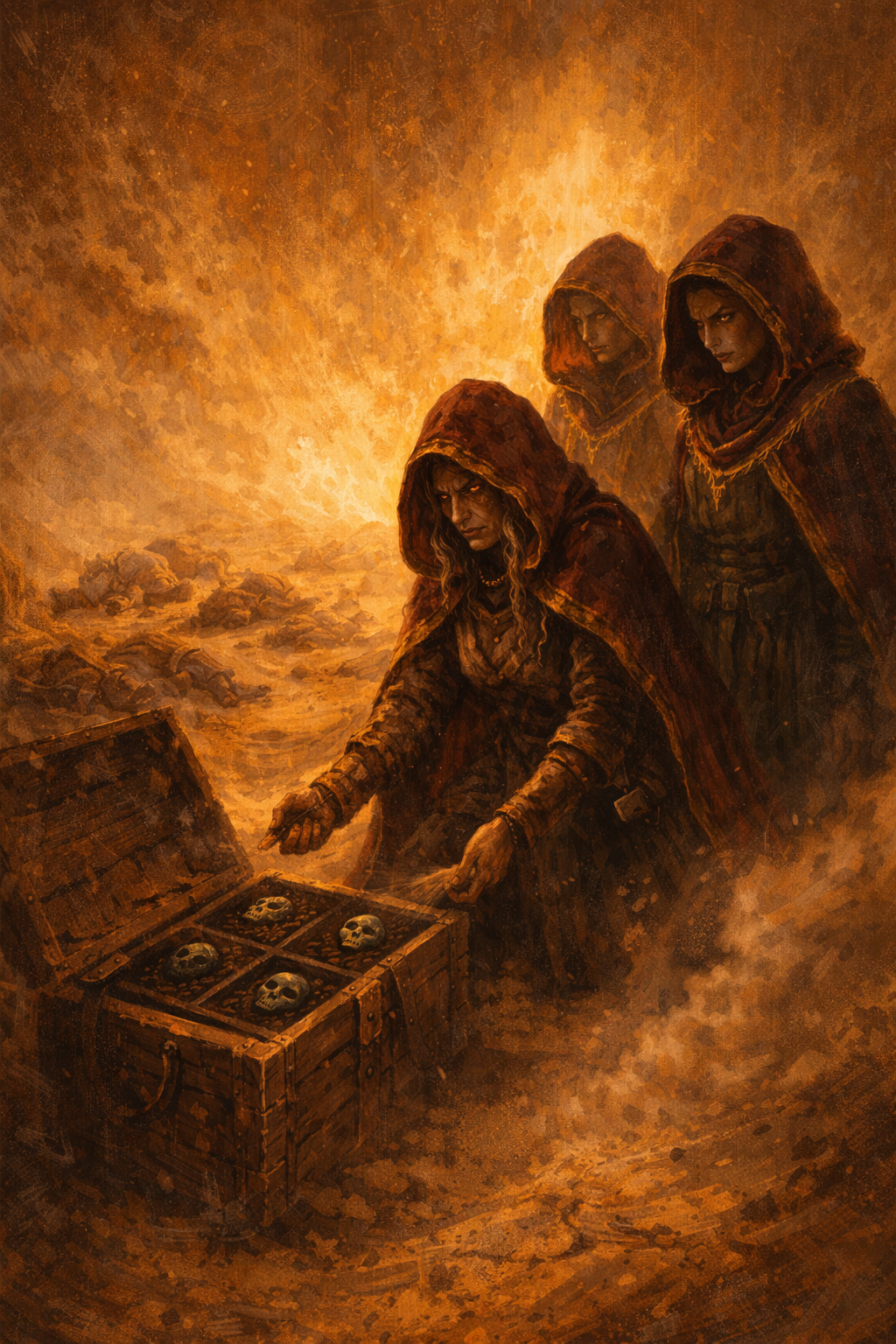
They were hooded, their cloaks deep red edged in dull gold that caught what little light survived the storm. The air around them shimmered—not from heat, but from a pressure that made the skin prickle. The soldiers saw them at the same time the camels did.
One camel screamed.
The middle figure lifted a hand.
A wave of fire rolled out, low and wide, a flat sheet that did not flicker like a torch but flowed like a tide. It hit the first line of soldiers and turned cloth to ash before the scream finished leaving their throats. It hit the camels and dropped them mid-step, the animals collapsing in smoking heaps that dragged the sleds sideways. Sand hissed into the sudden heat and became glassy clumps underfoot.
The storm tried to swallow the scene again.
The middle mage spoke a single syllable and the sand peeled away from them, forced outward as if pushed by an invisible dome. A pocket of stillness formed—quiet air, clear sight—while beyond it the desert raged on, blind and roaring.
In the calm, faces became possible.
The older woman’s hair was a red that had begun to lose its war to time, strands of grey woven through it like frost in dried grass. Her eyes were hard, the color of old amber. Beside her stood a younger redhead, leaner, with a sharper jaw and impatience in her posture, as if every second spent here was a risk she could taste.
The third figure remained half in the storm, a shadow at the edge of the bubble, watching the emptiness for threats that might move inside the sand.
The older woman stepped to the nearest crate and placed her palm against the rotting wood.
The wood sagged as if relieved to be touched.
“Open it,” she said.
The younger woman drew a knife and cut the straps. The lid came free with a sound like bone snapping.
Inside, runes lay stacked in felt-lined trays.
They were not the warm reds of flame or the clean blues of utility. These were darker than the night the storm had eaten. Each rune had a skull shape worked into the stone, not carved like an artist’s flourish but impressed like a seal—simple, brutal, undeniable. The air above them felt colder. Wronger. As if the world itself was trying not to acknowledge their existence.
The younger woman exhaled and her breath fogged in the desert heat.
The older woman did not touch them. She only looked, and her expression tightened with something that might have been satisfaction—or fear.
“So the tales are true,” she murmured.
“Who is moving them?” the younger one asked. “Who has the reach for this?”
“Someone with patience,” the older woman said. “Someone who expects a kingdom to rot from the inside before it falls.”
She glanced toward the storm-wrapped horizon, toward the unseen roads that led north and west and home.
“We share this carefully,” she said, voice low. “Not with every eager ear. Not with anyone who collects rumors like trophies.”
The younger woman’s gaze flicked to the dead soldiers, to the camels still twitching in the sand.
“And we leave no trail,” she said.
The older woman nodded once. A decision made, final as a blade.
They spoke words that were swallowed by the storm, and the air shivered. Their bodies blurred, then thinned, then were simply… not. Even the pocket of stillness seemed to forget the shape of them.
The bubble collapsed.
Sand rushed back in. Heat and grit and noise returned as if nothing had happened, as if the desert had dreamed the fire and the skull-marked stones.
Only the crates remained, half-buried, rotting in silence—waiting for the next hands bold enough to claim them.