MADISON
The bird returned at noon.
Madison was sparring with Keto at the edge of the trade center's practice ground—a trampled rectangle of dirt where guild parties worked off the rust of travel. She had been trying to break his guard for twenty minutes and failing; the man's shield discipline was maddening. He didn't dodge, didn't flinch, didn't overcommit. He just stood there and turned her aside, over and over, until her arms ached and her frustration built into something close to respect.
"Better," Keto said.
"I barely touched you."
"That's why it's better. Yesterday you wouldn't have come close."
A shadow flickered overhead. The messenger bird dropped from the sky and landed on the wagon rail where Mantis sat cleaning his sword. It carried a small parchment tube sealed with the wax stamp of Hegal's Guild.
Mantis broke the seal and unrolled the slip. The party gathered without being told.
He read aloud.
"To Party Five. New assignment. Mission difficulty: Level Two. Dwarven mining operation in Stoneheart reports loss of two workers in deep tunnel incursion. Plague of tarantulas and venomous spiders confirmed in lower shafts. Party with fire-capable druid requested to cleanse affected tunnels and locate missing personnel. Contact: Knothgar, Hugar, and Grant at the Ironhearth Tavern, Stoneheart. Report findings to Solundria upon completion."
Mantis looked up. "Stoneheart. Two days south from here, maybe less if we push."
Juvar shifted his weight, staff planted. "Fire-capable druid. That's me."
"That's you," Mantis agreed. "Spider nest in a mine. Deep tunnels. Tight quarters. Not the kind of fight where archers do their best work."
Rovan shrugged. "We adapt."
Merita did not look thrilled. "How big are these spiders?"
"Plague-level," Mantis said. "Which means a lot of them. Big enough to kill dwarves, and dwarves don't die easily."
They struck camp within the hour.
The road south ran through open grassland that thinned as they moved. Green gave way to yellow. Yellow gave way to dry scrub and red-brown earth that crunched under their boots. The sky grew wider as the terrain dropped, and ahead the mountains of Stoneheart rose in stacked layers—dark rock, old roads carved into cliff faces, the mouths of tunnels and shafts visible even from a distance as black dots against grey stone.
Madison had seen Stoneheart's approaches on the way to the trade center, but approaching from the north was different. The dwarven settlement was not a city above ground—it was a city that went down. What showed on the surface was deceptive: a ring of stone buildings, a market square carved from living rock, forge chimneys that vented from underground and filled the air with the smell of hot metal and coal. But the real Stoneheart was below. Tunnels. Halls. Mines. A vertical empire that had been old before humans arrived.
They entered through the western gate—a stone arch wide enough for four wagons abreast, its lintel carved with dwarven runes that Juvar studied as they passed.
"Mining guilds, forge rights, and tunnel authority," he murmured. "They take their hierarchy seriously down here."
Mantis asked a guard for directions. The guard—a dwarf in chainmail with a hammer slung over one shoulder—pointed them deeper into the settlement with three curt words: "Ironhearth. Bottom level. Left."
They descended.
The first level was commerce—shops, trading posts, taverns with signs in dwarven and common script. The ceilings were high for dwarven standards, which meant Madison only had to duck twice. Lanterns burned in sconces carved into the walls, casting warm orange light that made the stone glow. The air was cooler here, and clean—ventilation shafts hummed somewhere overhead.
The second level was residential and administrative. Narrower corridors, doors marked with family crests, the sound of children somewhere behind stone walls.
The third level was the Ironhearth Tavern.
It sat in a chamber carved from bedrock—the ceiling vaulted in a way that made the space feel enormous despite the low entrance. Support pillars thick as tree trunks held the weight of the mountain above. The bar was a single slab of polished granite. The stools were stone. The tables were stone. Everything here was built to outlast the people who sat at it.
Three dwarves waited at the far table.
Knothgar was the eldest. Heavy-set, even by dwarven standards, with a beard that fell to his belt in iron-grey braids. A massive war hammer leaned against the table beside him—the head scarred from strikes that had nothing to do with mining. His eyes were sharp under heavy brows, and when he stood to greet them, he moved with the careful economy of a man who knew exactly how much damage he could do.
Hugar sat to his right. Younger, broader, his black beard shorter and less decorated. A pair of black axes were strapped to his back in a crossed harness. He nodded once at the party and said nothing.
Grant was on the left. Similar build to Hugar, similar axes, but with a wider face and a scar across his nose that pulled his expression into something that might have been permanent suspicion. He was drinking from a stone cup and did not stop when they arrived.
"Hegal's people," Knothgar said. Not a question. "Sit."
They sat. The stone stools were exactly as uncomfortable as they looked.
Mantis introduced himself and the party. Knothgar listened, eyes moving from face to face as if cataloguing each one for future reference.
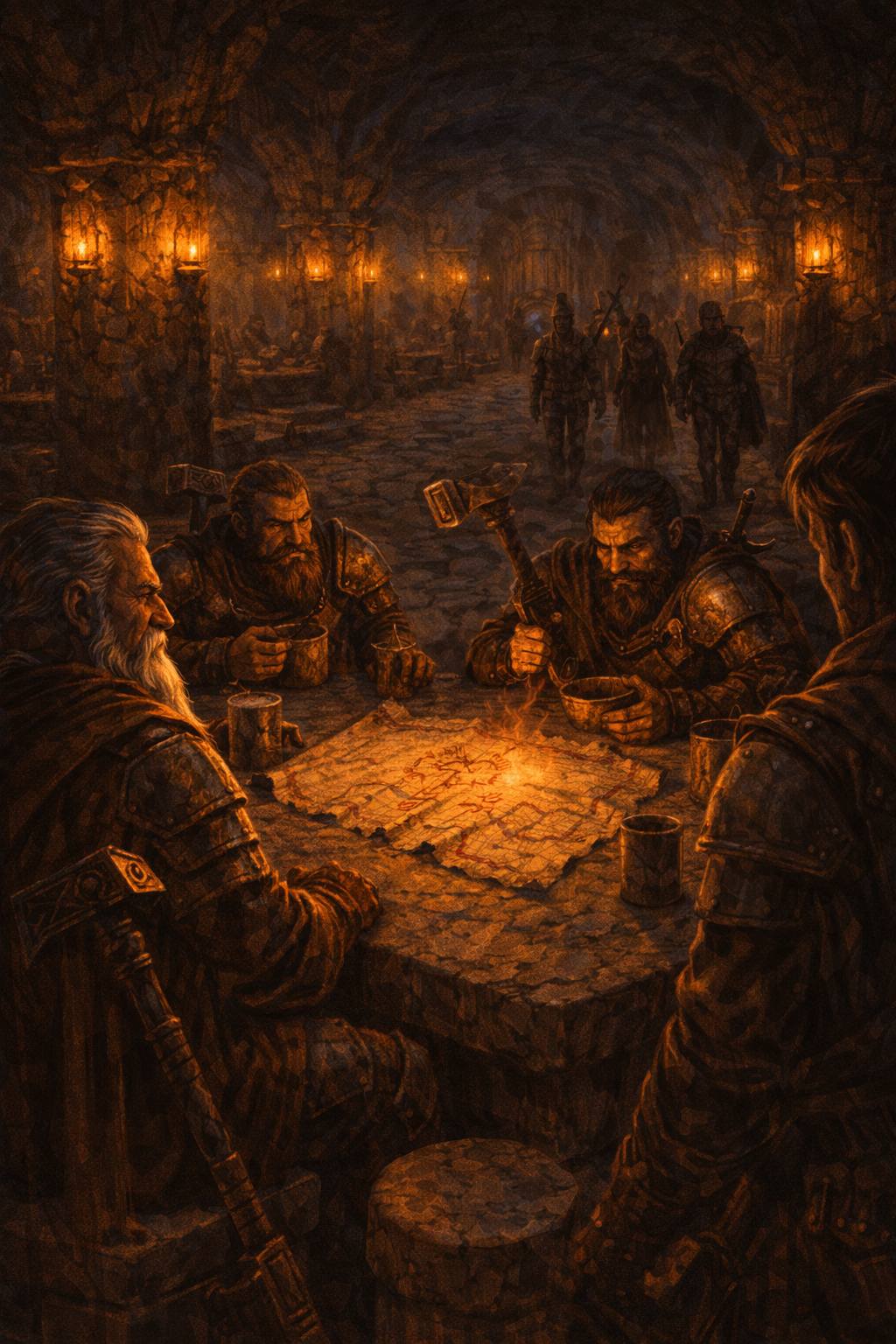
When Mantis finished, Knothgar spread a hide map on the table. The leather was stained with use, the lines drawn in charcoal and red ink. It showed a cross-section of mine shafts—seven main tunnels branching from a central access corridor, each descending at different angles into the mountain.
"This is the Seven," Knothgar said, tapping the map with a thick finger. "Seven mines. Our oldest operation. The upper shafts are clean—regular patrols, ventilated, mapped. The lower shafts..." He tapped deeper on the map, where the lines became thinner and less certain. "We extended them six months ago. Chased a new vein of iron ore, deep. The tunnels go where the ore goes. Not all of them are on this map."
Hugar spoke for the first time. His voice was low and graveled. "We lost Yuna and Mant four days ago. They were surveying a new lateral off Shaft Five. The survey team of six went in. Four came out running. They said spiders."
"What kind?" Juvar asked.
"Small ones first," Knothgar said. "Tarantulas. Poison fangs. We've dealt with those before—they come in waves when you break into new caverns. Standard clearing work. But Yuna and Mant were deeper than the others when the swarm started. The four who ran couldn't get to them."
Grant set down his cup. "We went in after them. Twice. Both times the spiders drove us back. They're not just tarantulas anymore. Something bigger is in there. The deeper tunnels are infested."
Mantis studied the map. "How big is 'something bigger'?"
Knothgar and Hugar exchanged a look.
"We don't know," Knothgar admitted. "The four survivors described different things. Large shapes in the dark. Sounds that didn't match anything they'd heard before." He met Mantis's eyes squarely. "We're miners, not monster hunters. That's why we called your guild."
"Four days, though," Puli said, leaning forward. "If they're alive, four days without supplies—"
"Dwarves hold longer than your kind underground," Grant said. Not unkindly. A fact, delivered flat. "Our lungs are made for thin air. Our bodies store water better. And Yuna is no fool—she'd have found a defensible position and held it."
"And Mant?" Nocta asked.
Grant's jaw tightened. He picked up his cup and drank instead of answering.
Knothgar filled the silence. "Mant is steady. Quiet lad, good with a pick, better with an axe. If anyone could survive down there, it would be those two together." His voice carried the careful weight of a man who was choosing to believe something because the alternative was worse. "But we can't wait any longer. Every day that passes, whatever's in those tunnels digs deeper."
Mantis nodded slowly. "We go in tomorrow. First light. Juvar handles the fire work. The rest of us clear and protect." He looked at Madison. "Sub-leader takes rear guard. Nobody gets left behind."
"Understood," Madison said.
Knothgar rapped his knuckles on the granite bar and a dwarven woman emerged from the back room carrying a tray that looked too heavy for her frame but clearly wasn't. On it sat bowls of thick stew—chunks of mushroom and dark meat swimming in a broth that smelled of pepper and something earthier, something that only grew underground. Beside the bowls, a platter of bread so dense it could have been used as a weapon, sliced into thick rounds and glistening with rendered fat. A wheel of sharp cheese the color of old bone. And stone cups of dwarven ale, already poured, already sweating.
"Tonight you eat with us," Knothgar said. "Tomorrow we show you the way in."
The stew was extraordinary—hot, peppery, the mushrooms tender and full of a flavor Madison had never tasted before. Earthy and faintly sweet, like the stone itself had a taste and someone had learned to cook with it. The meat was boar, Knothgar said, taken from the mountain's western slopes. The bread was baked in forge ovens, which explained why the crust crackled like something being broken.
The ale was dark, thick, and tasted like someone had dissolved a small mountain into it.
Puli took one sip and went very still. "This is... strong."
Hugar almost smiled. "That's the breakfast blend."
"What's the evening blend?" Merita asked, her voice slightly strangled.
"You don't want to know," Grant said, and for the first time his expression cracked into something that might have been amusement.
Knothgar tore a piece of bread and used it to mop his stew. "The Seven has been our mine for three generations," he said. "My grandfather helped carve the first shaft. Every tunnel down there has a name. Every junction has a story." He chewed slowly, the bread disappearing into his beard. "We don't like calling outsiders to handle our problems. But those spiders aren't our problem anymore. They're something else."
"Have you seen infestations like this before?" Juvar asked.
"Small ones. Tarantulas nest in natural caverns—they're part of the mountain. We clear them with fire and smoke and that's the end of it." Knothgar's brow furrowed. "But this time, when we broke through to the new lateral, the air that came out was different. Warm. Wet. It smelled like rot." He glanced at Hugar, who nodded. "Whatever we opened, it wasn't just a cavern. It was something's home."
The table was quiet for a moment. Around them, the tavern hummed with the low conversation of other dwarves—miners finishing their shifts, families eating in clusters, a pair of old men playing a board game that involved stone pieces and a lot of swearing.
Madison watched Knothgar's hands as he ate. They were enormous—scarred, calloused, the knuckles swollen from decades of swinging a hammer. Hands that had built things and broken things in equal measure. She thought of her father's hands in the old stories Elane told—sword-calloused, gentle with children, steady on the tiller of a boat. Different hands, same weight behind them.
Puli was trying the ale again, smaller sips this time. His face suggested he was losing the argument.
"Is it always this quiet down here?" he asked, looking up at the vaulted ceiling.
"This is loud," Hugar said.
Puli blinked. "This is loud?"
"For us." Hugar's almost-smile returned. "Dwarves hear what the stone says. Too much talking and you miss the important sounds."
"What does the stone say?" Puli asked, genuinely curious.
Hugar paused. He tilted his head slightly, as if listening to something none of them could hear. "Right now, it says the mountain is settled. The pressure is even. The water table is where it should be." He tapped the granite table with one thick finger. "When the stone is unhappy, you hear it. Creaks. Shifts. A sound like old bones settling. That's when you move."
"Hugar once cleared an entire shaft because he didn't like the sound of a wall," Grant said. "Twelve miners. Made them all walk out. They called him mad."
"The wall collapsed an hour later," Hugar said. He took a long drink of ale. "They stopped calling me mad."
They entered the mines at dawn.
Knothgar led them to the surface entrance on the western face of Stoneheart—a wide mouth cut into the cliff, reinforced with timber beams and iron brackets. Rail tracks ran into the dark, disappearing where the lantern light failed. The air that came from inside was cool, damp, and carried a smell that Madison couldn't identify—mineral and old, like stone that had never seen sunlight.
"Shaft Five is the third junction left," Knothgar said, his hammer resting on his shoulder. "We'll take you through the upper tunnels. Once we pass the third support station, the new extensions begin. That's where we lost them."
They entered.
Madison had never been inside a dwarf mine.
The scale was the first shock. The main corridor was wide enough for two wagons and tall enough that even the humans didn't need to duck. The walls were smooth—not rough-hewn, but carved with geometric precision, the chisel marks forming patterns that might have been decorative or might have been structural. Support beams crossed the ceiling at regular intervals, each one stamped with dwarven runes. Rail tracks ran down the center, polished from use. Niches in the walls held lanterns that burned with a steady, windless flame—rune-lit, Madison realized. No oil. No smoke.
"Beautiful," Merita breathed.
Knothgar glanced back. "Functional. Beauty is what happens when you do the work right."
Madison ran her fingers along the wall as they walked. The stone was cool and glass-smooth under her touch, each chisel mark precise enough that she could feel the rhythm of the mason who had carved it—strike, turn, strike, turn—a pattern as regular as a heartbeat. The rune-lanterns threw long shadows that moved with them, and the silence was different from the silence above ground. Not empty. Full. The silence of a place that had been listening for centuries.
This is what they built, she thought. While we were fishing and farming and fighting over borders, they were carving a world inside the world.
Keto walked beside her, his shield catching the lantern light. She saw his eyes moving across the carved walls, and for a moment his careful stoicism cracked into something like wonder.
"My father was a blacksmith," he said quietly. "He would have wept to see this stonework."
They walked deeper. The corridor branched and branched again. At each junction, Knothgar pointed confidently—left, straight, right—without consulting the map. He knew these tunnels the way sailors knew currents.
The deeper they went, the more the character of the mines changed. The upper levels were polished and maintained—supply caches at regular intervals, ventilation shafts humming overhead, the walls clean. Below the second support station, the finish grew rougher. Tool marks were fresher. The rune-lanterns were spaced further apart, and between them the darkness pressed in like something physical.
Mantis walked near the front, his eyes never stopping. "How old are these lower sections?"
"Six months," Knothgar said. "We broke through fast. The ore was good. We didn't spend time making it pretty."
"You can feel the difference," Juvar said. He had one hand extended, palm flat, as if testing the air. "The upper tunnels are settled. Stable. Down here, the stone is still adjusting to being opened. The pressure hasn't equalized."
Knothgar gave him an appraising look. "You know rock."
"I know magic in rock," Juvar said. "Not the same thing. But close enough."
At the third support station—a wider chamber with tool racks, water barrels, and a small forge for sharpening—Knothgar stopped.
"From here, the new extensions begin." He pointed into a corridor that descended at a sharper angle, the walls rougher, the ceiling lower. No rune-lanterns. Just darkness. "Shaft Five lateral is two hundred paces down, first left."
Juvar activated a light rune and held it above his head. The glow pushed the dark back in a pale circle. Beyond it, the tunnel walls glistened with moisture.
"Stay tight," Mantis said. "No one wanders."
They descended.

The tunnel narrowed gradually. The ceiling dropped until even the dwarves had to lower their heads at points. The air grew warmer—not uncomfortably, but noticeably. Madison could hear the mountain breathing around them: faint creaks, the distant drip of water, the low hum of stone under pressure.
The warmth thickened as they went deeper, and with it came a smell—faint at first, then unavoidable. Sweet and rotten, like fruit left in the sun too long. Underneath it, something sharper. Acidic. Madison's throat tightened.
Four days, she thought. Four days alone in this dark, with that smell getting closer.
"There," Hugar said, pointing.
A side tunnel branched left—narrower, rougher, the entrance partially blocked by a collapsed timber beam. Cobwebs stretched across the opening, thick as rope, catching the light rune's glow in silver threads.
Juvar extended his staff and touched the nearest web. It didn't burn. It stuck.
"Old," he said. "But maintained. Something is living in this web."
Knothgar moved the broken beam aside with one hand. "Yuna went in here."
They entered the lateral tunnel in single file. Juvar led with his light rune and fire magic ready. Knothgar and Hugar flanked him. Grant walked behind with the party's archers. Madison, Keto, Boro, and Vask brought up the rear in a shield wall that barely fit the corridor.
Fifty paces in, the webs thickened. They hung from the ceiling in curtains, draped across the walls in layered sheets. The texture was wrong—not the airy gossamer of house spiders, but dense, fibrous, almost like woven cloth. Juvar burned through them with controlled bursts of flame, the fire hissing as it consumed the silk.
The smell was acrid. Sweet. Wrong.
"Contact!" Nocta said sharply.
Shapes moved in the dark ahead.
Small at first—tarantulas the size of fists, scurrying across the walls and ceiling with a dry, clicking sound that set Madison's teeth on edge. They poured from cracks in the rock like water from a broken dam.
"Juvar!" Mantis barked.
Juvar planted his staff and spoke a word. Fire erupted from the ground in a knee-high wall that stretched across the tunnel's width. The leading wave of spiders hit it and burned—legs curling, bodies popping in the heat. The smell was terrible. Smoke filled the corridor.
"Push through!" Mantis ordered.
They advanced behind the fire wall, Juvar feeding it with steady pulses of energy, sweat running down his temples. The tarantulas scattered—some retreating deeper, some climbing the walls to get above the flames. Puli and Nocta picked off the climbers, arrows and stars thudding into bodies that dropped and twitched.
Then the bigger ones came.
The first emerged from a side crack—a spider the size of a crouching dwarf, legs thick as fingers, mandibles dripping something that steamed when it hit stone. Its body was dark brown, armored in chitin plates that overlapped like scale armor. It moved with horrible speed for its size.
"By the gods," Merita whispered.
It lunged for Knothgar.
Knothgar's hammer came down like judgment.
The impact was brutal—chitin cracked, legs shattered, the spider's body caved inward with a wet crunch. Knothgar wrenched the hammer free and swung again, finishing it. His face showed nothing. He might have been breaking rock.
Two more came from the ceiling.
Hugar and Grant moved as if they had fought together their entire lives. Hugar's axe took the first spider's legs on the left side; Grant's took the right. The creature collapsed between them and they finished it with overhead strikes that shook the tunnel.
A third dropped onto Boro's shield. He staggered under the weight, the spider's legs wrapping around the rim, mandibles scraping metal. Vask drove his sword into its underbelly. Black ichor sprayed. Boro threw the body off with a shout of disgust.
Juvar shifted his fire—a horizontal bolt that hit a cluster of spiders emerging from the ceiling and detonated in a burst that sent burning fragments in all directions. The heat washed over Madison's face.
"Keep moving!" Mantis shouted. "Forward! Don't let them regroup!"
They fought through. The tunnel opened slightly—the ceiling rising, the walls pulling back. The spider attacks came in waves: small swarms of tarantulas, then the bigger ones in pairs and trios, then a brief lull that felt worse than the fighting.
Madison heard her own breathing. Loud. Too fast. She forced it slower.
You've trained for this. You've bled for this. Breathe.
The passage opened into a wider chamber—natural, not carved. The ceiling rose high enough that Juvar's light rune couldn't reach it. Stalactites hung in the dark like stone teeth. Water dripped somewhere. The floor was uneven, covered in a layer of web so thick it felt like walking on carpet.
In the center of the chamber, curled against the far wall, was Yuna.
She was alive.
Barely.
Her armor was scratched and dented, her axe still clutched in both hands, her face a mask of exhaustion and terror. She had built a rough barricade from loose stone and timber scraps—enough to keep the smaller spiders at bay, not enough for the bigger ones. The area around her was littered with dead spiders, some stabbed, some crushed, some still twitching.
Knothgar saw her first and broke formation.
"Yuna!" He ran. His hammer swung forgotten at his side. He dropped to a knee beside her and gripped her shoulders. "Yuna. We're here. Can you hear me?"
Yuna's eyes focused slowly. Recognition came in stages—confusion, disbelief, then a flood of something raw.
"Knothgar," she said. Her voice was a cracked whisper. "Thank the gods. Thank the gods you found me."
"Are you hurt?"
"Bites. My arm. I used the last antidote rune two days ago." She gripped his hand with sudden, desperate strength. "Please. Let's leave. Now. Please."
Her eyes found the rest of them—the humans, the unfamiliar faces—and something flickered across her expression. Not suspicion. Bewilderment. As if she had forgotten there was a world outside this chamber and was surprised it still contained people.
"The guild sent help," Knothgar said gently. "They're here for you."
Yuna's gaze settled on Madison. On the Sword of Fury at her hip. On the shield. Something in her face steadied, the way a drowning person steadies when they see a rope.
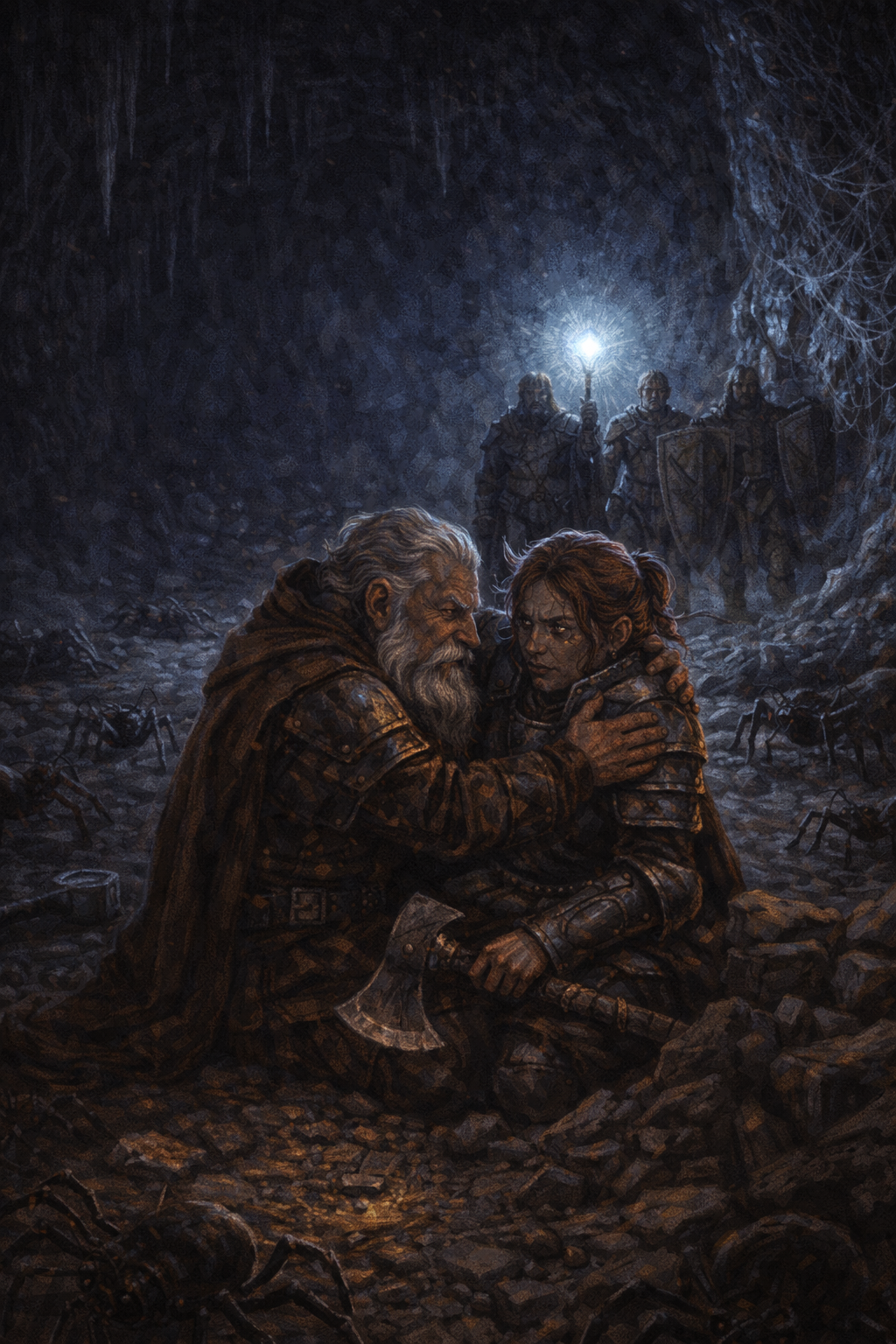
"I counted the hours," Yuna said. Her voice was raw, scraped thin. "The first day I shouted for help until my voice broke. The second day I stopped shouting because the sound drew them. The little ones would come in waves—eight, ten, a dozen. I killed them. I killed so many I lost count." Her hands were shaking. She looked at them as if they belonged to someone else. "But the big ones. They'd come after the small ones cleared. Slow. Patient. Testing how tired I was. I'd kill one and two more would come."
"You survived four days down here alone," Madison said. She wasn't sure if she said it as a statement or a question. Both, maybe.
"Alone," Yuna repeated. The word broke something in her face. "After the first night, I heard Mant calling. Deeper. Faint. I almost went to him." She stopped. Drew a breath that sounded like it hurt. "I couldn't. The tunnel between us—the big ones had claimed it. I could hear them moving in there. The sound their legs make on stone. Like knives on glass."
"Where is Mant?" Hugar asked, already scanning the chamber.
Yuna's face crumbled.
"I lost him," she said. "We were deeper—much deeper. The big ones... he couldn't—" Her voice broke. "He was right behind me. Then he wasn't."
Grant's hands tightened on his axes.
Juvar knelt beside Yuna and examined her arm. The bite was swollen, veined with green—poison working through muscle. He pressed a support healing rune against the wound and activated it. The rune pulsed with a warm amber light. Yuna hissed through her teeth as the magic took hold, the green veins dimming slightly at their edges.
"The healing is slow," Juvar said. "But it will hold. The rune will draw the venom, but you'll feel weak for hours. Can you walk?"
"I can walk out," Yuna said. "That's all I want to do. Walk out."
Mantis looked deeper into the chamber. Beyond it, a larger passage descended—wider, rougher, the walls glistening with moisture and webbing. The darkness down there was absolute.
"Mant is still in there," Mantis said quietly.
Yuna shook her head violently. "You don't understand. The things down there—they're not like these." She gestured at the dead spiders around her. "They're bigger. Much bigger. I heard something moving in the deep tunnels. The ground shook."
Knothgar stood slowly. His jaw was set. "We don't leave our people."
Hugar and Grant said nothing. They didn't need to. Their axes were already in their hands.
Mantis looked at Madison.
She looked back. "We go."
He nodded once.
"Juvar, take point. Fire and light. Archers, stay in the center—you're useless if you can't see. Knights, tight formation. Dwarves, you know these tunnels better than we do. Call out anything that looks wrong."
They left Yuna with Merita and Rovan at the chamber entrance—three guards to hold the retreat path. Madison didn't like splitting the party, but Yuna couldn't go deeper and they needed someone to watch the way back.
The rest of them descended.
The deeper tunnels were different.
Not just darker—they felt different. The air was thicker, warmer, and carried a smell like rotting silk and something metallic. The walls were rougher, the stone broken by natural fissures that gaped like wounds. Webs covered everything—not in thin strands, but in layered sheets that Juvar had to burn through with sustained fire. Each time he cleared a section, the darkness behind it seemed to pulse.
Madison's shield arm ached from holding position in the cramped space. Sweat ran down her spine. The warmth was wrong—not the dry heat of a forge, but humid, biological, the warmth of something breathing. Keto walked beside her, silent, his shield up and his breathing even.
Puli, walking behind Juvar, murmured over his shoulder: "Well, that wasn't so difficult."
A beat of silence.
"Don't," Madison said.
"What?"
"Don't say that."
Puli opened his mouth to reply, then closed it.
They found Mant two hundred paces deeper.
He lay against the tunnel wall in a position that looked almost peaceful—seated, his mining helmet beside him, his hands in his lap. His face was wrong. Green veins branched across his skin like roots, radiating from a bite on his neck. His eyes were open. His chest was still.
Knothgar stopped.
Hugar stopped.
Grant walked forward slowly, knelt, and pressed two fingers against Mant's throat.
He looked back and shook his head.
Knothgar's hammer hit the ground. The sound echoed through the tunnel like a bell.
"Mant," Hugar said. Just the name. Just the sound of it in the dark.
Grant stood. His face was very still, very controlled, and then it wasn't. "Who did this?" he snarled. Not at anyone. At the dark. "What did this?"
"Poison," Juvar said quietly, examining the wound without touching it. "Concentrated venom. The green veining suggests a neurotoxic compound—strong enough to bypass dwarven constitution." He looked up. "Whatever bit him was large. The fang marks are wide."
Knothgar lifted his hammer. His eyes were wet. His grip was not.
"We bring him out," he said. "Now."
Then the floor trembled.
Not a vibration. Not the natural settling of stone. A rhythmic impact—heavy, measured, getting closer. Dust shook from the ceiling. Small stones rattled loose.
Everyone went still.
The trembling grew. The impacts came faster. Something enormous was moving toward them from the deeper tunnels, each step shaking the ground hard enough to make the water droplets on the walls jump.
Then they heard it—a sound that was not a roar, not a shriek, but a deep, grinding chirp that resonated in the stone itself. Madison felt it in her chest, in her teeth, in the bones of her hands where they gripped the Sword of Fury.
Move, her body said. Run, said every instinct carved into her blood by a thousand generations of ancestors who had survived by knowing when something was too big to fight.
She held.
Juvar's light rune blazed brighter. The tunnel ahead opened into a vast natural chamber—the mine had broken through into a cavern so large that the ceiling disappeared into absolute darkness above. The space was enormous. Cathedral-scale. The floor was uneven stone covered in webbing thick as quilts.
And from the far end of that chamber, something moved.
It came fast.
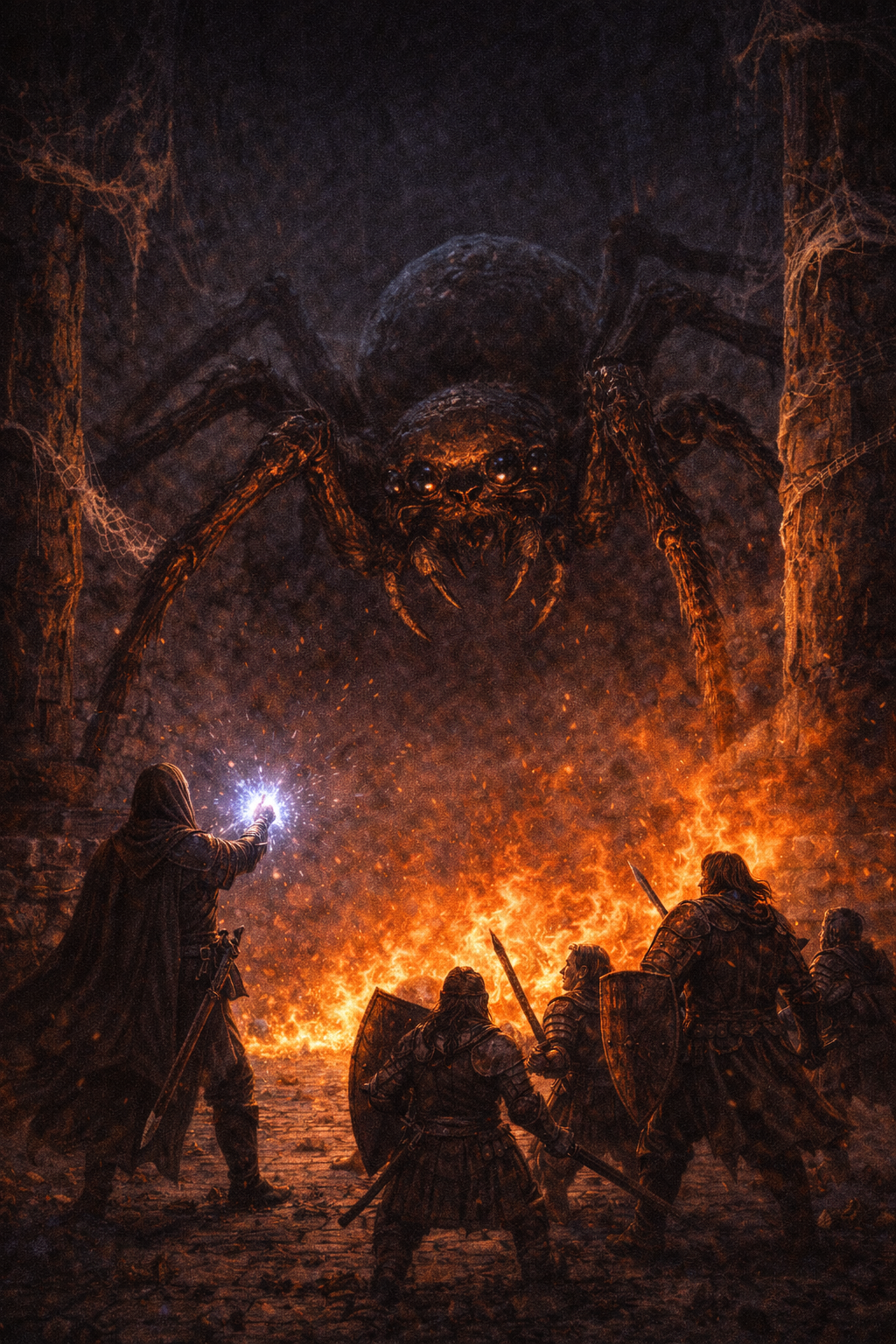
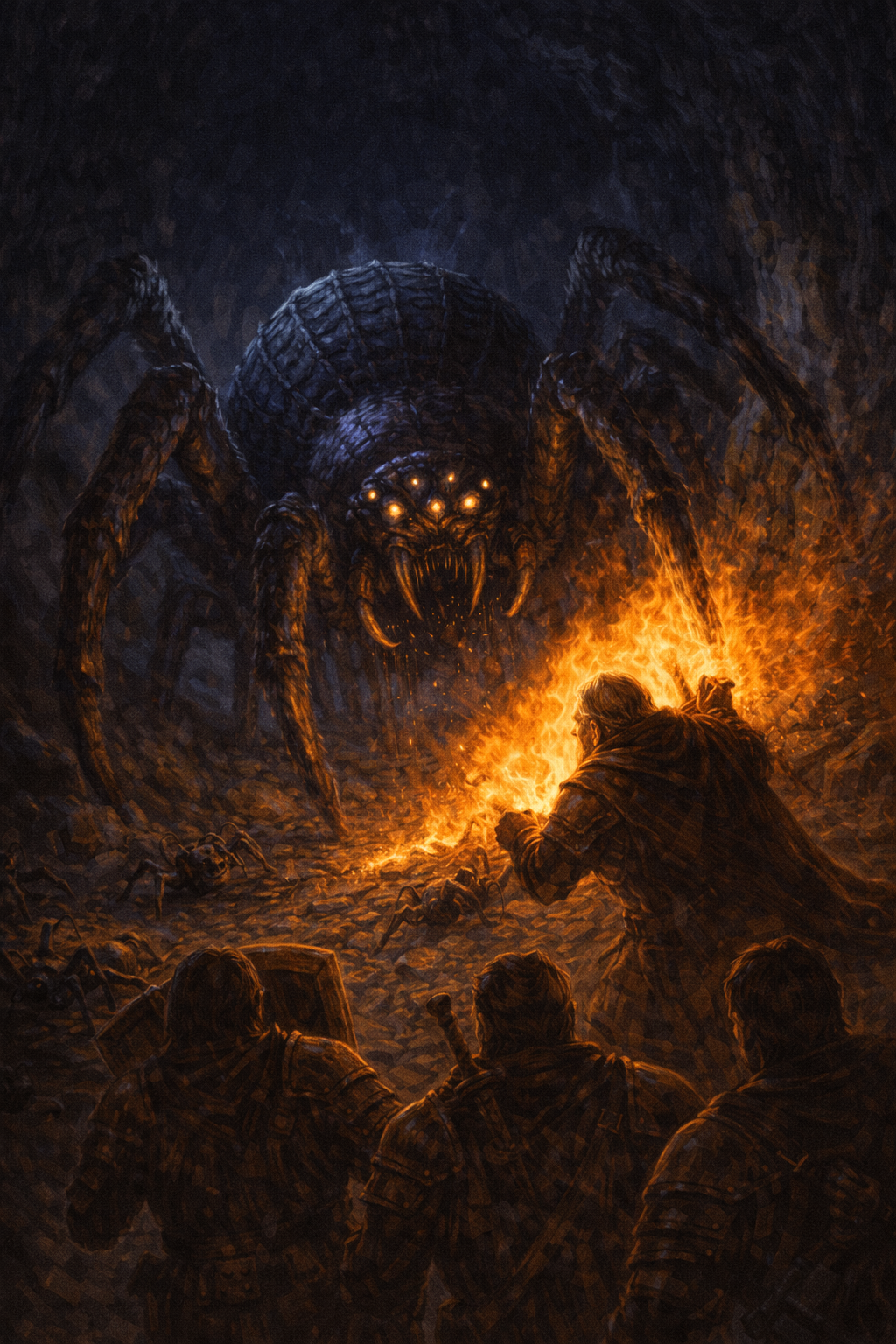
The giant spider emerged from the dark like a nightmare given legs—eight of them, each as thick as a man's torso, tipped with chitin hooks that cracked stone as they struck. Its body was massive, the abdomen alone the size of a wagon, armored in plates of dark chitin that gleamed wetly in the rune-light. Its mandibles were the length of swords. Eight eyes reflected the light like black mirrors, each one fixed on the group with a focus that was not animal. It was something worse than animal. Something patient.
It lunged.
Juvar threw everything he had.
A wall of fire erupted across the chamber entrance—twice his height, roaring, fed by every scrap of energy he could channel. The heat was immediate and savage. Madison's face burned from ten meters back.
The spider hit the fire wall and kept coming.
The flames scorched its legs, blackened the chitin on its forward limbs, but the body was too massive. It crashed through the wall and skidded into the chamber's mouth, mandibles snapping, legs hammering stone.
"Fall back!" Mantis roared. "NOW!"
They ran.
Not a retreat. A rout. The tunnel was too narrow for formation, too cramped for shields. They ran single file with the spider's legs striking the walls behind them, sending showers of stone and dust. Each impact sounded like a siege ram hitting a gate.
Madison's world narrowed to the sound of boots and breathing and the terrible rhythmic crash behind them. She could feel the displaced air each time a leg struck the wall—close, too close, the gap shrinking with every stride.
Keto stumbled. His boot caught a rail track and his knee hit stone. Madison grabbed his arm and hauled him forward. "MOVE!"
"Going!" he gasped, finding his feet, shield scraping the wall as he lurched back into a run.
Juvar turned and fired a blast of flame backward—a concentrated bolt that hit the spider's face. It shrieked, that grinding chirp amplified to a sound that shook the corridor. One leg lashed out blindly and struck the wall beside Puli's head. Stone exploded. Puli ducked, stumbled, kept running.
"It's still coming!" Nocta shouted from behind.
Grant swung around and hurled one of his axes. The throw was perfect—a flat spin that buried the blade in the spider's forward leg joint with a meaty thunk. The spider faltered for half a step, ichor spraying from the wound, and Grant was already running again, his remaining axe in his fist.
Knothgar was carrying Mant's body over his shoulder. Even burdened, he ran with the determination of something that refused to die. His breathing came in great heaving gasps, but his legs never slowed.
Boro stumbled next—the floor uneven, treacherous with loose stone and webbing. Vask caught his arm without breaking stride, the two knights holding each other upright through momentum and instinct.
They reached a narrowing in the tunnel—the ceiling dropping, the walls closing in. The spider's legs scraped the walls. It was too big for this section. Its body jammed.
Hugar saw it at the same moment Madison did.
"The supports!" Hugar screamed. "Break the supports!"
Wooden beams braced the ceiling at the narrowing—old timber, thick, holding back the mountain's weight.
Keto didn't hesitate. He drove his sword into the base of the nearest beam. Boro hit the opposite one with his shield, hammering the wood until it cracked. Vask grabbed a third beam and pulled with his full weight, boots sliding on stone, every muscle in his neck standing out like cord.
The spider was forcing itself through. Chitin scraped stone with a sound that set every nerve screaming. The walls cracked around it. One leg reached through the gap and swiped for Madison—close enough that she felt the displaced air on her face, close enough to see the chitin hook at its tip, close enough to smell the thing—rot and acid and something ancient.
She swung the Sword of Fury. The blade bit into chitin. The leg recoiled.
"CLEAR!" Knothgar bellowed.
Hugar's axe hit the final support beam.
The beam exploded into splinters.
The ceiling gave.
Tons of stone dropped with a sound like the end of the world. The corridor filled with dust and roaring noise. Madison felt something hit her shoulder—a rock the size of her fist—and stumbled backward. Hands grabbed her. Puli. Keto. They dragged her clear as the collapse thundered on.
When the dust settled, the tunnel was sealed.
Behind the wall of fallen stone, the spider screamed. The sound was muffled now—distant, furious, trapped. The vibrations shook the ground under their feet, then faded as the creature retreated into the deep.
Silence.
Then breathing. Coughing. The sound of someone spitting dust.
"Everyone here?" Mantis called, voice raw.
Names came back. All of them. Everyone accounted for.
Knothgar laid Mant's body down gently and sat beside it. His hands were bleeding where rock had cut them. He did not seem to notice.
Juvar leaned on his staff, drained. His robe was scorched at the sleeves. "I don't have enough fire left to light a candle," he said.
Puli sat against the wall and laughed—a broken sound, too high, too fast. "Well. That was difficult."
Nobody argued.
They climbed out of the mines in silence.
They collected Merita, Rovan, and Yuna at the upper chamber. Yuna saw Mant's body and went still. She did not cry. She pressed her forehead against Knothgar's arm and stayed there, silent, while they walked. Merita fell in beside Madison without a word, her face pale in the rune-light, and Madison could see the question she didn't ask: How bad?
Bad enough.

The upper tunnels felt different on the way out. The carved walls, the smooth stone, the rune-lanterns—all of it looked fragile now. A thin shell of order laid over something vast and wild that waited below. Madison understood, for the first time, what the dwarves lived with every day. The mountain gave them everything—ore, stone, shelter—and beneath it all, the dark.
Stoneheart's surface air hit Madison like cold water. She hadn't realized how stale the mine air had become until she tasted wind and sky. The sun was low, painting the stone buildings amber and casting long shadows across the market square. They had been underground for most of the day.
Madison stood at the mine entrance and breathed. Just breathed. The wind carried the smell of forge smoke and pine from the slopes above, and she closed her eyes and let it fill her lungs until the memory of rot and burning silk faded to something she could file away.
Knothgar carried Mant to the mining guild hall. Other dwarves gathered. Words were spoken in the dwarven tongue—low, formal, heavy with grief. Madison didn't understand the language, but she understood the sound. She had heard it before, in Jul, when the sea took someone. Different words. Same weight.
Later, at the Ironhearth Tavern, Knothgar sat across from Mantis with two cups of the same terrible ale.
"The giant spider is sealed," Knothgar said. "Not killed. The collapse will hold, but not forever."
Mantis nodded. "What will you do?"
"Petition the king. We'll need a specialized force—siege druids, fire mages, maybe a team from the eastern holds. The mine stays closed until that thing is dead." He took a long pull of ale. "Your guild completed the mission. The upper tunnels are cleared. Yuna is alive. Mant..." He stopped. "Mant is home."
He pushed a sealed packet across the table—the mission completion receipt, stamped with the dwarven mining guild's mark.
"You fought well," Knothgar said. "All of you."
Mantis took the packet. "We'll report to Solundria."
Knothgar looked past him to Madison, who sat at the next table with a cup of ale she hadn't touched, staring at the surface of it.
"The woman with the sword," Knothgar said. "She didn't hesitate."
"No," Mantis said. "She didn't."
Knothgar was quiet for a moment. Then: "My grandfather used to say that courage isn't the absence of fear. It's the decision that something else matters more." He lifted his cup. "She made that decision fast."
Mantis drank. The ale was still terrible. "She did."
That night they camped in Stoneheart's surface quarter, in a bunkhouse reserved for visiting guild parties. The beds were stone slabs with thin mattresses—dwarven hospitality at its finest. Nobody complained.
Someone had brought food to the bunkhouse—a platter of cold meats and hard bread and more of those underground mushrooms, roasted this time, glistening with oil and pepper. A jug of water and a smaller jug of ale. Puli picked at the mushrooms while Keto ate methodically, the way he did everything. Boro sat with his back against the wall, his empty plate on his knees, staring at nothing.
"That thing under there," Boro said. He rarely spoke, and when he did the room listened. "I've never seen anything that big. I've never even heard of anything that big."
"The deep places hold what the surface forgot," Juvar said. He sat on the edge of his bunk, staff across his knees. "Old things. Things that grew in the dark for centuries without anything to stop them."
"Comforting," Vask said.
"It's not meant to be."
Puli looked at Juvar. "Could you have killed it? With everything you had?"
Juvar considered this honestly. "No. Not alone. Not with ten of us. That creature was beyond fire magic in a tunnel. You'd need a mage circle—three, four druids working in concert—or a siege rune powerful enough to collapse the entire cavern." He shook his head. "We were right to run."
"We were right to run," Madison repeated. The words felt strange. Running was not what her father would have done. Running was not what the stories said heroes did. But Mantis had made the call, and the call was right, and everyone was alive because of it.
Sometimes the brave thing is to leave.
Madison lay awake after the others settled and stared at the ceiling.
The spider's shriek still echoed in her skull. She could feel the rock striking her shoulder, Puli's hands dragging her clear, the ground shaking as the creature threw itself against the sealed collapse. The displaced air from the leg that had nearly taken her head. The smell.
She had not hesitated.
She wasn't sure if that was courage or something else. Something that lived in her blood—her father's blood, the blood of a man who had walked into dragon fire and never walked out. Was it bravery, or was it just the inability to stop? Was there a difference?
Across the room, Keto was awake too. She could tell by his breathing—too even, too controlled, the breathing of a man pretending to sleep.
"Keto," she whispered.
A pause. "Yeah."
"You good?"
Another pause. Longer. "I will be." He shifted on his stone slab. "My father would have said that today was a test. He believed the gods put you in front of things you can't beat to see what you do instead of winning." A breath. "I think I'd rather just win."
"Me too," Madison said.
She believed him.
Puli, somewhere in the dark, murmured, "I'm never saying 'that wasn't so difficult' again."
"Good," Madison said.
"I mean it this time."
"You said that last time."
"Last time I hadn't been chased by a spider the size of a house."
Nocta, from his bunk near the door, said nothing. But she heard him turn over, and in the faint light from the corridor she saw him slip a throwing star under his pillow.
Somewhere below them, deep in the stone, the mountain breathed. Madison could almost feel it—the slow pulse of a place that had been here long before any of them and would be here long after. The dwarves lived inside that pulse. They built their lives in rhythm with it. She wondered if they ever forgot it was there, the way people who live near the sea forget the sound of waves.
They were not the same party that had left Haze.
They were something harder now. Something that had bled together and run together and held the line together in the dark.
Madison closed her eyes.
Tomorrow they would move again. Another mission. Another road.
But tonight, in the stone heart of the mountain, they rested.