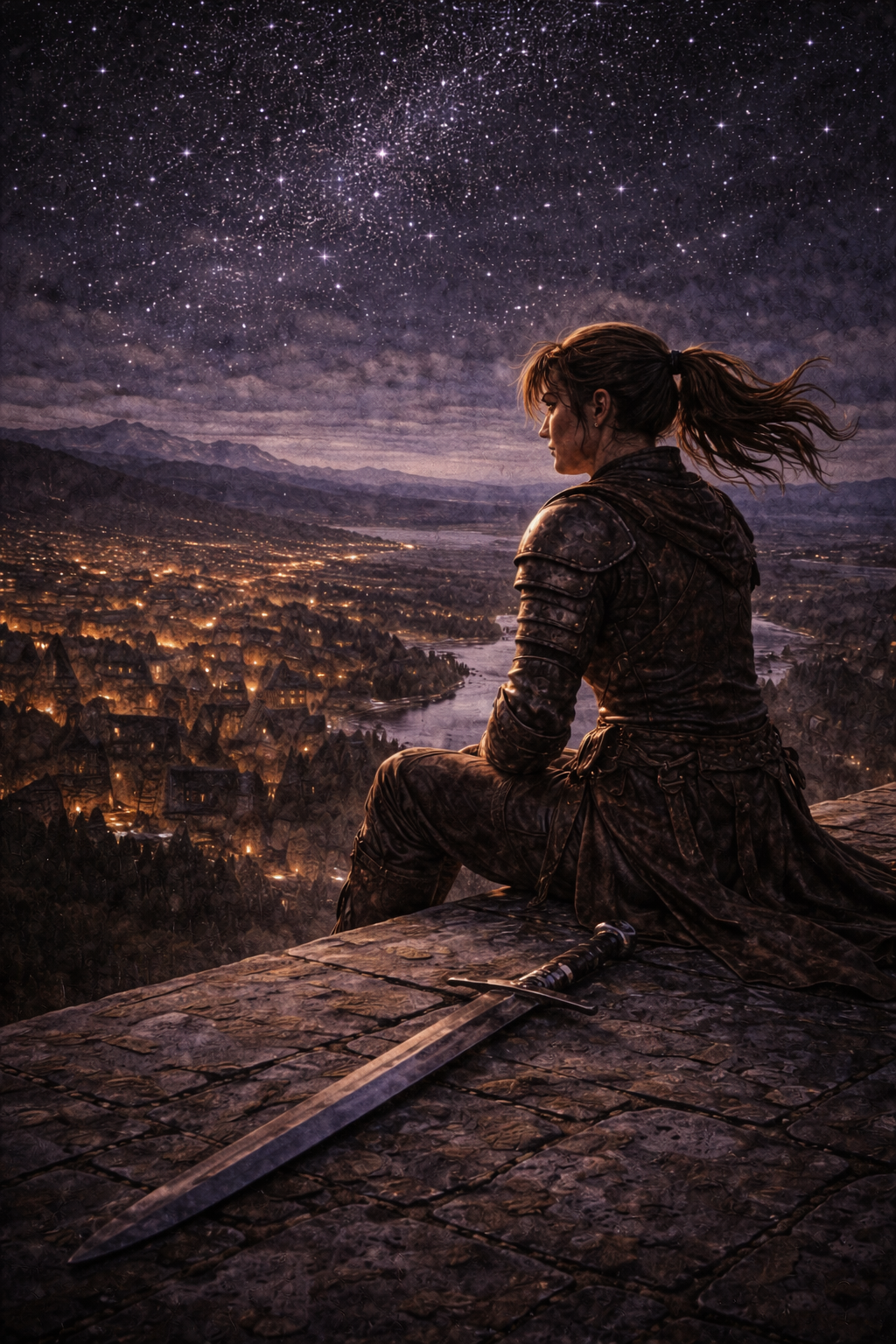
JUVAR
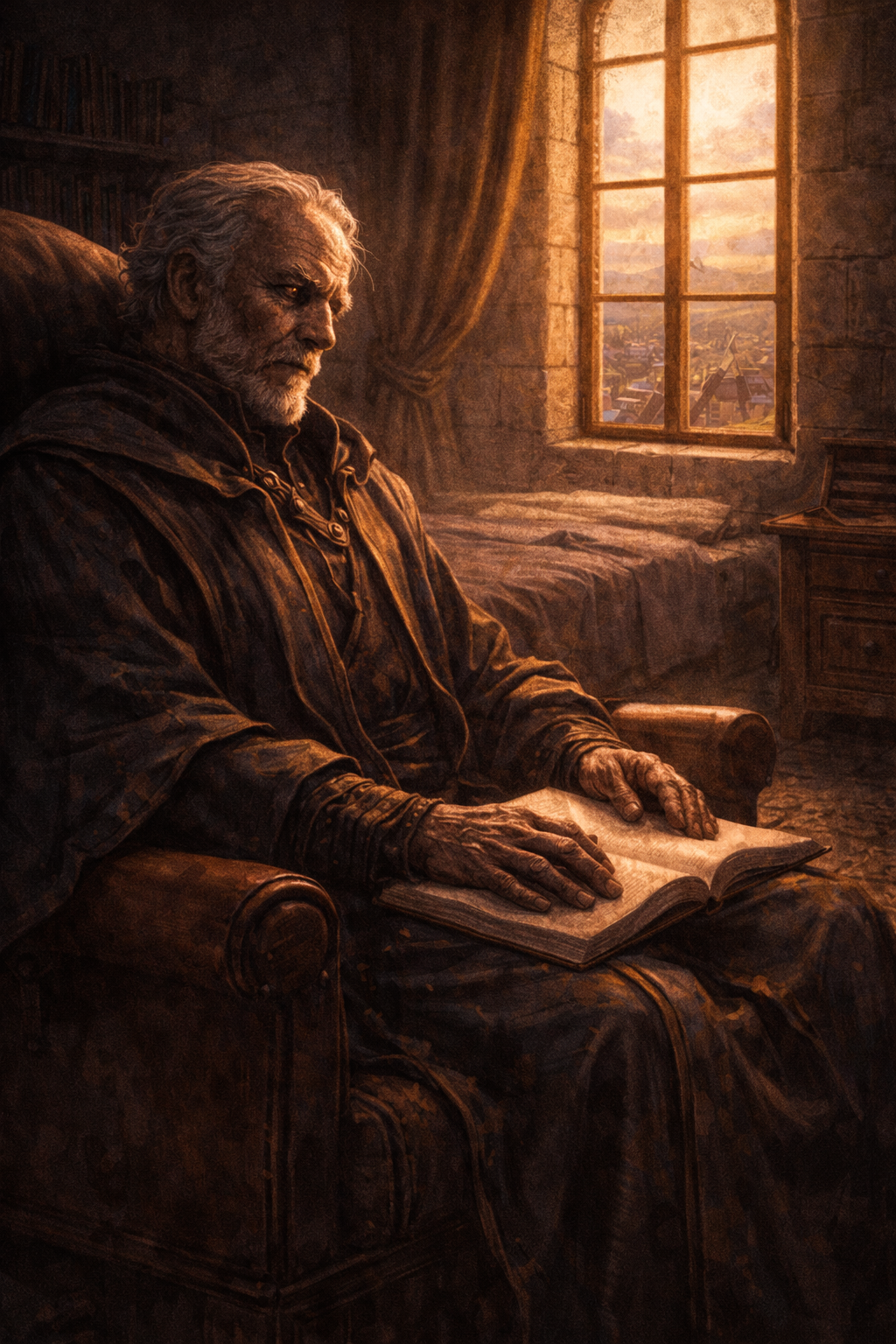
They had not beaten him. That was the first thing he had expected and the first thing they had failed to deliver. He sat with his back against the wagon's rear wheel, his wrists bound behind him with proper guild rope — double-hitched, checked twice — and watched the camp settle for what he knew was his last night.
No beatings. No interrogation. Mantis had read the law and Mantis had issued the sentence and the rest was waiting. They treated him the way they treated a man who had been sentenced, not a man who was a problem to be solved, and he found that harder to hold against them than cruelty would have been.
Nocta was gone. He would have seen Nocta leave — the hesitation at the wagon rail, the look that passed between them, the wordless argument that ended in Nocta's back receding into the dark. He did not blame Nocta for running. He had told Nocta to run. One of them needed to get clear, get to Bozton, give the Brotherhood the caravan's route and the manifest contents and whatever else the mission had been worth. Nocta had done exactly what he should. The fact that it had also meant leaving Juvar on the ground with a rope around his ankles was not betrayal. It was trade.
He had told himself that for approximately four hours, with moderate success.
The camp fire burned low. He could see Puli sitting on the far side of it, knees drawn up, not sleeping. On another night Juvar might have appreciated that — Puli's inability to let things alone, his restless vigilance. He had liked Puli. He had liked most of them, which was the part of the mission no one had warned him about.
You will be assigned to a party, Bozton had told him. You will complete their missions, build their trust. Learn what they carry. When the time comes, do what you were sent to do. He had made it sound like wearing a coat that didn't fit — uncomfortable, temporary, easily set aside.
He had not mentioned what it felt like to press a healing rune into Mantis's poisoned leg at midnight, the man's breathing shallow and wrong, and feel the satisfaction of watching the color return to his face. He had not mentioned Keto calling down from a collapsing shaft and the involuntary decision to cast the barrier before the order came from anywhere outside himself. He had not mentioned the way a team begins to move like a single thing when the fighting is bad enough, and what it does to a man to be part of that thing.
None of it changed what the Brotherhood was or what the rune network meant or why dismantling Hegal's guild was necessary work. It only made the work harder.
He thought about Bozton. His cousin would come — not for rescue, because Bozton was not a man who confused sentiment with strategy — but for the body and for the reckoning that followed. He would be angry in the way a man is angry when grief disguises itself as principle. He would be precise about it, which was worse.
He'll blame the woman, Juvar thought. He'll blame her because she's the one who runs fast enough to catch a druid who doesn't want to be caught.
That, too, was not wrong.
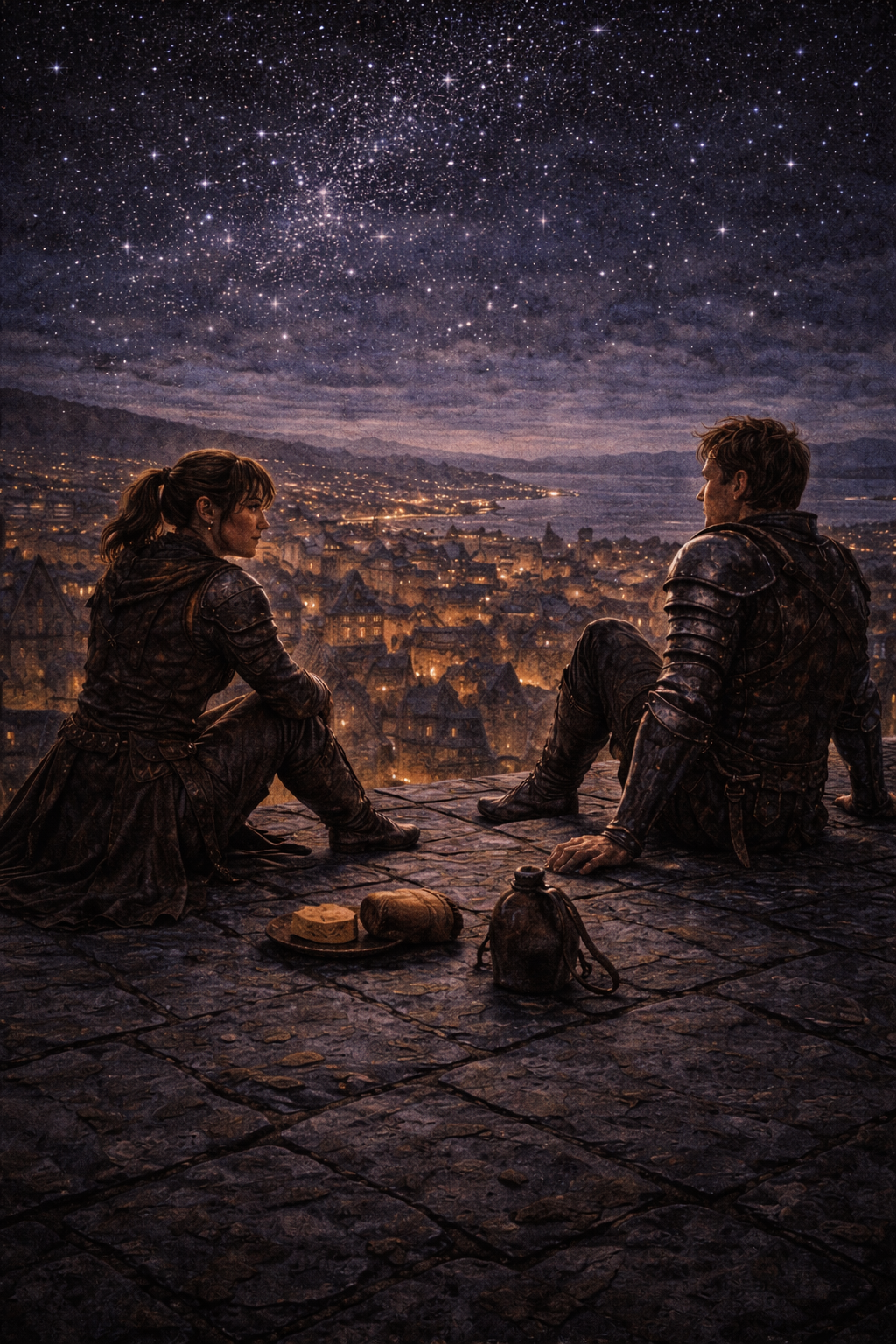
The fire shrank. The stars wheeled overhead with the patient disinterest of things that would be there long after the plains dried out and the wind erased everything in this camp and everyone in it. He thought about begging. Not because he had decided to, but because the option existed and he was a thorough man who examined his options.
He discarded it cleanly. Begging would not change the verdict. It would only make what he believed look like something he had only believed when it was cheap to do so.
He had believed it when it was expensive. He had believed it on three missions carrying cargo that couldn't be named in daylight. He had believed it kneeling in Bozton's ward-circle reciting commitments that were real and permanent and signed in something older than ink.
He could still believe it here, without begging.
There was a small stone caught between the sole of his boot and the sole of his foot. He had noticed it two hours ago. His hands were tied and he could not remove it. In the morning, when the guild executed a Brotherhood operative under lawful sentence, the operative's boot would contain a small stone and nobody would ever know, and that somehow felt like the truest thing about the whole night.
Dawn began, slowly, to recommend itself.
MADISON
The words hollowed her.
She felt them enter and leave, and what remained was a silence inside her chest that was worse than noise. The camp seemed to recede—the lanterns dimming, the faces blurring, the sound of wind and breathing falling away until all that existed was her and Juvar and the dirt between them.
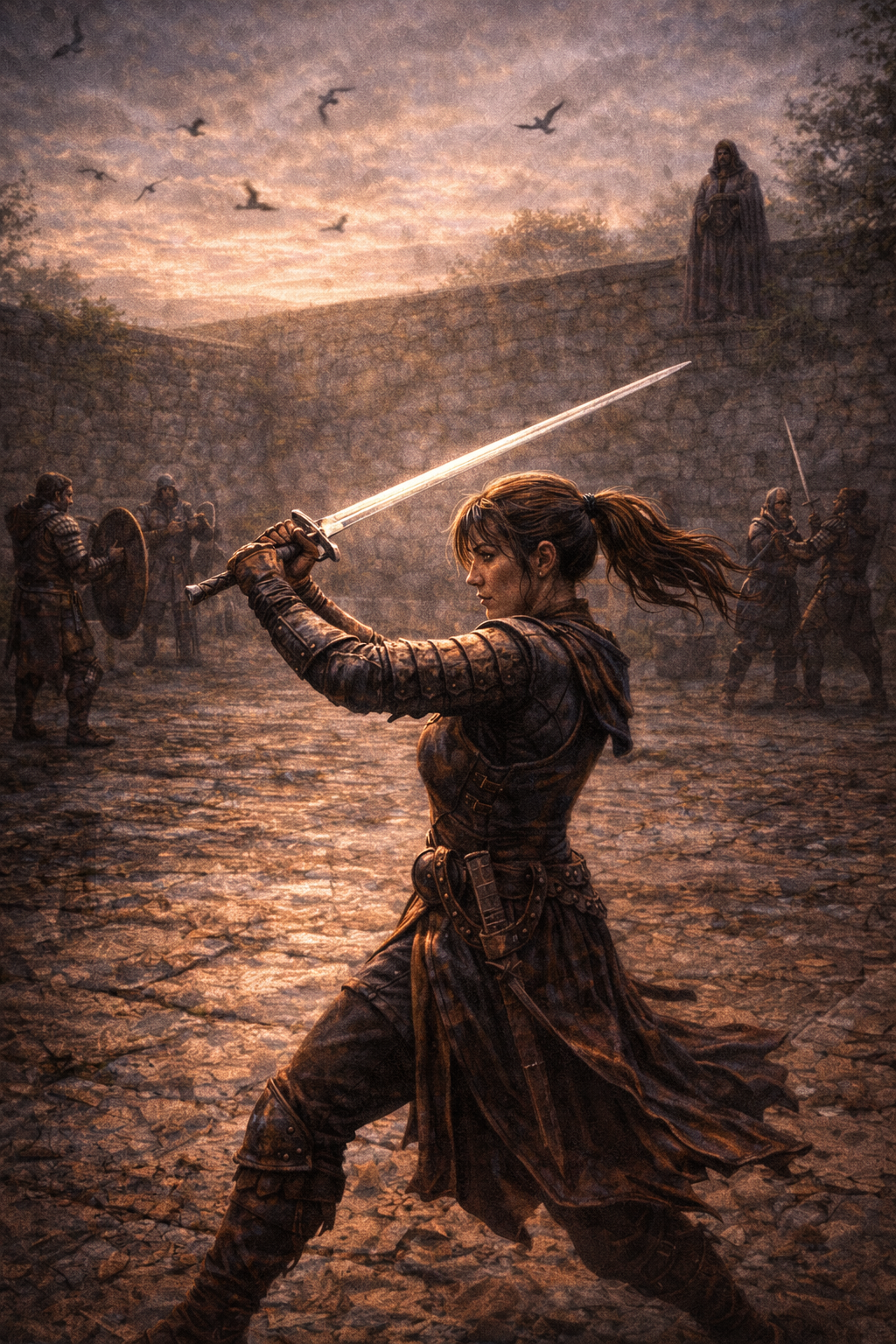
Madison had fought a bear in the Haze trials and told herself it was proving, not killing. She had cut spiders in the Stoneheart mines while their legs twitched and their venom sprayed. She had driven the Sword of Fury into a wyvern's neck and felt it convulse beneath her.
But those were creatures. Creatures made for dying, built by a world that expected violence from its children.
Juvar was not a creature.
Juvar was a man who had knelt over Mantis's poisoned leg and pressed a rune into his flesh with careful hands. A man who had cast a barrier to save Keto's life. A man who had said Breathe to Mantis the way a healer says it—not as advice, but as a command that means I will not let you die.
And he had been lying the entire time.
Madison drew the Sword of Fury from its scabbard.
Her father's sword.
The weight of it was familiar now—she had carried it since Jul, since Captain Thorne had pressed it into her hands on the docks with salt spray on his face and said Be present, girl. Whatever comes, be present for it. The blade caught the first gray light of dawn and held it along its edge like a thread of silver.
She heard Thorne's voice in her head. Be present.
She heard Elane's voice—soft, distant, belonging to a world that felt impossibly far away. Come back to us.
She heard her father's silence. The silence of a man who had been turned to stone defending a port city from a threat no one else would face. Maximo had never come back. He had made his choice and paid for it with everything, and the sword Madison held was all that remained.
Would he have done this?
She stepped toward Juvar.
He raised his chin. His eyes were not smug now. The defiance was there still—buried, habitual—but on the surface something else moved. Something raw and involuntary.
Fear.
He was afraid.
Madison felt her stomach clench. She tightened her grip on the hilt until the leather bit into her palm.
The dawn light looked thin—like paper held over a flame. She wished for one more minute of darkness, not because darkness was kind, but because it hid faces better.
"Say your last," Mantis told Juvar from the wagon. His voice carried no pleasure. No triumph. Only the weight of a man enforcing a law he wished did not apply.
JUVAR
Juvar heard the order the way a man hears a door latch—small sound, final weight.
He had rehearsed bravado until it wore thin. What remained was simpler: the memory of Nocta's boots fading east, the taste of venom mist still burned into his tongue, and the absurd wish for one more morning where kindness could be innocent.
If he begged, he would make them smaller. If he cursed, he would make them righteous.
So he looked at Madison and let her see the fear without performing it. Let her carry that, too. It was the last honest thing he could give the people he had betrayed.
MADISON
Juvar's mouth twitched. He looked at Madison—really looked, not through her, not past her, but at her, as if seeing her for the first time. His bound hands trembled behind his back.
"You think this makes you safe?" he said. His voice cracked on the last word.
The camp's silence tightened, as if everyone held the same breath.
Madison stepped closer. She set the blade at the side of his neck where the flesh was soft, where the blood ran close to the surface. She could feel his pulse jumping against the steel—quick, desperate, alive. A rhythm that begged without words.
The sky was lightening. Purple turning to gray. Gray threatening to turn to gold.
This is real, she thought. This is happening. I am doing this.
"No," she said quietly. "I think it makes me guilty."
Then she pulled.
It was not clean.
Nothing like the stories. Nothing like the executions described in Captain Thorne's war tales, where the blade falls once and the body drops and the crowd goes home. The Sword of Fury bit and tore, and the resistance was worse than anything she had imagined—not hard, not like cutting wood or bone, but wrong in a way that went deeper than muscle. She felt the moment his body stopped fighting. Felt the tension leave the rope as his weight shifted forward.
Blood spilled into the red-brown dirt. Juvar's body sagged against his bonds, head at an angle that nature never intended. His eyes were wide and already emptying—not closed, not peaceful, just... going. Like a lamp running out of oil.
Madison staggered back.
And the sword would not let her go.
The grip flared hot against her palm—hotter than blood, hotter than the rising dawn—and something poured up her arm and settled in her chest like a second pulse laid over her own. The shaking was not fear. It was appetite. The blade had taken Juvar and it was not full; it wanted the next throat, and the one after that, and it did not care whose they were. The world narrowed and reddened at its edges. Sound thinned to a single low roar that might have been the wind or might have been inside her skull. Juvar lay open in the dirt, and some animal part of her, riding high on the kill, wanted to raise the steel and bring it down again, and again, because stopping felt like falling.
She turned—and Puli was there.
"Madison." His voice came from very far away. He had one hand half-raised, his bow lowered, and he had taken a step back without seeming to know he'd done it. So had Keto. They were watching her the way you watch a dog you have known its whole life when something behind its eyes goes wrong. "Madison. It's done. Put it down."
Her hand would not open. The hunger had her fingers. For one horrifying breath she felt herself measure the distance to him—pulse, throat, the soft place under the jaw—the way the sword measured everything now, and the part of her that loved him recoiled in flat terror from the part of her that had just done the arithmetic.
Be present.
Thorne's voice—not memory, not comfort. An order. Be present, girl. Whatever comes, be present for it.
She seized it like a rope thrown to a drowning swimmer. She made herself feel the things the hunger wanted to drown out: cold dawn on her wet face, the cramp knotting her calf, the splinter wound stinging in her palm, Merita's shallow breathing from the wagon, Puli's frightened eyes. One real thing, then the next. The red drew back by inches. The roar thinned again into wind. The heat in the grip cooled—slow, grudging, like a hound being hauled off a carcass—and then, all at once, it let her go.
Her fingers opened. The Sword of Fury dropped point-first into the dirt and stood there, quivering, blood sheeting down the steel in the new light.
No one spoke.
The wind moved through the camp and stirred the dead man's hair.
Madison walked to the edge of the lantern circle on legs that did not feel like hers, knelt in the dirt, and breathed. In and out. In and out. Be present. Be present. Be present. Until the words stopped being a wall she was holding against something and went back to being only words.
When she stood, her face was still. Her hands had stopped shaking. Something in her eyes had changed, but she did not know what it was—and no one who had watched her stand over Juvar with her fingers locked on that hilt knew how to name it either. Only that they had seen it. And that, for the rest of the morning, they would not quite meet her eyes.
Dawn climbed anyway. The first fly landed on the grass near Juvar's blood and she hated that too—small, ordinary hungers moving in while humans pretended they had become something other than animals. I felt one of those hungers, she thought. It was not ordinary. And it was wearing my hand.
She flexed her fingers once. They obeyed. That felt like an insult.
They left Juvar in the plains where the wind could take what it wanted.
No grave. No marker. No words beyond the ones already spoken. They untied the ropes—Madison insisted on that, though she couldn't say why—and left him lying in the grass as if he had fallen asleep and chosen not to wake.
They loaded Merita—still breathing, still unconscious, her face pale and unresponsive—into the caravan beside Mantis. They tightened ropes. Checked straps. Counted the remaining crates twice and compared the number to what they remembered loading in the Stoneheart cuts. Six missing. Nocta's work.
Mantis gave orders from the wagon in a voice that sounded like it was being pulled from the bottom of a well. "Archers placed where they can see. Knights where they can shield. Rotating flanks. No one walks alone."
They set formation.
Madison took point. The Sword of Fury was clean now—she had wiped it with grass and oil until the steel shone again—but she could still feel the weight of what it had done. It hung at her hip the same way it always had, and that sameness felt like a lie.
They started moving toward Solundria with a stolen fortune, a wounded leader, an unconscious archer, and a fresh corpse behind them.
No one looked back.
BOZTON
Nocta and Athena reached the hills by late day.
The land there rolled in long bones of earth between Varlin and Ab'Dendriel, five hard riding hours from the plains where Madison's party had left Juvar's body to the wind. The Femur Hills were mostly open field broken by low rises, wind-bent grass the color of old copper, and pockets of stone that offered little shade and less mercy. Sound carried strangely—voices arriving before their speakers, hooves echoing off limestone ridges that amplified every noise and gave nothing back but direction.
Their camp sat in the center of that open ground, spread wide instead of hidden.
Bozton had designed it that way.
Watchfires ringed the perimeter in disciplined intervals, each one flanked by spear-posts driven into packed dirt—sharpened stakes angled outward, not as a real defense but as a signal. We are here. We know you know. Come if you dare. Cook pits were cut into the earth in long trenches, their smoke channeled through ground-level vents that dispersed it before it could rise high enough to mark position from a distance. Horse lines were staked in precise rows—watered, fed, hooves checked, every animal saddled and ready to ride within minutes.
People moved through the camp with tight purpose. Archers waxed bowstrings and checked broadheads by lantern light, their movements repetitive and precise, the way soldiers work when the work is the only thing keeping their minds still. Knights oiled armor, rewrapped gauntlets, tested edge alignment against whetstone sparks that spiraled into the dark like tiny orange stars. Two druids marked ward-circles with ash and powdered rune stone while quartermasters counted crates and cross-checked ledgers under canvas awnings, their quills scratching in the silence.
No singing. No drunken boasting. No dice games or storytelling circles.
This was not a camp. It was a machine waiting for orders.
The Brotherhood.
When Nocta and Athena arrived with the caravan, some of the camp cheered. Others clapped, hands meeting in the firelight. Most only watched with the quiet hunger of people who measured profit before praise.
Bozton stood as they entered the central ring.
He had been sitting by the main fire, but the motion of his rising was itself a statement—unhurried, deliberate, the kind of movement that pulls attention the way gravity pulls water. He was a knight in the way old legends remembered knights: heavy in presence, not in posture. Broad across the shoulders, thick through the arms, with hands that had broken things and a jaw that looked like it had been carved from the same limestone that ridged these hills. His armor was dark steel, well-maintained but not ornamental. Functional. Earned.
He looked like he could stand still and make the world hesitate.
His eyes went first to the caravan. He counted crates with a glance—six. Fewer than expected. His mouth tightened by a fraction.
Then to Nocta. Standing at the caravan's edge, face drawn, hands empty.
Then to the space beside Nocta where a third person should have been.
"Where is my cousin?" Bozton asked.
His voice was not loud. It did not need to be. In the silence of the camp, with the watchfires crackling and the horses shifting on their lines, it carried like a blade across still water.
Nocta's throat worked. He looked at the ground, then at Athena, then at the ground again. When he spoke, his voice had none of the cold competence it carried in combat. It was the voice of a man delivering news he knew would not be forgiven.
"He—he distracted them," Nocta said. "Held them off so we could run. Cast the venom cloud, the speed spell. He said he'd meet us. He said he'd circle back through the southern grass and—"
"Did he?"
The question cut Nocta's explanation in half.
"No," Nocta admitted.
Bozton's jaw tightened. The muscle under his ear moved like something alive beneath the skin. He looked at Athena, who sat on the caravan's bench with the reins still in her hands, her face carefully empty.
"And you?" he said.
Athena opened her mouth as if to explain—to offer context, justification, the calculus of survival that had made leaving Juvar seem reasonable. Then she met Bozton's eyes, and whatever she saw there made her close her mouth again. Her gaze dropped.
Bozton stared at them both until shame did its work.
The camp was silent. Even the fire seemed to burn quieter.
Bozton's cousin. His blood. The boy he had trained, fed, protected, brought into the Brotherhood when the rest of the world had no use for a skinny druid with too much anger and not enough sense. Juvar had been reckless and sharp-tongued and frustrating, but he had been family. And now he was somewhere on the plains, either captured or dead, and the two people who were supposed to bring him home had brought six crates instead.
"We don't abandon our people," Bozton said. The words were simple. The weight behind them was not.
He exhaled through his nose—a long, controlled breath that in another man might have been a scream—and turned away from Nocta and Athena. He needed a moment. Just one. To press the fury down deep enough that it would not make him stupid.
"Dragoneye," he said.
A figure stepped from the shadow near the eastern ward-circle. Taller than Juvar had been. Thinner. Staff in hand, carved with old marks that looked like scars in the firelight—deep, deliberate, and unsettling in the way all things are unsettling when they carry the memory of pain. His gaze was pale, the color of river ice, and unpleasantly calm. He looked at Bozton the way a surgeon looks at a wound—assessing, not sympathizing.
The two ward-circle druids had drifted to the far side of the fire without appearing to decide to. They did not like to stand near Dragoneye—or near the thing he carried against his chest beneath the leathers, a small dense weight that made the ash in their circles want to lie flat and the back of the teeth ache. None of them spoke of it. Dragoneye preferred it unspoken. A thing that frightened even his own side was worth more kept quiet, like a blade you do not draw until the room has already decided you are harmless.
"I heard," Dragoneye said. Nothing more.
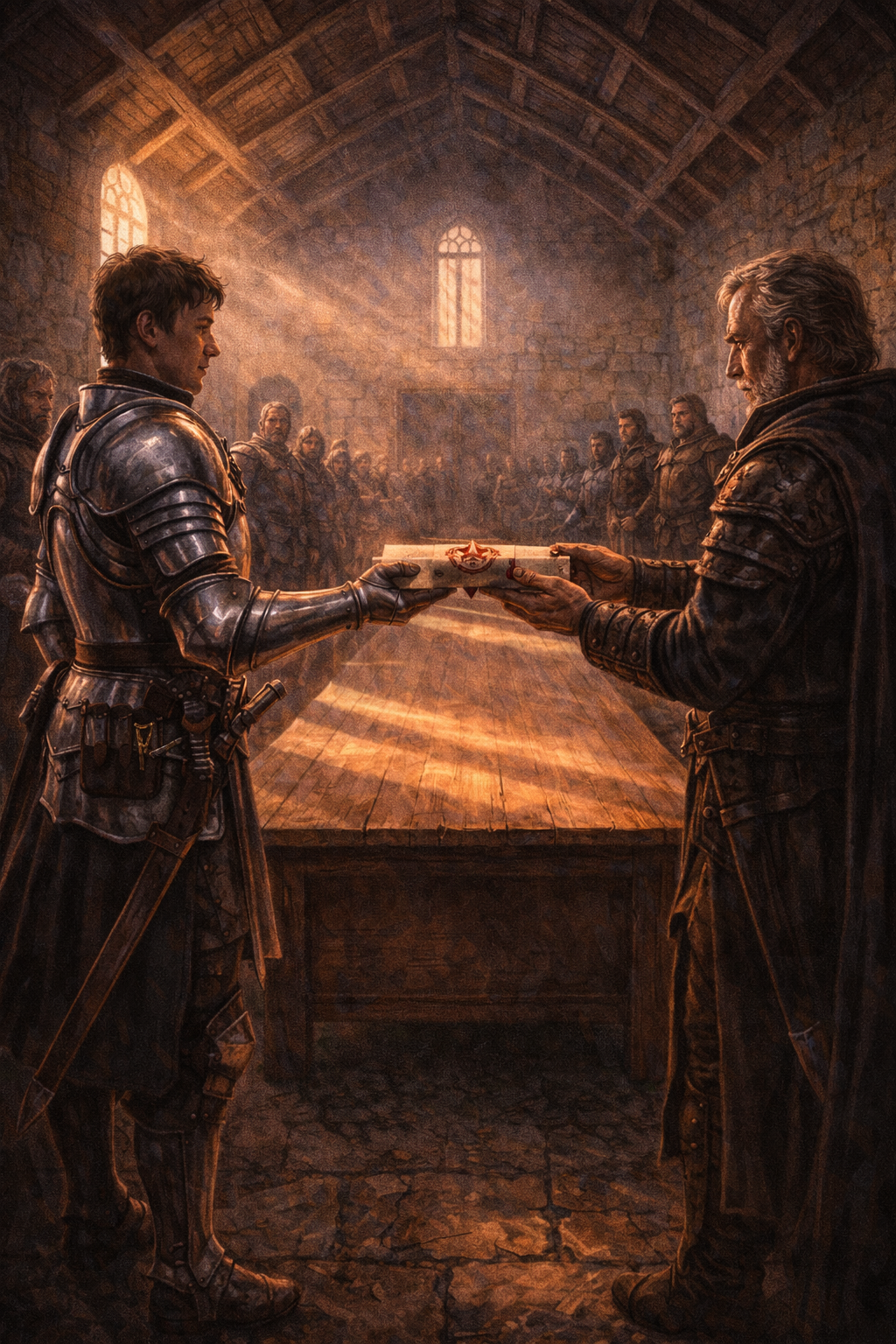
Bozton began assembling a party without raising his voice. He pointed. Named. Each selection was precise: Nocta, because he knew the route. Athena, because she had been there. Another archer—a broad-shouldered woman named Talia who said nothing and checked her bowstring twice. Another knight—Falk, square-jawed, a scar across his forearm that he wore like a rank insignia. Bozton himself.
And Dragoneye.
"Saddle up," Bozton said. "We move now. We find Juvar."
Nocta hesitated. "If they captured him—"
"Then we take him back." Bozton's eyes were flat. "If they harmed him, we take more than him back. Questions later. Move now."
They left at a pace that turned miles into hours. The horses were fresh and the riders drove them hard, cutting through the hills on paths that followed ridgeline and shallow cut, avoiding the main roads where guild patrols might spot a mounted column and ask questions that would slow them down.
Bozton rode at the front. He did not speak. He did not look back. His body moved with the horse in the effortless rhythm of a man who had spent more of his life in the saddle than out of it, but his hands gripped the reins too tightly, and the muscles in his jaw never unclenched.
Hold on, boy, he thought. Whatever you did, whatever trouble your mouth got you into, hold on.
They found the trail where the plains opened.
Crushed grass marked the passage of boots and wheels—a camp broken in haste, gear dragged and loaded without care for neatness. Bozton read the signs the way other men read letters: boot depths told him weight and hurry; wheel ruts told him direction and speed; the spacing of footprints told him how many had walked and how many had run.
They followed the trail past broken wheel ruts and flattened grass, past the place where someone had slept in a hurry—a rectangular impression in the dirt, body-shaped, with the marks of a shield laid flat. Past faint stains in the soil that the wind hadn't yet taken—dark spots that could have been oil or blood or both.
Dragoneye dismounted and knelt by one of the stains. He touched it with two fingers, brought them to his nose, and said nothing. His silence was its own verdict.
When they found Juvar, the sky was already turning. Dusk painted the plains in shades of amber and rust, and the wind had picked up—a low, constant moan that moved through the grass like breath through a reed.
Nocta saw his boots first.
Then his legs.
Then the rope, dark with dried blood, lying in loose coils beside a body that no longer needed binding.
Bozton dismounted.
He walked to where his cousin lay and stopped. The grass around the body was trampled flat. The earth was stained. Juvar's hands were free—someone had untied him after the act, a gesture of mercy or guilt that Bozton registered without understanding.
His cousin's eyes were open. They caught the last light of the dying sun and held it, but saw nothing.
Bozton knelt.
He stayed there for a long time.
The others waited. Nocta turned away. Athena's face was white. Dragoneye watched with those pale, steady eyes that gave nothing and took everything in.
Bozton reached out and closed Juvar's eyes with his thumb and forefinger. The gesture was gentle. Almost tender. The hands that had broken men and bent steel moved with the care of a man handling something fragile.
When he stood, his face was not the face of a man in grief.
It was the face of a man who had decided something.
"Who leads them?" he asked. His voice was quiet. Dangerously quiet.
"Mantis," Nocta said. "A knight. Hegal's man. But there is a warrior—a woman. Madison. She carries a blade I have not seen before. She is the one who chased Juvar. She is the one who—"
He stopped.
"Say it," Bozton said.
Nocta swallowed. "She is the one who would have done this."
Bozton looked down at his cousin's body one last time. The wind moved through Juvar's hair, lifting it gently, as if trying to tell him a secret he could no longer hear.
"Wrap him," Bozton said. "We bring him home."
He turned to Dragoneye. The druid met his gaze. No words were needed. The question was asked and answered in the space between two breaths.
"They move toward Solundria," Bozton said. "They will reach it within two days."
"Then we have two days," Dragoneye replied.
Bozton mounted his horse. His shadow stretched long across the plains, touching the edge of Juvar's body and beyond, reaching toward the road that led east.
"We will find them," Bozton said. "And we will make them understand what it costs to kill one of ours."
No one argued.
The wind carried his words across the open ground, and the grass bent beneath them as if even the earth understood what was coming.
QUEEN ELOISE
Dron smelled of salt, tar, and money.
Queen Eloise arrived before sunset with her daughter under a travel hood and Lyrra at her shoulder, both escorted by twelve Varlin guards in plain cloaks. The port city rose in layered terraces above the harbor, every level crowded with trade houses, mercenary barracks, and private docks where flags changed faster than loyalties.
Daniel Steelsoul greeted her at the upper gate in polished dark mail, all courtesy and measured smiles. "Your Majesty. Had I known you were coming, I would have arranged a proper reception."
Eloise did not slow. "If I had sent word, Daniel, I wouldn't be here."
He laughed softly and offered to lead her to private quarters.
As they passed beneath a lantern arch, Eloise saw his right hand clearly for the first time. Black wraps wound from wrist to knuckles beneath his glove line. At one seam, the cloth had shifted. Under it, the skin looked marbled—veins too dark, too deliberate, like ink moving through flesh.
Corruption mark.
Lyrra saw it at the same moment and touched two fingers to the rune satchel hidden in her sleeve.
Daniel noticed neither. Or pretended not to.
"We have much to discuss," he said, guiding them deeper into the citadel.
Eloise smiled the way rulers smile when they are counting exits.
"We do," she said. "And quickly."