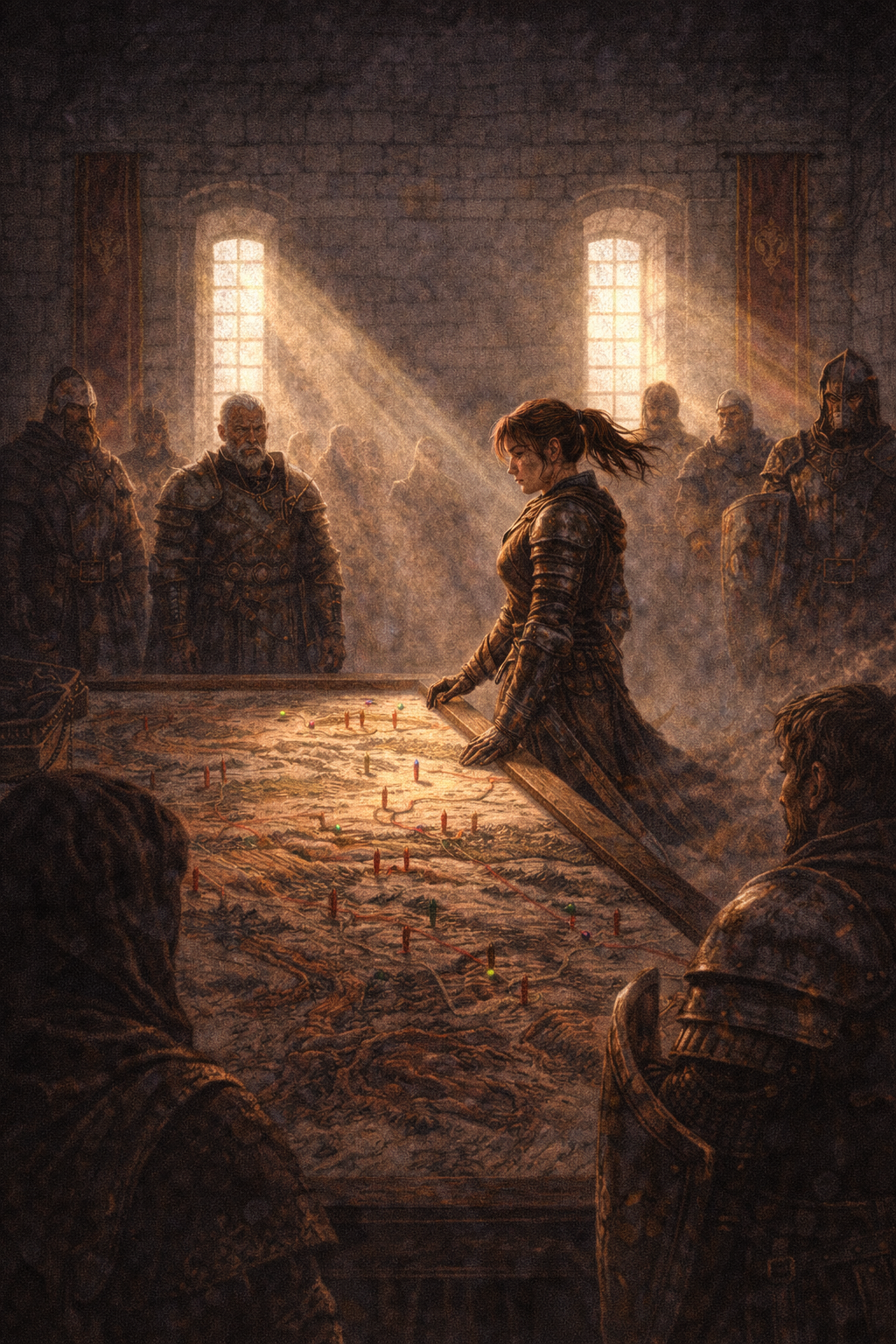
MADISON
The bird came at dawn.
Madison heard it before she saw it—a flutter of wings cutting through the low hum of Stoneheart's morning. She sat against the stone wall of the tavern's upper terrace, the Sword of Fury across her knees, her cloak pulled tight against the chill that crept down from the peaks. The air tasted of iron and coal smoke. Below her, in the grey half-light, columns of dwarven miners filed toward the shaft entrances like a river of helmets and hammers, their lanterns swinging in disciplined rows, boots crunching gravel in a rhythm so steady it could have been music.
She had been awake for an hour. Sleep came hard in Stoneheart—too much stone overhead, too much weight pressing down on the silence. Every time she closed her eyes, she saw the spider chamber: the ceiling swallowed by dark, the creature's legs crashing against the tunnel walls, the vibration in her bones as the collapse thundered. Four days since the mines. The bruises had yellowed. The memory had not.
You didn't hesitate, she told herself. The same thing she had been telling herself every morning since. It was supposed to feel like comfort. It felt like a question.
Mantis was already awake, sitting on a flat stone near the terrace edge with a bowl of porridge going cold beside him. His posture was deceptively still—Madison had learned to watch his eyes. They never stopped. They scanned the road, the sky, the mountain face beyond the settlement's ring wall, cataloguing threats from nothing more than habit and a lifetime of knowing what the world could do.
The rest of Party Five stirred in various stages of sleep and bruise. Puli lay on his back near the door, one arm draped over his eyes, his bow propped against the wall within arm's reach. Keto sat cross-legged by the fire pit, methodically tightening his boot straps with the mechanical patience that defined everything he did. Boro leaned against a support beam, arms folded, eyes closed, though Madison suspected he was listening to everything. Vask was still fully asleep, his snoring low and even. Merita and Rovan shared a bench by the water barrel, passing a stone cup back and forth in silence. Juvar stood apart from the group, near the edge of the terrace where the stone railing crumbled, his staff planted, his gaze fixed on the mountain line to the northeast as if he could see something there that the rest of them could not.
And Nocta—Nocta sat in shadow near the far wall, legs drawn up, hands resting on his knees. Still. Watchful. His throwing stars were laid out on a cloth beside him in a neat row, each one freshly oiled. He had been the first awake after Mantis, as he always was, and had said nothing to anyone, as he always did.
The messenger bird dropped from the grey sky and landed on Mantis's extended wrist. It was a guild bird—compact, fast, feathers ruffled from distance. Mantis untied the small parchment tube from its leg with practiced fingers, cracked the wax seal stamped with Hegal's mark, and unrolled the slip.
His eyes moved once across the words. Then again.
"New mission," he said.
The terrace's half-awake murmur died. Bodies shifted. Heads lifted. Even Vask's snoring stopped, though whether from waking or coincidence, Madison couldn't tell.
Mantis read aloud. "Merchant caravan lost in the Stoneheart approaches following a creature attack. Survivors fled on foot—reported to the Solundria outpost. Cargo abandoned. Objective: locate caravan, secure cargo, escort recovery to Solundria for transfer. Mission difficulty: Level Three."
Level Three. Madison's stomach tightened. The spider mines had been Level Two, and they had nearly died in there.
She let herself count slowly to five—an old trick Thorne had taught her when adrenaline tried to masquerade as clarity. The mountain air bit the back of her throat. Somewhere below, a forge hammer rang once, and the sound traveled through stone as if the whole peak were a struck bell.
Mantis looked up. "We're already here. Two days' march from the approach road. Faster than sending another party from Haze."
Puli stretched his arms above his head, wincing where the spider fights had left bruises across his shoulders. "Another caravan. At least we know the terrain now." He paused, scratching at a half-healed scrape on his forearm. "More or less."
"What kind of creature attack?" Keto asked, not looking up from his boot straps.
Mantis checked the parchment again. "Doesn't say."
"Of course it doesn't," Rovan muttered. He tilted his cup and found it empty. "Level Three and they can't even name the thing. That's reassuring."
"It's Hegal's way," Mantis said flatly. "You get what you need to start moving. The rest you find out yourself."
Merita leaned forward on the bench, her dark hair still tangled from sleep. "We barely rested. Three, four days since the mines? Some of us still can't lift a bow straight." She glanced at her own hands, flexed them. The knuckles were swollen from the mine fighting—gripping weapons in tight quarters did that.
"I can lift a bow straight," Rovan said.
"I wasn't talking about you."
"I know you weren't."
Mantis let the exchange settle. He had that way about him—letting people talk just long enough to drain the pressure, then closing the valve before it went too far.
"I know we're tired," he said. His voice was not loud but it carried. "I know the mines took pieces from all of us. But we're the closest party. If that cargo sits out there another three days, it's gone. Creatures take the horses. Bandits take the goods. Weather takes the rest." He folded the parchment and tucked it inside his vest. "We're guild. This is what guild means."
Juvar turned from the railing. "The approaches are creature-active this time of year," he said. "The warm season drives them down from the upper ridges. Whatever attacked that caravan may still be nearby."
"Then we go in ready," Mantis said.
Puli sat up and reached for his bow. "One hour?"
"One hour." Mantis's gaze swept the group. "Fill water. Check straps. Eat something. No heroics."
Madison caught Puli's eye. He gave her a small nod that said what it always said: I'm with you. She nodded back.
Boro opened one eye. "What do we know about the approach road? Width? Cover?"
"Narrow in places," Mantis said. "Ridge cuts, shallow passes. The road follows the mountain face. Good for ambushes. Bad for formation."
"Wonderful," Boro said, and closed his eye again.
They left Stoneheart by the western road as the sun cleared the peaks, throwing long shadows across the settlement's stone buildings and turning the forge chimneys into pillars of gold. The air at altitude was thin and clean, cut with the smell of pine resin from the slopes above and the faint mineral tang that clung to everything in dwarven territory—iron in the water, iron in the dust, iron in the blood of the mountain itself.
Madison walked near the center of the column, the Sword of Fury at her hip, its weight a constant companion. She had carried her father's blade since Jul, since Captain Thorne had pressed the hilt into her hands on the dock and said He would have wanted you to have it. Some days the sword felt like a gift. Other days it felt like an anchor chained to a dead man's legacy. Today it felt like both.
The land they had come to know over the past days shifted again as they descended from Stoneheart's plateau. Grass thinned to scrub. Scrub gave way to bare soil the color of dried blood—red-brown and gritty, crunching underfoot like crushed bone. Jagged outcrops rose from the ground like broken teeth, their faces streaked with mineral stains in bands of rust and black. The Stoneheart approaches were different from the mines—wider, more exposed, with mountain faces layered one behind another in receding walls of dark stone, scarred with old cut roads and switchbacks that climbed into nowhere.
The wind came down the passes in gusts that smelled of dust and distance. It pressed at their cloaks and found the gaps in their armor where sweat had loosened straps. The sky above was vast and pale, bleached by altitude, the kind of sky that made you feel small without trying.
Mantis kept a hard pace without looking rushed, checking horizon and road cuts with equal attention. Keto and Vask rotated point. Juvar stayed near center, one hand often resting on the carved wood totem at his belt as if it anchored him to this world. Nocta, Merita, Rovan, and Puli scanned ridgelines while they moved—archers' habits, eyes always hungry for high ground.
The party walked differently since the mines. Madison noticed it in small ways—the gaps between them had closed, the silence between words had thinned. Before Stoneheart, they had marched like strangers sharing a road. Now they moved like something approaching a unit. It was not yet trust. But it was the foundation trust was built on.
Puli fell into step beside her after the first hour. "You sleep at all?"
"Some."
"Liar."
Madison let a breath out through her nose. "Two hours. Maybe three. The stone beds don't help."
"Stone beds, stone cups, stone stools." Puli adjusted his quiver strap. "The dwarves built a beautiful civilization out of the one material guaranteed to ruin your back."
Rovan, walking behind them, snorted. "Hugar would tell you the beds build character."
"Hugar sleeps on a granite slab by choice," Puli said. "Hugar is not a reliable authority on comfort."
They walked on. The road curved around a shoulder of mountain and opened into a wider valley, the floor scattered with boulders that had fallen from the cliffs above in some forgotten age. Wildflowers grew between the rocks—small, stubborn things with yellow petals that trembled in the wind. Madison looked at them and thought of Jul's harbor in spring, the salt grass bending in the sea breeze, Elane's garden behind the house where she grew herbs that smelled like warmth. A different life. A different girl.
You'll come back, Elane had said at the dock, holding her so tight Madison could feel the bones in her mother's hands. Promise me.
I promise.
She hadn't known then what promises cost.
By midday they reached a river: wide, green, and running hard over submerged stone. The water was ice-cold—snowmelt from the peaks above, Juvar said, and the current was strong enough to drag a man under if he stepped wrong. A bridge crossed it—old stone supports with planked wood decking patched in places with newer timber that was already warping. The structure creaked under foot traffic like something alive and complaining.
"Single file," Mantis called. "No bunching."
They crossed one by one, the planks groaning, the river churning below. Madison could feel the bridge sway under her weight—not dangerously, but enough to send a cold thread through her gut. She kept her eyes forward and her hand on the rail and did not look down.
On the far side, Juvar pointed northeast.
"There," he said.
A mountain stood apart from the rest of the range. Taller. Darker. Its upper slopes were wreathed in a strange haze that did not move like cloud—it hung motionless against the stone, a grey veil that seemed to drink the light rather than reflect it. The peak above was invisible, swallowed by that unnatural stillness.
"Remirik's mountain," Juvar said. "Or what's left of his tower. No one knows for certain." He shrugged once, but his eyes stayed on the mountain longer than the gesture warranted. "Some say he sealed it himself before he died. Some say the seal wasn't for outsiders. It was for whatever he left inside."
Madison stared at the mountain. The haze seemed to pulse, though she told herself that was a trick of the afternoon light.
"What was Remirik?" she asked.
Juvar was quiet for a moment, as if choosing his words the way a mason chooses stones. "A sorcerer. Old. Powerful. He lived alone up there for decades—some say centuries, though that's likely embellishment. He studied things that most druids and mages agreed should remain unstudied." A pause, weighed. "Some say the thing that finally ended the Race Wars was first drawn in that tower. You won't find that in any imperial song, and you won't find a soul willing to tell you what it was." Juvar's hand tightened on his staff. "When the tower went dark, no one went to check. The haze appeared within days. It hasn't moved since."
"Encouraging," Puli murmured.
"The mountain doesn't bother anyone," Juvar said. "As long as you don't bother it."
No one argued.
They kept to the road and gave the mountain a wide berth. Madison felt its presence at her back for the next hour, a weight between her shoulder blades that didn't lift until the road curved south and the mountain slipped behind a ridge wall.
CRESCENDO
Crescendo watched the guild column from a spine of rock that did not appear on their maps—not because it was secret, but because accuracy was a kind of mercy most clients refused to pay for.
He counted nine bodies, good spacing, too many eyes on the sky. Wyvern country, not dragon country: the difference mattered if you cared about living. He did, in the narrow sense—contracts required a pulse.
Below, the woman with the famous blade walked like someone arguing with her own skeleton. The druid in the center kept one hand on his staff as if it were a lever that could move fate. Crescendo filed faces the way other men filed nails: quick, efficient, no affection.
A second caravan trace cut the lower switchback—fresh wheel wax, muffled axles, escort riding too clean for merchants. Dron markers. He memorized the angle where the trail kissed the guild route.
"Not my contract," he murmured. The wind stole the words. That was fine. Words were liabilities.
Somewhere in a Haze tavern there was a handbill with his name on it and a crude crown some joker had inked onto the painted helm. Somewhere else hung three more, forged—men selling their own small kills under a borrowed legend. He had stopped minding years ago. A name that did your fighting for you was worth more than the truth and cost less to keep. Let them believe Crescendo was ten feet tall and rode out of the songs. The ones who believed it rarely tested it.
He had seen three wyvern kills in ten years. All of them looked like accidents until you walked the ground and found the second set of talon marks—older, deeper, a migration scar cut into stone like a warning in another language.
This one was early. The wyvern came through the eastern ridge runs in autumn, not summer—wrong season, wrong side of the mountain. Something had moved it before its time. He filed the fact the way he filed all facts: cleanly, without attribution.
The world was getting full again. Full meant hungry.
He slid back off the ridge without dislodging a pebble. Amoral was a child's insult. Professional was a survival trait.
MADISON
Afternoon stretched. The sun climbed to its peak and then began its slow descent, dragging the shadows long. Feet ached. Straps rubbed raw where the mine bruises sat tender under leather. Canteens emptied. Madison's throat was dry and her calves burned from the uneven terrain, each step a negotiation with loose stone and angled ground.
They crossed a second river, narrower and shallower, on stepping stones and a rope rail strung between iron posts. The water here was clearer—Madison could see the bottom, the smooth stones and the dark shapes of fish holding station against the current. Beyond the crossing, the road began to narrow. The mountain walls closed in on either side, and the character of the sound changed—boots echoing off stone, wind whistling overhead through the cuts, dust clinging to sweat until everyone wore the land on their skin and in their teeth.
Mantis called a brief halt in a flat section where two ridges formed a natural shelter. They sat on rocks and drank water and chewed dried meat that was mostly salt and determination. The food was dwarven—dense, flavorless, designed to sustain rather than satisfy. Madison missed the mushroom stew from the Ironhearth Tavern. She missed hot food in general. She missed sitting down without checking for threats.
"How much farther?" Merita asked, stretching her legs.
Mantis studied the terrain ahead—the road disappearing into a cut between two ridges, the light already shifting from white to amber. "Reports said the approach road. Could be anywhere in the next few hours of walking."
"The survivors ran for the Solundria outpost," Juvar said. "Which is southwest. So the attack happened somewhere between here and the last junction."
"That narrows it to about ten miles," Rovan said.
"That narrows it to walking until we find it," Mantis corrected. He stood and shouldered his shield. "Move."
They did not find the caravan at noon.
They did not find it in midafternoon.
They found it when the light began to go.
The wagon sat half off the path in a shallow cut between two ridges, tilted at an ugly angle where one wheel had shattered and the tongue had splintered clean through. The canvas covering was torn and flapping in the wind like a wounded banner, snapping against the wooden frame with a sound like slow, rhythmic clapping. No horses. No guards. No bodies.
Just the wagon, and the wind, and the fading light.
Mantis raised a fist. Party Five stopped. The silence that followed was so complete Madison could hear her own breathing inside her helm—the small rasp of air through the visor, the thud of her heart, the creak of her armor as her chest moved.
The cut smelled wrong. Not rot, exactly—something drier than that. Animal musk, heavy and acrid, layered under the mineral dust of the approaches. The kind of smell that made the small hairs on Madison's arms stand upright and the part of her brain that was still an animal whisper predator territory.
"Why hasn't anyone—" Merita began, then swallowed her words.
"Stolen it?" Mantis finished for her. He didn't take his eyes off the ridgeline. "Because the thing that attacked it is still nearby. And because anyone with sense avoids this road unless desperate."
"Or stupid," Rovan added.
"Those are often the same people," Mantis said.
They approached in formation—knights forward, archers spread to flanks, Juvar in the center. The light was dying in earnest now, the sun dropping behind the western ridge and casting the cut in deep shadow. The torn canvas threw strange shapes on the ground as the wind moved it.
The nearer Madison got, the more absurd the abandoned wealth became. Crates stacked under ripped canvas. Seals unbroken. Wax stamped with merchant marks she didn't recognize. Someone had dropped their fortune and run for their life, and in the days since, nothing and no one had touched it.
That should have been reassuring. It was the opposite.
If the cargo is untouched, the thing that scattered the caravan wasn't after cargo. It was after flesh.
Rovan pried a lid open with his dagger, grunting as the nails gave. The crate exhaled a breath of dry straw and something else—a faint hum, like a tuning fork struck and slowly fading.
Inside were runes.
Stones in rows, each one etched with a different symbol, some pulsing faintly as if they still held heat from the hands that had carved them. Blue runes, steady and cool. Green runes, their light wavering like candleflame. Red runes, dark as embers in ash. And a few—set apart in their own padded section—that were black-veined, ugly, their surfaces threaded with dark lines that seemed to move when Madison's eyes tried to follow them.
She reached in before she could stop herself and picked one up between finger and thumb.
It was heavier than it looked. Much heavier. The weight was wrong—concentrated, as if the stone contained something denser than stone. The symbol etched into its face felt wrong to her eyes, like reading a word backwards. Her skin prickled where her fingers touched it, a sensation between heat and numbness.
For one heartbeat she imagined activating it—just to see, just to know—because knowledge was the lie her fear wore when it wanted to be brave. The Sword of Fury hung at her hip, warm from her body, and for a sick moment the two weights spoke to each other across her belt like old conspirators.
Thorne's voice rose uninvited: Hungry.
She almost dropped the stone. She did not. Pride, stubborn as stupidity, kept her fingers closed until she could set it down gently, as if gentleness could undo what curiosity had already done to her.
"What's this?" she murmured.
Juvar stepped closer. His gaze fell on the rune in her hand and something shifted behind his eyes—recognition, maybe. Or something colder.
He covered the rune with his palm and gently pushed it back into the crate. "Not for your hands," he said quietly. "Not without knowing what you're waking."
Madison looked at him. "You know what it is."
Juvar met her gaze, held it. "I know what it looks like. And what it looks like is something that doesn't belong in a merchant's crate."
Then why is it here? she thought. But Mantis was already moving, snapping the canvas down over the open crate with a sound like a whip crack.
"Don't get distracted." His voice cut clean through the awe. "We fix it. We move it. We're not here to admire a merchant's taste."
Other crates held life fluids packed in straw—glass vials sealed with wax, the liquid inside glowing faintly amber. Mana fluids gleaming a deeper blue, thicker, like liquid sky. Bundles of support healing runes wrapped in cloth and bound with cord. Coils of rope, spare axles, lantern oil. Boxes of crossbow bolts—some tipped with dark metal, some etched with tiny runic lines that caught the fading light.
It looked like enough supplies to feed a war.
And all of it sat here, untouched, waiting.
"Keto, Boro—perimeter," Mantis ordered. "Vask, take the far cut. Archers, eyes up. Madison—help me get the wheel set. Puli, Merita—tools and wood. Rovan—watch the ridge with Nocta."
Madison moved.
They worked fast, hands clumsy in the dying light. Puli and Merita hauled a spare beam from under the wagon—a length of hardwood that had been lashed to the undercarriage as a replacement, covered in road dust and spider webs. Madison braced the axle while Mantis drove wedges into place with the flat of his blade. Nails bent. Wood splintered. They cursed softly and tried again. The wagon creaked like it was alive and hated them.
"We need light," Merita muttered, voice tight.
Puli pulled a small light rune from his pouch, murmured the activation phrase, and pressed it against a lantern's glass. The rune flared and then settled into a steady glow. Not day. Not even close. But enough to see hands and wood and blood where a splinter had opened Madison's palm.
Another light bloomed near the rear of the wagon—Rovan, doing the same, face pale in the rune-glow.
The lights felt wrong out here. They made the darkness around them darker. They turned the party into a beacon in the cut—visible from the ridges, visible from the sky.
Madison's eyes kept pulling upward, to the ridge line.
The mountains watched.
Something's here, she thought. Not a thought, exactly. A feeling. The way the air changes before a storm. The way the sea goes quiet before it turns.
She opened her mouth to say something—she didn't know what—and the sound came like a knife.
A shriek. High, thin, and wrong. So sharp it made her teeth ache and her jaw clench involuntarily. Not a roar. Not a scream. Something between metal tearing and a bird dying, stretched long, rising in pitch until it seemed to vibrate inside her skull.
Everyone froze.
The wind stopped. Or seemed to stop. The torn canvas hung limp.
Then it came again—closer. From above.
Mantis's head snapped up. "Formation!"
They were too late.
For a heartbeat Madison saw every lantern flame lean the same direction, as if the world had drawn a breath and held it. Her hand found the Sword of Fury and the grip felt too small—then too large—then exactly what it was: a tool, waiting for a decision her body had already made.